

About this paper
This is the real UDSM LW 101 Law of Contract I final examination, sat on 3 February 2015 by first-year LL.B students. Its six questions cover offer and acceptance, minors, intention to create legal relations and consideration. The worked answer to the compulsory Question 1 is free below.
Part 1
The UDSM LW 101 Law of Contract I Exam Paper, as Set
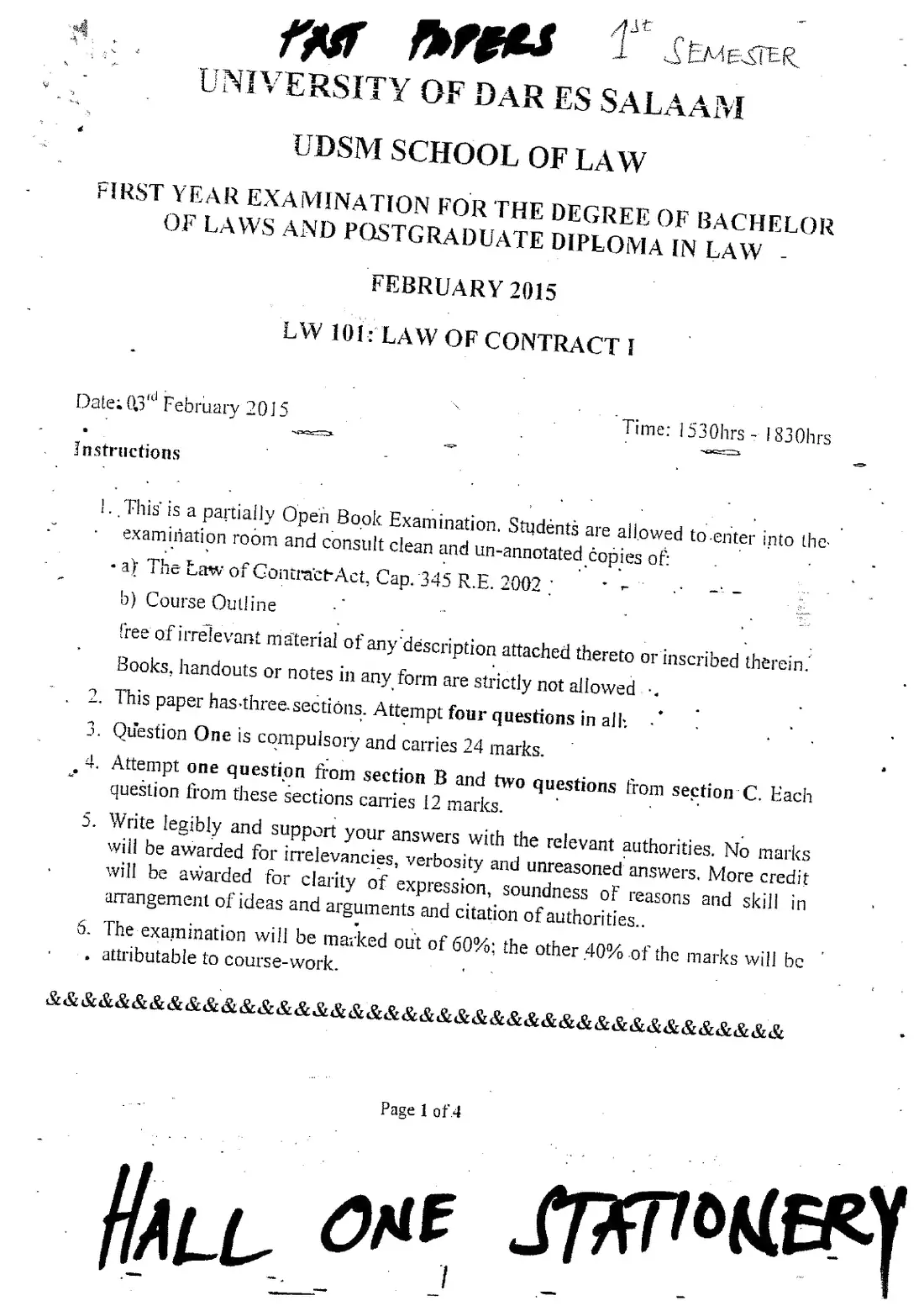
Partly open book (Cap. 345 and the course outline allowed). Answer four questions: Question 1 (compulsory, 24 marks), one from Section B and two from Section C (12 marks each).
 Full size
 Full size
Page 3 of 4
Create a free account to see the whole paper. It takes a minute.
Create a free accountAlready a member? Log in
Page 4 of 4
Create a free account to see the whole paper. It takes a minute.
Create a free accountAlready a member? Log inRead the questions as text
University of Dar es Salaam, UDSM School of Law. First Year Examination for the Degree of Bachelor of Laws and Postgraduate Diploma in Law, February 2015. LW 101: Law of Contract I. Date: 03 February 2015. Time: 1530 hrs to 1830 hrs.
Instructions: (1) This is a partially open book examination. Students may consult clean and un-annotated copies of (a) the Law of Contract Act, Cap. 345 R.E. 2002 and (b) the course outline. Books, handouts or notes in any form are strictly not allowed. (2) This paper has three sections. Attempt four questions in all. (3) Question One is compulsory and carries 24 marks. (4) Attempt one question from Section B and two questions from Section C. Each question from these sections carries 12 marks. (5) Write legibly and support your answers with the relevant authorities. (6) The examination is marked out of 60%; the other 40% is coursework.
Section A
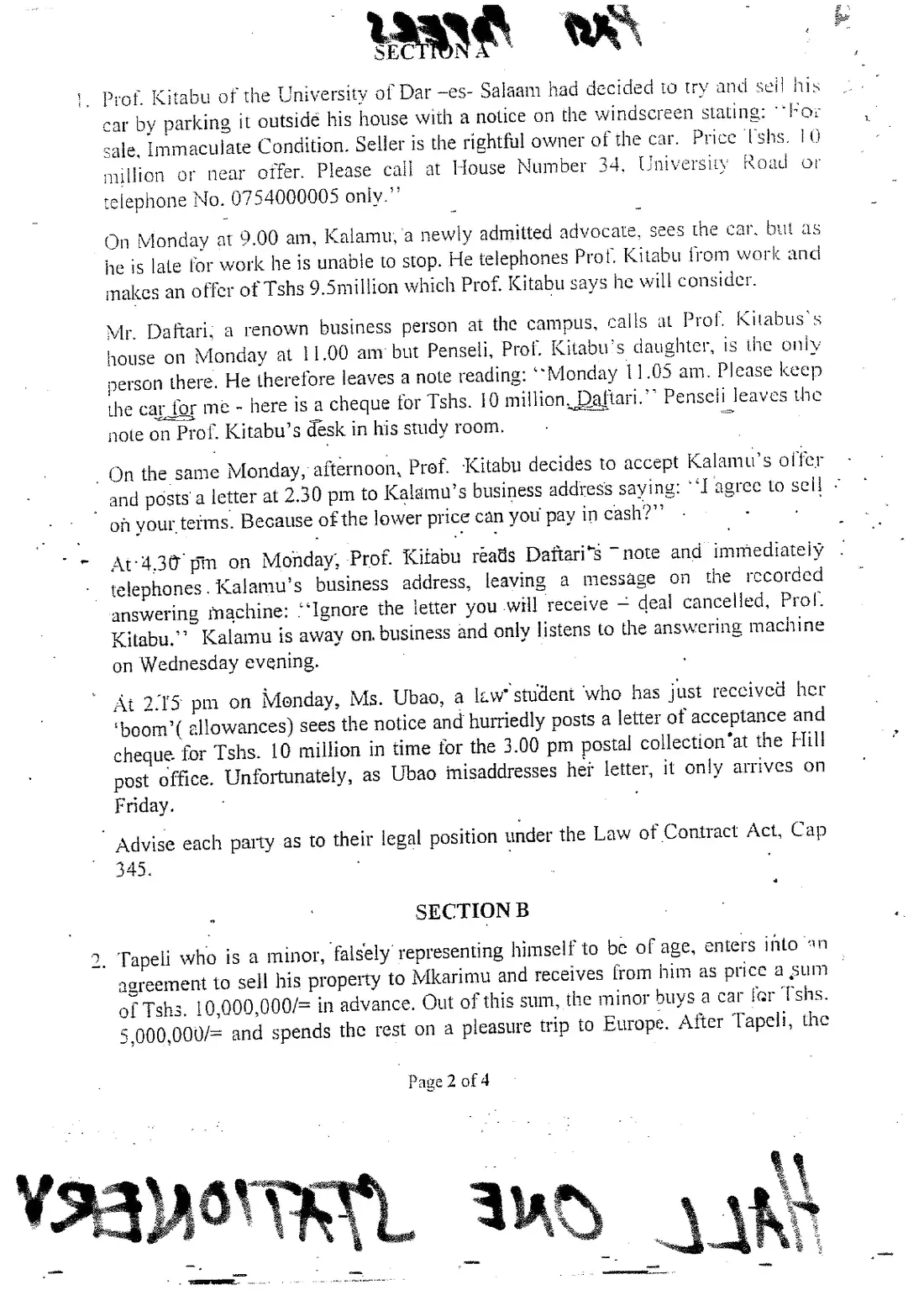
1. Prof. Kitabu of the University of Dar es Salaam had decided to try and sell his car by parking it outside his house with a notice on the windscreen stating: “For sale, Immaculate Condition. Seller is the rightful owner of the car. Price Tshs. 10 million or near offer. Please call at House Number 34, University Road or telephone No. 0754000005 only.”
On Monday at 9.00 am, Kalamu, a newly admitted advocate, sees the car, but as he is late for work he is unable to stop. He telephones Prof. Kitabu from work and makes an offer of Tshs 9.5 million which Prof. Kitabu says he will consider.
Mr. Daftari, a renown business person at the campus, calls at Prof. Kitabu’s house on Monday at 11.00 am but Penseli, Prof. Kitabu’s daughter, is the only person there. He therefore leaves a note reading: “Monday 11.05 am. Please keep the car for me – here is a cheque for Tshs. 10 million, Daftari.” Penseli leaves the note on Prof. Kitabu’s desk in his study room.
On the same Monday afternoon, Prof. Kitabu decides to accept Kalamu’s offer and posts a letter at 2.30 pm to Kalamu’s business address saying: “I agree to sell on your terms. Because of the lower price can you pay in cash?”
At 4.30 pm on Monday, Prof. Kitabu reads Daftari’s note and immediately telephones Kalamu’s business address, leaving a message on the recorded answering machine: “Ignore the letter you will receive – deal cancelled, Prof. Kitabu.” Kalamu is away on business and only listens to the answering machine on Wednesday evening.
At 2.15 pm on Monday, Ms. Ubao, a law student who has just received her ‘boom’ (allowances) sees the notice and hurriedly posts a letter of acceptance and cheque for Tshs. 10 million in time for the 3.00 pm postal collection at the Hill post office. Unfortunately, as Ubao misaddresses her letter, it only arrives on Friday.
Advise each party as to their legal position under the Law of Contract Act, Cap 345.
Section B
2. Tapeli who is a minor, falsely representing himself to be of age, enters into an agreement to sell his property to Mkarimu and receives from him as price a sum of Tshs. 10,000,000/= in advance. Out of this sum, the minor buys a car for Tshs. 5,000,000/= and spends the rest on a pleasure trip to Europe. After Tapeli, the minor has attained majority, Mkarimu makes a decision to sue him for the conveyance of the property or, in the alternative, for the refund of Tshs. 10,000,000/= and damages. However, before Mkarimu institutes that case to the court of law, he has learnt that you are an expert in the Law of Contract and comes to you for advice on his intended suit against Tapeli. Advise him.
3. Answer both aspects of this question: (a) Briefly explain what do you understand by an intention to create legal treaty in contracts. (b) Discuss whether or not intention to create legal relations is an essential element of a contract in Tanzania.
Section C
4. While adopting the general rule of the English common law that a promise is not enforceable by law unless it is supported by consideration, the Tanzanian law has made several significant departures to mitigate the rigour of the English doctrine. (a) Discuss these departures. (b) Would you recommend the abolition of the doctrine altogether from the Tanzanian Law of Contract?
5. Answer both aspects of this question: (a) Discuss types of consideration under the Tanzanian Law of Contract. (b) Evangelist Munguatosha promised his nephew, Elihuruma, in a congratulatory letter which he wrote upon Elihuruma scoring an upper second class in his LL.B examinations, to make a gift of 2,000,000/= to him on graduation day to enable him begin a new life comfortably. In anticipation, Elihuruma bought on credit, a flat screen television he had long been dreaming of. Now Evangelist Munguatosha, who disapproves the high flying life style of his nephew, changed his mind and does not fulfil his promise. Elihuruma, who until now is unemployed, is threatened with legal action for payment of the promised 2,000,000/=. Advise Elihuruma on whether he can sue his uncle Evangelist Munguatosha on his promise.
6. Fundi is a director and general repair man. He is approached by Tajiri, a property developer who offers him Tshs. 600,000/= to paint and decorate a small terraced house owned by Tajiri by the end of December 2014. While Fundi is on the job, Tajiri’s wife visits the house and admires Fundi’s work. She says that if Fundi completes the job early, then she is sure there would be bonus on it for him. Fundi asks her how much would the bonus be. She replies that “she could persuade her husband to pay a sum of Tshs. 100,000/= in such circumstances.” She also says that the work is so professional that she will herself pay him Tshs. 50,000/= once the work is completed. Fundi finishes the job two days early. He seeks the original fee agreed with Tajiri and the two additional sums. Tajiri and his wife refuse to pay the additional sums. Advise Fundi.
Source: University of Dar es Salaam School of Law examination paper, February 2015, shared for revision. Rights holders can ask for removal through our Contact page.
Part 2
Solved Law of Contract I Paper: Model Answers to All 6 Questions
Question 1 is answered in full below, free. Tap any other question to see it and a preview of its answer.
Q1Offer, acceptance and the postal ruleSection A · Compulsory · 24 marks Free answer
The question
Prof. Kitabu of the University of Dar es Salaam had decided to try and sell his car by parking it outside his house with a notice on the windscreen stating: “For sale, Immaculate Condition. Seller is the rightful owner of the car. Price Tshs. 10 million or near offer. Please call at House Number 34, University Road or telephone No. 0754000005 only.”
On Monday at 9.00 am, Kalamu, a newly admitted advocate, sees the car, but as he is late for work he is unable to stop. He telephones Prof. Kitabu from work and makes an offer of Tshs 9.5 million which Prof. Kitabu says he will consider.
Mr. Daftari, a renown business person at the campus, calls at Prof. Kitabu’s house on Monday at 11.00 am but Penseli, Prof. Kitabu’s daughter, is the only person there. He therefore leaves a note reading: “Monday 11.05 am. Please keep the car for me – here is a cheque for Tshs. 10 million, Daftari.” Penseli leaves the note on Prof. Kitabu’s desk in his study room.
On the same Monday afternoon, Prof. Kitabu decides to accept Kalamu’s offer and posts a letter at 2.30 pm to Kalamu’s business address saying: “I agree to sell on your terms. Because of the lower price can you pay in cash?”
At 4.30 pm on Monday, Prof. Kitabu reads Daftari’s note and immediately telephones Kalamu’s business address, leaving a message on the recorded answering machine: “Ignore the letter you will receive – deal cancelled, Prof. Kitabu.” Kalamu is away on business and only listens to the answering machine on Wednesday evening.
At 2.15 pm on Monday, Ms. Ubao, a law student who has just received her ‘boom’ (allowances) sees the notice and hurriedly posts a letter of acceptance and cheque for Tshs. 10 million in time for the 3.00 pm postal collection at the Hill post office. Unfortunately, as Ubao misaddresses her letter, it only arrives on Friday.
Advise each party as to their legal position under the Law of Contract Act, Cap 345.
Model answer
The short answer
There is probably no contract with anyone. The windscreen notice is only an invitation to treat. Kitabu’s posted acceptance bound Kalamu at 2.30 pm, but under section 5(2) of the Law of Contract Act Kitabu could still cancel it by phone, and his message almost certainly reached Kalamu first. Daftari and Ubao only made offers, and nobody accepted them.
This question tests whether you can apply sections 2 to 8 of the Law of Contract Act, Cap. 345 to four people one after another. The trick the examiner is looking for: Tanzania does not copy the English postal rule exactly. I’ll take each person in turn, the way you should in the exam.
The paper allowed Cap. 345 R.E. 2002. The section numbers below are the same in the current revised edition.
Step 1: What was the notice on the windscreen?
Under section 2(1)(a), a proposal (an offer) is made when one person “signifies to another his willingness to do or to abstain from doing anything, with a view to obtaining the assent of that other”. Read the notice again: “Tshs. 10 million or near offer. Please call … or telephone.” Prof. Kitabu is inviting people to make offers and is ready to negotiate. He is not saying he will be bound by the first person who says yes.
So the notice is an invitation to treat, just like the advertisement in Partridge v Crittenden [1968] 1 WLR 1204. Nobody can “accept” it. Keep this in mind, because it decides Daftari’s and Ubao’s positions.
Step 2: Kalamu
The offer. Kalamu’s phone call offering Tshs 9.5 million is a proposal. Its communication is complete when it comes to Kitabu’s knowledge (section 4(1)), which happens at once on the phone. “I will consider it” is not an acceptance.
The acceptance. At 2.30 pm Kitabu posts: “I agree to sell on your terms. Because of the lower price can you pay in cash?” Under section 7(a), an acceptance must be absolute and unqualified. Does the cash question spoil it? I’d argue no. Kitabu accepts “on your terms” and then asks about payment. That is a request for information, not a new term, so it is not a counter-offer (Stevenson, Jacques & Co v McLean (1880) 5 QBD 346). The letter is a valid acceptance.
When is the acceptance complete? Section 4(2) splits it in two:
- as against the proposer (Kalamu), when it is “put in a course of transmission” beyond the acceptor’s power to recall: 2.30 pm on Monday;
- as against the acceptor (Kitabu), only when it comes to the knowledge of Kalamu.
So from 2.30 pm Kalamu is bound and can no longer withdraw his offer (section 5(1)).
Did Kitabu’s phone message cancel the deal? This is where Tanzanian law departs from English law. Under section 5(2), an acceptance “may be revoked at any time before the communication of the acceptance is complete as against the acceptor”, meaning before it reaches Kalamu’s knowledge. A revocation is itself complete as against the person it is made to only when it comes to his knowledge (section 4(3)(b)). Kalamu heard the message on Wednesday evening. So the whole case turns on one question: which reached Kalamu’s knowledge first, the letter or the phone message?
- Kalamu was away on business, so he most likely learned of the letter only after hearing the message. If so, the revocation worked and there is no contract. Kalamu has no claim.
- If Kalamu had already read the letter before Wednesday evening (say his office told him about it), the acceptance was complete on both sides and the revocation came too late. Kitabu would then be in breach and liable to compensate Kalamu under section 73.
Contrast with England. In England the contract is complete for both parties the moment the letter is posted (Adams v Lindsell (1818) 1 B & Ald 681; Household Fire Insurance Co v Grant (1879) 4 Ex D 216), and an acceptor cannot recall a posted acceptance with a faster message. Pointing out this difference is what earns the top marks.
Step 3: Daftari
An offer, not an acceptance. His note (“keep the car for me – here is a cheque for 10 million”) cannot be an acceptance, because the notice was not an offer. It is a proposal to buy at Tshs 10 million.
When was it communicated? Only when it reached Kitabu’s knowledge (section 4(1)). Leaving it with Penseli is not enough, because nothing shows she was Kitabu’s agent to receive offers. The offer reached Kitabu at 4.30 pm, when he read it.
Has Kitabu accepted? Cancelling the deal with Kalamu shows he wants to sell to Daftari, but a decision in his own mind is not an acceptance. It must be communicated (sections 3 and 7(b); compare Felthouse v Bindley (1862) 11 CB (NS) 869). Watch out for section 8, though: “the acceptance of any consideration for a reciprocal promise” is an acceptance of the proposal. If Kitabu banks or keeps Daftari’s cheque, he has accepted by conduct and there is a contract at Tshs 10 million.
Advice to Daftari: until Kitabu accepts, by words or by dealing with the cheque, Daftari can withdraw his offer under section 5(1) and take his cheque back.
Step 4: Ubao
Nothing to accept. Ubao calls her letter an “acceptance”, but you cannot accept an invitation to treat. In law her letter is a proposal. The postal rule in section 4(2) applies only to acceptances, so posting her letter achieved nothing. Her offer is communicated only when it reaches Kitabu’s knowledge (section 4(1)), on Friday, by which time he is free to say no.
Even if the notice were an offer, she would still lose:
- The notice said to call or phone “only“. Section 7(b) requires acceptance “in some usual and reasonable manner, unless the proposal prescribes the manner“. A posted letter is not the manner asked for, and under the proviso to section 7 Kitabu may insist on the manner he prescribed.
- Her letter was misaddressed. A letter sent to the wrong address through the sender’s own fault is arguably never “put in a course of transmission to him” under section 4(2)(a).
Advice to Ubao: there is no contract, and she is entitled to her cheque back.
Step 5: Prof. Kitabu’s own position
- Kalamu: Kitabu is free if his phone message reached Kalamu before the letter did, which is the likely position. Otherwise he must sell at 9.5 million or pay compensation.
- Daftari: no contract unless Kitabu accepts. Banking or keeping the cheque counts as accepting (section 8).
- Ubao: no obligation, but he must return her cheque.
- Practical advice: do not bank Daftari’s cheque until it is clear he is not bound to Kalamu, or he could end up bound to two buyers for one car.
What the examiner wants
The notice classified as an invitation to treat; sections 4(1), 4(2), 4(3), 5(1), 5(2), 7 and 8 applied to each person in turn; and a clear statement of how section 5(2) departs from the English postal rule.
Common mistakes
- Treating the notice as an offer, so that Ubao “accepts” it.
- Saying the acceptance bound both parties at posting. That is English law, not the Law of Contract Act.
- Forgetting section 8 and the effect of Kitabu keeping the cheque.
- Missing the word “only” in the notice.
Q2A minor who lied about his ageSection B · 12 marks Locked
The question
Tapeli who is a minor, falsely representing himself to be of age, enters into an agreement to sell his property to Mkarimu and receives from him as price a sum of Tshs. 10,000,000/= in advance. Out of this sum, the minor buys a car for Tshs. 5,000,000/= and spends the rest on a pleasure trip to Europe. After Tapeli, the minor has attained majority, Mkarimu makes a decision to sue him for the conveyance of the property or, in the alternative, for the refund of Tshs. 10,000,000/= and damages. However, before Mkarimu institutes that case to the court of law, he has learnt that you are an expert in the Law of Contract and comes to you for advice on his intended suit against Tapeli. Advise him.
Model answer
Unlock the model answer to Question 2
Get all 5 locked answers on this paper for TSh 3,000. Pay once, keep them in My Library for life.
Get the solved paper · TSh 3,000Or get every solved paper with Elite
Q3Intention to create legal relations in TanzaniaSection B · 12 marks Locked
The question
Answer both aspects of this question: (a) Briefly explain what do you understand by an intention to create legal treaty in contracts. (b) Discuss whether or not intention to create legal relations is an essential element of a contract in Tanzania.
Model answer
Unlock the model answer to Question 3
Get all 5 locked answers on this paper for TSh 3,000. Pay once, keep them in My Library for life.
Get the solved paper · TSh 3,000Or get every solved paper with Elite
Q4How Tanzanian law departs from English considerationSection C · 12 marks Locked
The question
While adopting the general rule of the English common law that a promise is not enforceable by law unless it is supported by consideration, the Tanzanian law has made several significant departures to mitigate the rigour of the English doctrine. (a) Discuss these departures. (b) Would you recommend the abolition of the doctrine altogether from the Tanzanian Law of Contract?
Model answer
Unlock the model answer to Question 4
Get all 5 locked answers on this paper for TSh 3,000. Pay once, keep them in My Library for life.
Get the solved paper · TSh 3,000Or get every solved paper with Elite
Q5Types of consideration and the uncle's promiseSection C · 12 marks Locked
The question
Answer both aspects of this question: (a) Discuss types of consideration under the Tanzanian Law of Contract. (b) Evangelist Munguatosha promised his nephew, Elihuruma, in a congratulatory letter which he wrote upon Elihuruma scoring an upper second class in his LL.B examinations, to make a gift of 2,000,000/= to him on graduation day to enable him begin a new life comfortably. In anticipation, Elihuruma bought on credit, a flat screen television he had long been dreaming of. Now Evangelist Munguatosha, who disapproves the high flying life style of his nephew, changed his mind and does not fulfil his promise. Elihuruma, who until now is unemployed, is threatened with legal action for payment of the promised 2,000,000/=. Advise Elihuruma on whether he can sue his uncle Evangelist Munguatosha on his promise.
Model answer
Unlock the model answer to Question 5
Get all 5 locked answers on this paper for TSh 3,000. Pay once, keep them in My Library for life.
Get the solved paper · TSh 3,000Or get every solved paper with Elite
Q6Fundi's two bonusesSection C · 12 marks Locked
The question
Fundi is a director and general repair man. He is approached by Tajiri, a property developer who offers him Tshs. 600,000/= to paint and decorate a small terraced house owned by Tajiri by the end of December 2014. While Fundi is on the job, Tajiri’s wife visits the house and admires Fundi’s work. She says that if Fundi completes the job early, then she is sure there would be bonus on it for him. Fundi asks her how much would the bonus be. She replies that “she could persuade her husband to pay a sum of Tshs. 100,000/= in such circumstances.” She also says that the work is so professional that she will herself pay him Tshs. 50,000/= once the work is completed. Fundi finishes the job two days early. He seeks the original fee agreed with Tajiri and the two additional sums. Tajiri and his wife refuse to pay the additional sums. Advise Fundi.
Model answer
Unlock the model answer to Question 6
Get all 5 locked answers on this paper for TSh 3,000. Pay once, keep them in My Library for life.
Get the solved paper · TSh 3,000Or get every solved paper with Elite
Get the Full Solved Paper
All 6 questions answered under the Law of Contract Act, with what the examiner wants and the mistakes to avoid. TSh 3,000, yours for life in My Library.
Pata majibu yote ya mtihani huu kwa TSh 3,000 tu.




Law You Need for the Law of Contract I Paper
- Law of Contract Act, Cap. 345, s. 2(1)Proposal, acceptance, consideration and contract defined
- Law of Contract Act, Cap. 345, ss. 3 to 8Communication, revocation and acceptance, including the postal rule
- Law of Contract Act, Cap. 345, ss. 10, 11, 25 and 63What makes a contract, capacity, agreements without consideration, and remission without consideration
- Age of Majority Act, Cap. 43, s. 2The age of majority is 18
- Judicature and Application of Laws Act, Cap. 358, s. 2(3)English common law and equity received in Tanzania
UDSM Law of Contract I Past Paper: Common Questions
Is this a real UDSM past paper?
Yes. It is the LW 101 Law of Contract I final examination set by the University of Dar es Salaam School of Law and sat on 3 February 2015, shown page by page as scanned.
Is any answer free?
Yes. The full worked answer to the compulsory Question 1, on offer, acceptance and the postal rule, is free to everyone.
How much are the other answers?
TSh 3,000 for this paper, or TSh 2,000 for Pro members, and they stay in My Library for life. Elite members get every solved past paper included.
Does the postal rule work the same way in Tanzania as in England?
No. Under section 5(2) of the Law of Contract Act an acceptor can still revoke a posted acceptance until it comes to the proposer's knowledge, which English law does not allow.
Which law do the answers use?
The Law of Contract Act, Cap. 345, with English common law and equity received through the Judicature and Application of Laws Act, Cap. 358. The section numbers are the same in the current revised edition.