

About this paper
Solved answers to all 5 questions
Part 1
SAUT Law of Torts I Past Paper (SLW 203): The Full Exam as Set
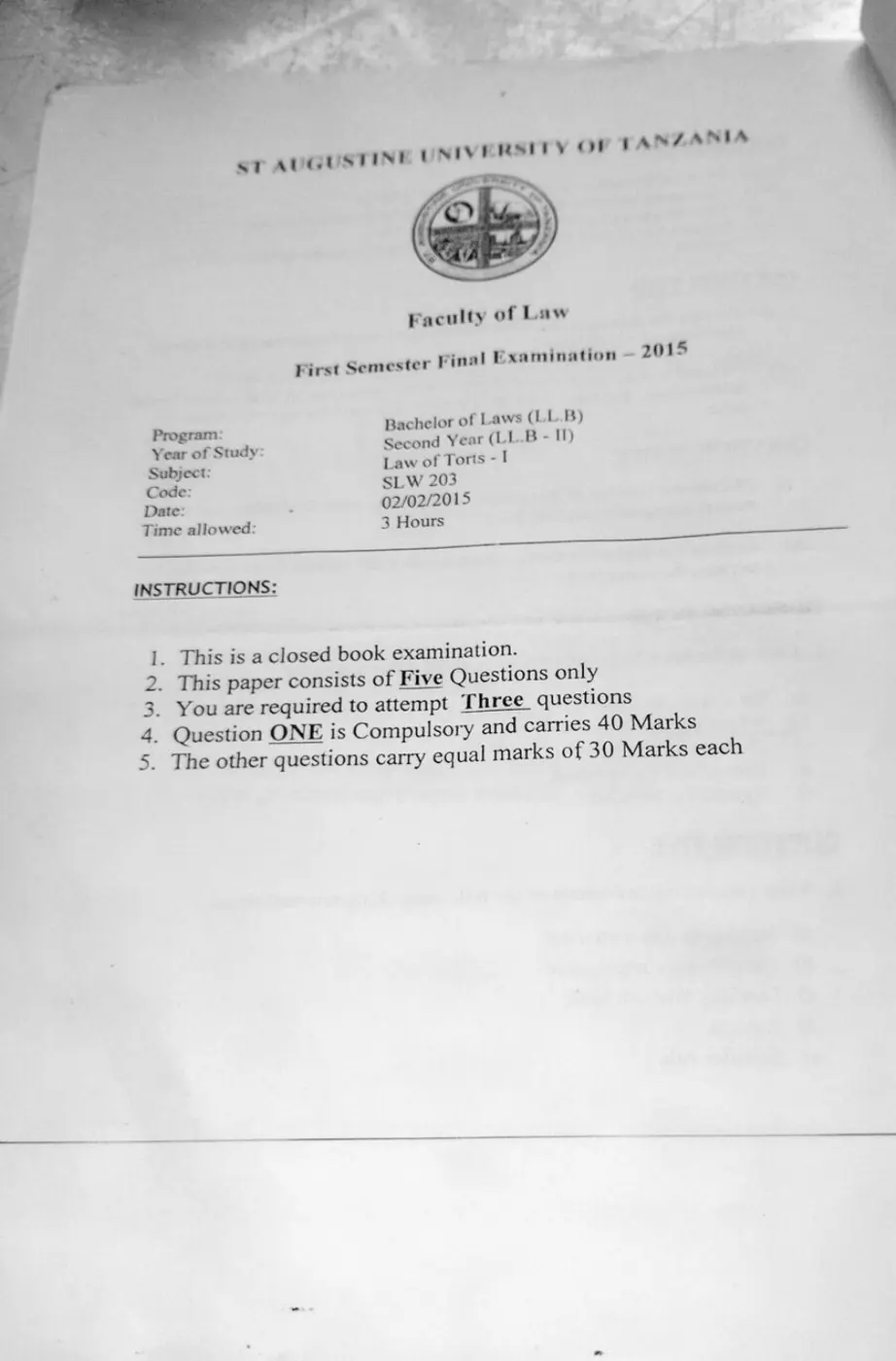
Five questions. Attempt three. Question 1 is compulsory (40 marks); the rest carry 30 marks. Closed book.
Read the questions as text
This is a closed book examination. This paper consists of FIVE questions only. You are required to attempt THREE questions. Question ONE is compulsory and carries 40 marks. The other questions carry equal marks of 30 marks each.
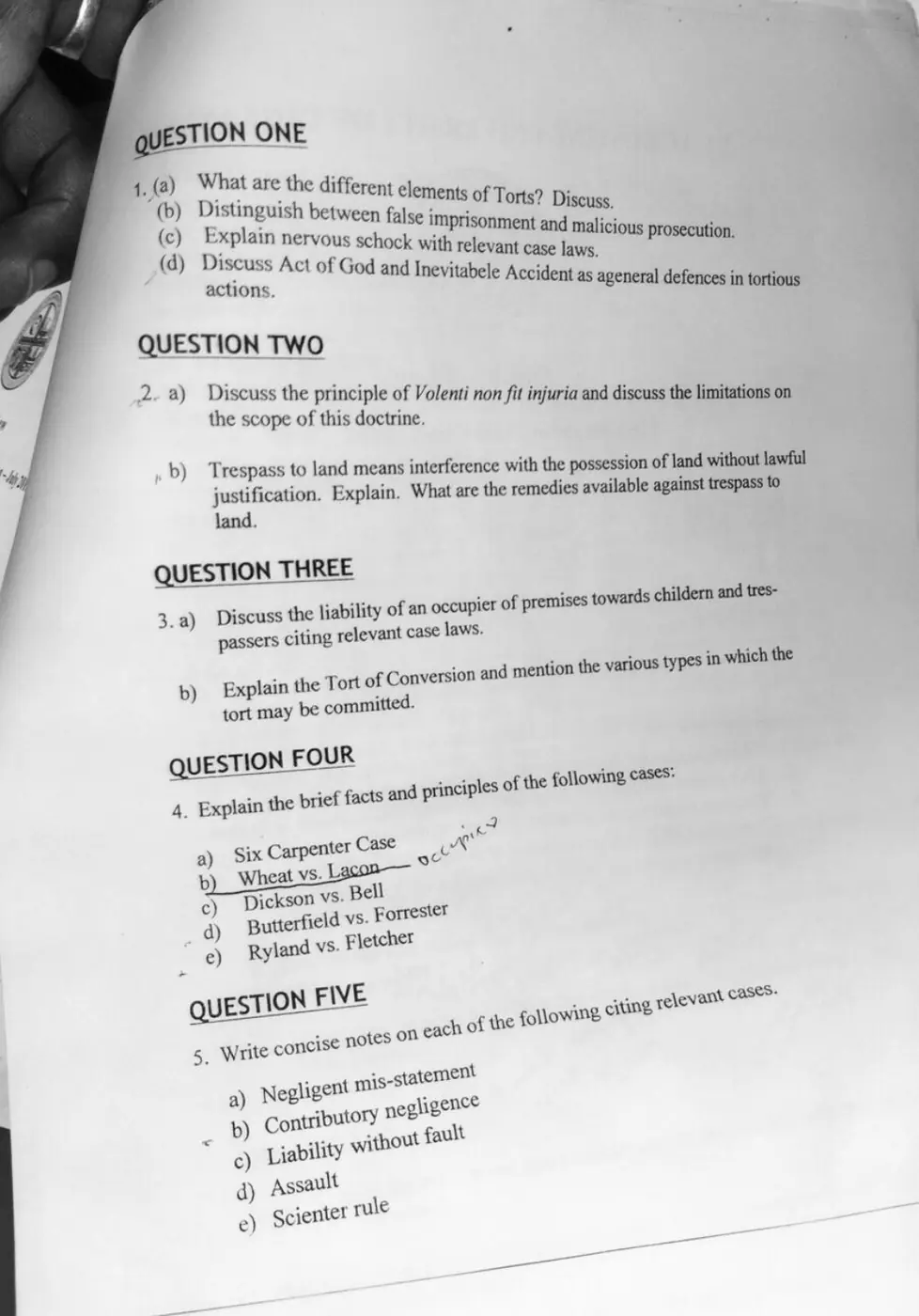
1. (a) What are the different elements of torts? Discuss. (b) Distinguish between false imprisonment and malicious prosecution. (c) Explain nervous shock with relevant case law. (d) Discuss Act of God and inevitable accident as general defences in tortious actions.
2. (a) Discuss the principle of volenti non fit injuria and discuss the limitations on the scope of this doctrine. (b) Trespass to land means interference with the possession of land without lawful justification. Explain. What are the remedies available against trespass to land?
3. (a) Discuss the liability of an occupier of premises towards children and trespassers, citing relevant case law. (b) Explain the tort of conversion and mention the various ways in which the tort may be committed.
4. Explain the brief facts and principles of the following cases: (a) Six Carpenters Case; (b) Wheat v Lacon; (c) Dickson v Bell; (d) Butterfield v Forrester; (e) Rylands v Fletcher.
5. Write concise notes on each of the following, citing relevant cases: (a) Negligent misstatement; (b) Contributory negligence; (c) Liability without fault; (d) Assault; (e) Scienter rule.
Source: St. Augustine University of Tanzania examination paper, February 2015, shared for revision. Rights holders can ask for removal through our Contact page.
Part 2
Law of Torts I Past Paper Answers: Model Answers to All 5 Questions
Question 1 is answered in full below, free. Tap any other question to see it and a preview of its answer.
Q1Question 1: Elements of a tort, false imprisonment v malicious prosecution, nervous shock, Act of God and inevitable accident
40 marks · Essay · Compulsory Free answer
The question
(a) What are the different elements of torts? Discuss. (b) Distinguish between false imprisonment and malicious prosecution. (c) Explain nervous shock with relevant case law. (d) Discuss Act of God and inevitable accident as general defences in tortious actions.
Model answer
The short answer
A tort needs a wrongful act or omission, legal damage (the violation of a legal right) and a remedy in damages. False imprisonment is unlawful restraint of liberty; malicious prosecution is the abuse of legal process to prosecute someone without reasonable cause. Damages for nervous shock need a recognised psychiatric illness and, for secondary victims, a close tie, proximity and direct perception. Act of God and inevitable accident both excuse a defendant whose care could not have prevented the harm, but an Act of God must come from natural forces.
Tanzania has no general torts statute. The law of torts applies here as received English common law under the Judicature and Application of Laws Act, Cap. 358, adapted by local statutes and Tanzanian decisions.
(a) The elements of a tort
- A wrongful act or omission. The defendant must do something the law forbids or fail to do something the law requires, such as breaching a duty of care: Donoghue v Stevenson [1932] AC 562.
- Legal damage. The plaintiff must suffer the violation of a legal right, not merely loss. Two maxims show this:
- Injuria sine damno (violation of a right without actual loss) is actionable in torts actionable per se, such as trespass. In Ashby v White (1703) 2 Ld Raym 938 the returning officer wrongfully refused the plaintiff’s vote; he recovered although his candidate won.
- Damnum sine injuria (loss without violation of a right) is not actionable. In Bradford Corporation v Pickles [1895] AC 587 the defendant drained water under his own land to force the council to buy it; his malicious motive did not make a lawful act a tort.
- A remedy, usually unliquidated damages. A tort is a civil wrong redressed by an action for damages that are not fixed in advance, which distinguishes it from breach of contract (liquidated sums) and crime (punishment).
- Mental element, where required. Some torts require intention (trespass to the person, deceit) or malice (malicious prosecution); negligence requires carelessness; strict liability torts require no fault.
(b) False imprisonment and malicious prosecution
| Point | False imprisonment | Malicious prosecution |
|---|---|---|
| Nature | Total restraint of a person’s liberty without lawful justification | Setting the law in motion against someone maliciously and without reasonable cause |
| Elements | (i) total restraint (partial obstruction is not enough: Bird v Jones (1845) 7 QB 742); (ii) without lawful authority | (i) prosecution by the defendant; (ii) ended in the plaintiff’s favour; (iii) without reasonable and probable cause; (iv) with malice; (v) damage: Glinski v McIver [1962] AC 726 |
| Proof of damage | Actionable per se; the plaintiff need not even know of the restraint: Meering v Grahame-White Aviation (1919) 122 LT 44 | Damage to reputation, person or property must be shown |
| Who acts | The person who detains (or directs the detention) | The person who instigates the prosecution, usually the complainant who gives false information to the police |
| Court involvement | Restraint happens without any judicial act | Involves a judicial process; once a court remands the accused, further detention is the court’s act, not the complainant’s |
Example: a shopkeeper who locks a customer in a store room without reasonable suspicion commits false imprisonment; if he then lies to the police so that she is charged and later acquitted, he may also be liable for malicious prosecution.
(c) Nervous shock
- Meaning: a recognised psychiatric illness (not mere grief or fright) caused by the defendant’s negligence.
- Development: early cases allowed recovery only to those in fear for their own safety: Dulieu v White [1901] 2 KB 669. Hambrook v Stokes [1925] 1 KB 141 extended it to a mother who feared for her children. In Bourhill v Young [1943] AC 92 a pregnant woman who heard a crash out of sight failed because she was not a foreseeable victim. In McLoughlin v O’Brian [1983] 1 AC 410 a mother who saw her family in hospital shortly after an accident recovered.
- Current tests: Alcock v Chief Constable of South Yorkshire Police [1992] 1 AC 310 (the Hillsborough disaster) distinguished:
- primary victims, in the zone of physical danger, who recover if personal injury was foreseeable: Page v Smith [1996] AC 155;
- secondary victims, who must show a close tie of love and affection with the victim, proximity in time and space to the accident or its immediate aftermath, and perception by their own unaided senses (not on television).
(d) Act of God and inevitable accident
- Act of God (vis major): an event caused by natural forces without human intervention that no human foresight could guard against. In Nichols v Marsland (1876) 2 Ex D 1 an extraordinary rainfall burst the defendant’s artificial lakes; he was not liable even under Rylands v Fletcher. The defence is narrow: heavy rain that should have been foreseen does not qualify: Greenock Corporation v Caledonian Railway [1917] AC 556.
- Inevitable accident: an accident that could not have been avoided by the exercise of ordinary care, caution and skill. In Stanley v Powell [1891] 1 QB 86 a pellet glanced off a tree and injured a beater during a shoot; the defendant was not liable because he was not negligent. In Holmes v Mather (1875) LR 10 Ex 261 horses bolted despite the driver’s care.
- Difference: an Act of God must be due to natural forces; inevitable accident can involve human agency. Both fail if reasonable care could have prevented the harm, and neither applies to the defendant’s own negligence.
What the examiner wants
Clear definitions with leading cases for each part. With 40 marks, give each of (a) to (d) roughly equal space.
Common mistakes
- Listing “duty, breach, damage” as the elements of every tort; those are the elements of negligence only.
- Saying false imprisonment needs a prison or knowledge by the plaintiff.
- Treating heavy but foreseeable rain as an Act of God.
Q2Question 2: Volenti non fit injuria and trespass to land
30 marks · Essay Locked
The question
(a) Discuss the principle of volenti non fit injuria and discuss the limitations on the scope of this doctrine. (b) Trespass to land means interference with the possession of land without lawful justification. Explain. What are the remedies available against trespass to land?
Model answer
Unlock the model answer to Question 2
Get all 4 locked answers on this paper for TSh 3,000. Pay once, keep them in Your Library for life.
Get the solved paper · TSh 3,000Or get every solved paper with Elite
Q3Question 3: Occupiers' liability to children and trespassers; conversion
30 marks · Essay Locked
The question
(a) Discuss the liability of an occupier of premises towards children and trespassers, citing relevant case law. (b) Explain the tort of conversion and mention the various ways in which the tort may be committed.
Model answer
Unlock the model answer to Question 3
Get all 4 locked answers on this paper for TSh 3,000. Pay once, keep them in Your Library for life.
Get the solved paper · TSh 3,000Or get every solved paper with Elite
Q4Question 4: Case notes: Six Carpenters, Wheat v Lacon, Dixon v Bell, Butterfield v Forrester, Rylands v Fletcher
30 marks · Case notes Locked
The question
Explain the brief facts and principles of the following cases: (a) Six Carpenters Case; (b) Wheat v Lacon; (c) Dickson v Bell; (d) Butterfield v Forrester; (e) Rylands v Fletcher.
Model answer
Unlock the model answer to Question 4
Get all 4 locked answers on this paper for TSh 3,000. Pay once, keep them in Your Library for life.
Get the solved paper · TSh 3,000Or get every solved paper with Elite
Q5Question 5: Short notes: negligent misstatement, contributory negligence, strict liability, assault, scienter
30 marks · Short notes Locked
The question
Write concise notes on each of the following, citing relevant cases: (a) Negligent misstatement; (b) Contributory negligence; (c) Liability without fault; (d) Assault; (e) Scienter rule.
Model answer
Unlock the model answer to Question 5
Get all 4 locked answers on this paper for TSh 3,000. Pay once, keep them in Your Library for life.
Get the solved paper · TSh 3,000Or get every solved paper with Elite
Get the Full Solved Paper
All 5 questions answered with the statutes and cases that apply, what the examiner wants and the mistakes to avoid. TSh 3,000, yours for life in Your Library.
Pata majibu yote ya mtihani huu kwa TSh 3,000 tu.




Statutes and Cases for This Law of Torts I Past Paper
- Judicature and Application of Laws Act, Cap. 358Reception of the English common law of torts into Tanzania
- Law Reform (Fatal Accidents and Miscellaneous Provisions) Act, Cap. 310Apportionment of liability for contributory negligence (s.11)
- Donoghue v Stevenson [1932] AC 562 (HL)Duty of care in negligence
- Ashby v White (1703) 2 Ld Raym 938; Bradford Corporation v Pickles [1895] AC 587Injuria sine damno and damnum sine injuria
- Bird v Jones (1845) 7 QB 742; Meering v Grahame-White Aviation (1919) 122 LT 44False imprisonment
- Glinski v McIver [1962] AC 726Malicious prosecution
- Alcock v Chief Constable of South Yorkshire Police [1992] 1 AC 310; McLoughlin v O'Brian [1983] 1 AC 410Nervous shock
- Nichols v Marsland (1876) 2 Ex D 1; Stanley v Powell [1891] 1 QB 86Act of God; inevitable accident
- Smith v Baker & Sons [1891] AC 325; Haynes v Harwood [1935] 1 KB 146Volenti non fit injuria
- Glasgow Corporation v Taylor [1922] 1 AC 44; British Railways Board v Herrington [1972] AC 877Occupiers, children and trespassers
- Hollins v Fowler (1875) LR 7 HL 757Conversion
- Rylands v Fletcher (1868) LR 3 HL 330Strict liability for escapes
- Hedley Byrne & Co v Heller & Partners [1964] AC 465Negligent misstatement
SAUT Law of Torts I Past Paper: Common Questions
Is this the real SAUT Law of Torts I exam paper?
Yes. These are scans of the First Semester Final Examination, February 2015 paper for SLW 203 Law of Torts I at St. Augustine University of Tanzania, sat on 2 February 2015. Nothing has been retyped or changed.
How many questions do you answer in this Law of Torts I paper?
Five questions. Attempt three. Question 1 is compulsory (40 marks); the rest carry 30 marks. Closed book.
Are there answers to this past paper?
Yes. All 5 questions have full model answers written to Tanzanian law and reviewed by Isack Kimaro, LL.B, PDLP. The Question 1 answer is free; the full solved paper is TSh 3,000 (TSh 2,000 for Pro members) and is included in Elite.
How do I see every page of the paper?
The first pages are open to everyone. Create a free account to read the whole paper.