

About this paper
Solved answers to all 5 questions
Part 1
SAUT Law of Evidence I Past Paper (SLW 202): The Full Exam as Set
Five questions. Attempt three, including Question 1 (40 marks). Other questions carry 30 marks. Closed book.
Read the questions as text
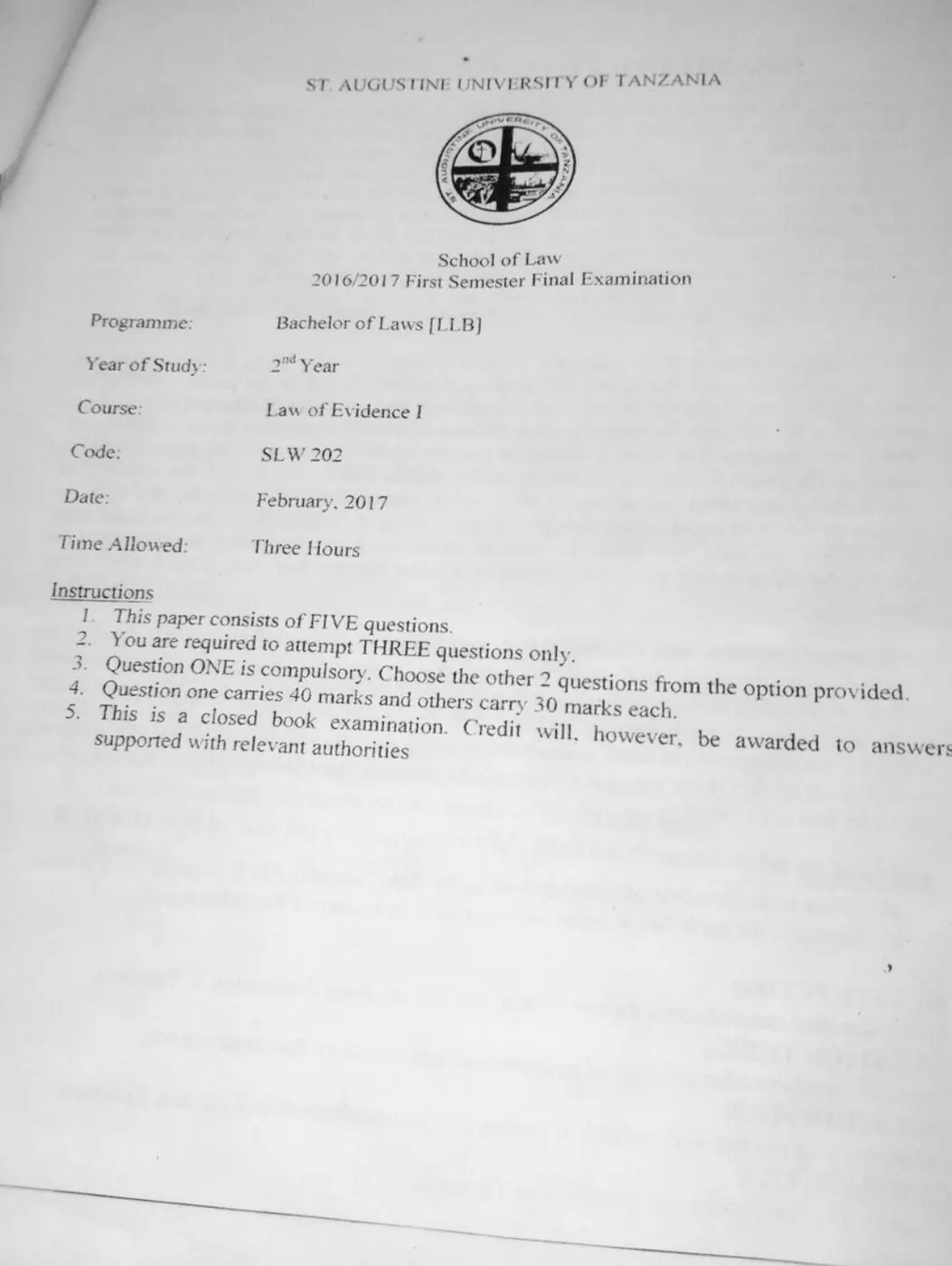
This paper consists of FIVE questions. You are required to attempt THREE questions only. Question ONE is compulsory; choose the other two questions from the options provided. Question one carries 40 marks and the others carry 30 marks each. This is a closed book examination. Credit will, however, be awarded to answers supported with relevant authorities.
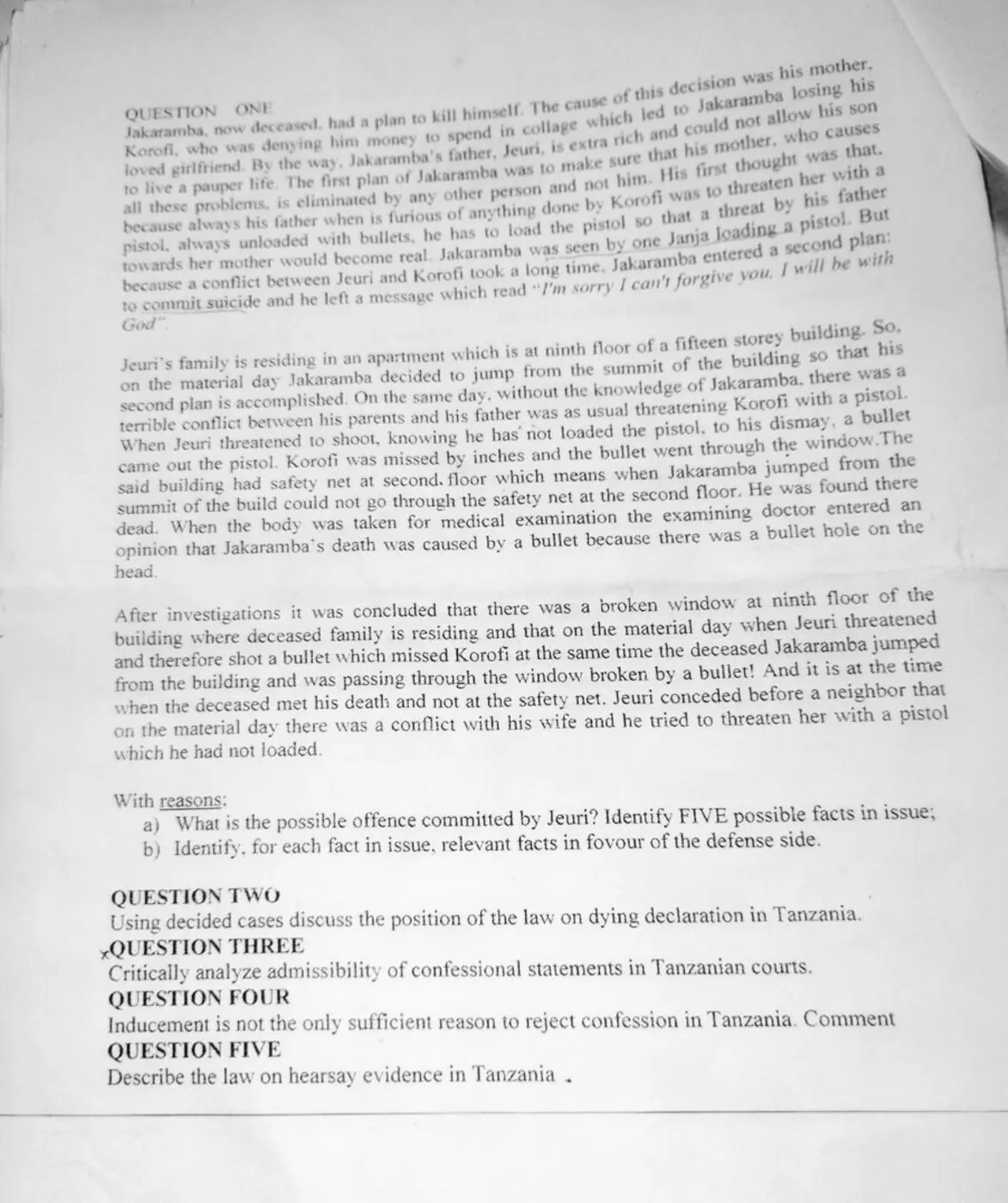
1. Jakaramba, now deceased, had a plan to kill himself. The cause of this decision was his mother, Korofi, who was denying him money to spend in college, which led to Jakaramba losing his loved girlfriend. By the way, Jakaramba’s father, Jeuri, is extra rich and could not allow his son to live a pauper life. The first plan of Jakaramba was to make sure that his mother, who causes all these problems, is eliminated by any other person and not him. His first thought was that, because his father always threatens her with a pistol, always unloaded, when he is furious about anything done by Korofi, he has to load the pistol so that a threat by his father towards his mother would become real. Jakaramba was seen by one Janja loading a pistol. But because a conflict between Jeuri and Korofi took a long time, Jakaramba entered a second plan: to commit suicide, and he left a message which read “I’m sorry I can’t forgive you. I will be with God.” Jeuri’s family is residing in an apartment which is on the ninth floor of a fifteen-storey building. So, on the material day Jakaramba decided to jump from the summit of the building so that his second plan is accomplished. On the same day, without the knowledge of Jakaramba, there was a terrible conflict between his parents and his father was, as usual, threatening Korofi with a pistol. When Jeuri threatened to shoot, knowing he had not loaded the pistol, to his dismay a bullet came out of the pistol. Korofi was missed by inches and the bullet went through the window. The said building had a safety net at the second floor, which means when Jakaramba jumped from the summit of the building he could not go through the safety net at the second floor. He was found there dead. When the body was taken for medical examination the examining doctor gave an opinion that Jakaramba’s death was caused by a bullet because there was a bullet hole in the head. After investigations it was concluded that there was a broken window on the ninth floor of the building where the deceased’s family is residing, and that on the material day when Jeuri threatened and therefore shot a bullet which missed Korofi, at the same time the deceased Jakaramba jumped from the building and was passing the window broken by the bullet! And it is at that time that the deceased met his death, and not at the safety net. Jeuri conceded before a neighbour that on the material day there was a conflict with his wife and he tried to threaten her with a pistol which he had not loaded. With reasons: (a) What is the possible offence committed by Jeuri? Identify FIVE possible facts in issue. (b) Identify, for each fact in issue, relevant facts in favour of the defence side.
2. Using decided cases, discuss the position of the law on dying declarations in Tanzania.
3. Critically analyse the admissibility of confessional statements in Tanzanian courts.
4. Inducement is not the only sufficient reason to reject a confession in Tanzania. Comment.
5. Describe the law on hearsay evidence in Tanzania.
Source: St. Augustine University of Tanzania examination paper, February 2017, shared for revision. Rights holders can ask for removal through our Contact page.
Part 2
Law of Evidence I Past Paper Answers: Model Answers to All 5 Questions
Question 1 is answered in full below, free. Tap any other question to see it and a preview of its answer.
Q1Question 1: Jeuri's pistol: the offence, five facts in issue and relevant facts for the defence
40 marks · Problem · Compulsory Free answer
The question
Jakaramba, now deceased, had a plan to kill himself. The cause of this decision was his mother, Korofi, who was denying him money to spend in college, which led to Jakaramba losing his loved girlfriend. By the way, Jakaramba’s father, Jeuri, is extra rich and could not allow his son to live a pauper life. The first plan of Jakaramba was to make sure that his mother, who causes all these problems, is eliminated by any other person and not him. His first thought was that, because his father always threatens her with a pistol, always unloaded, when he is furious about anything done by Korofi, he has to load the pistol so that a threat by his father towards his mother would become real. Jakaramba was seen by one Janja loading a pistol. But because a conflict between Jeuri and Korofi took a long time, Jakaramba entered a second plan: to commit suicide, and he left a message which read “I’m sorry I can’t forgive you. I will be with God.” Jeuri’s family is residing in an apartment which is on the ninth floor of a fifteen-storey building. So, on the material day Jakaramba decided to jump from the summit of the building so that his second plan is accomplished. On the same day, without the knowledge of Jakaramba, there was a terrible conflict between his parents and his father was, as usual, threatening Korofi with a pistol. When Jeuri threatened to shoot, knowing he had not loaded the pistol, to his dismay a bullet came out of the pistol. Korofi was missed by inches and the bullet went through the window. The said building had a safety net at the second floor, which means when Jakaramba jumped from the summit of the building he could not go through the safety net at the second floor. He was found there dead. When the body was taken for medical examination the examining doctor gave an opinion that Jakaramba’s death was caused by a bullet because there was a bullet hole in the head. After investigations it was concluded that there was a broken window on the ninth floor of the building where the deceased’s family is residing, and that on the material day when Jeuri threatened and therefore shot a bullet which missed Korofi, at the same time the deceased Jakaramba jumped from the building and was passing the window broken by the bullet! And it is at that time that the deceased met his death, and not at the safety net. Jeuri conceded before a neighbour that on the material day there was a conflict with his wife and he tried to threaten her with a pistol which he had not loaded. With reasons: (a) What is the possible offence committed by Jeuri? Identify FIVE possible facts in issue. (b) Identify, for each fact in issue, relevant facts in favour of the defence side.
Model answer
The short answer
(a) the most likely charge is murder (Penal Code s.196), with manslaughter (s.195) as the realistic outcome: Jeuri fired a pistol at his wife, which is an unlawful act, and the bullet killed his son; but he believed the gun was unloaded, so malice aforethought is hard to prove. The facts in issue are the death, its cause, that Jeuri fired the fatal shot, that the act was unlawful, and his state of mind. (b) For each, the defence can point to relevant facts: Jakaramba’s own plan and suicide note, Janja seeing him load the gun, Jeuri’s habit of using an unloaded gun, and his consistent statement to the neighbour.
Evidence Act sections are from the current revised edition, Cap. 6 R.E. 2023 (the 2017 exam used older numbering).
(a) The possible offence
- Murder (Penal Code ss.196 and 200) requires malice aforethought: an intention to cause death or grievous harm, or knowledge that the act will probably cause death or grievous harm. The prosecution could argue that intent towards Korofi transfers to the person actually killed. But Jeuri genuinely believed the pistol was unloaded, as on every previous occasion, so intention or knowledge of probable death is difficult to prove.
- Manslaughter (s.195): causing death by an unlawful act or omission. Pointing a pistol at a person and pulling the trigger in a threatening way is an assault and an unlawful act, and handling a firearm without checking it may also be culpable negligence. Manslaughter is the more likely conviction.
Facts in issue and relevant facts
Facts in issue are the facts from which, alone or with others, the existence or non-existence of a right or liability necessarily follows (Evidence Act s.3). Relevant facts are facts connected with them, for example as part of the same transaction (s.8) or as their occasion, cause or effect (s.9).
| Fact in issue | Relevant facts in favour of the defence |
|---|---|
| 1. That Jakaramba died | Not seriously disputed; but the defence may stress that he had already decided to die and jumped from the summit intending to kill himself, as shown by his note “I’m sorry I can’t forgive you. I will be with God.” |
| 2. That the death was caused by the bullet (causation), not the fall | He jumped voluntarily; the cause of death was a combination of events he set in motion. The defence may cross-examine the doctor on the basis of his opinion (an expert opinion under s.52 is not binding) and on whether the fall or the bullet killed him. It may also argue that Jakaramba’s own act of loading the gun was the real cause (a novus actus by the deceased). |
| 3. That the bullet came from Jeuri’s pistol and Jeuri fired it | Jeuri admits threatening Korofi with the pistol, but the defence can require ballistic proof linking the bullet to that pistol and the window; and stress that the shot was not aimed at Jakaramba, whom Jeuri did not know was passing. |
| 4. That the act was unlawful | Jeuri believed the gun was unloaded, so in his mind he was only threatening, not using deadly force; the defence may argue the discharge was accidental. (A threat with a gun is still an assault, which is why manslaughter remains likely.) |
| 5. Jeuri’s state of mind (malice aforethought or culpable negligence) | Janja saw Jakaramba loading the pistol; Jeuri always used it unloaded and had no reason to think otherwise; he had no motive to kill his son, whom he supported; his statement to the neighbour that he “tried to threaten her with a pistol which he had not loaded” is consistent with innocent belief. That statement is an admission (ss.19 and 23), not a confession to murder. |
Additional points
- Jakaramba’s plan to have his mother killed and his note are relevant to motive and to explain why the gun was loaded.
- Janja is a key defence witness; the defence should call him.
What the examiner wants
The correct offence with reasons, five distinct facts in issue, and for each the relevant facts the defence would rely on, with the Evidence Act provisions on relevance.
Common mistakes
- Concluding murder without discussing malice aforethought.
- Confusing facts in issue with relevant facts.
Q2Question 2: Dying declarations in Tanzania
30 marks · Essay Locked
The question
Using decided cases, discuss the position of the law on dying declarations in Tanzania.
Model answer
Unlock the model answer to Question 2
Get all 4 locked answers on this paper for TSh 3,000. Pay once, keep them in Your Library for life.
Get the solved paper · TSh 3,000Or get every solved paper with Elite
Q3Question 3: Admissibility of confessions in Tanzanian courts
30 marks · Essay Locked
The question
Critically analyse the admissibility of confessional statements in Tanzanian courts.
Model answer
Unlock the model answer to Question 3
Get all 4 locked answers on this paper for TSh 3,000. Pay once, keep them in Your Library for life.
Get the solved paper · TSh 3,000Or get every solved paper with Elite
Q4Question 4: Why inducement is not the only ground for rejecting a confession
30 marks · Essay Locked
The question
Inducement is not the only sufficient reason to reject a confession in Tanzania. Comment.
Model answer
Unlock the model answer to Question 4
Get all 4 locked answers on this paper for TSh 3,000. Pay once, keep them in Your Library for life.
Get the solved paper · TSh 3,000Or get every solved paper with Elite
Q5Question 5: The law on hearsay evidence in Tanzania
30 marks · Essay Locked
The question
Describe the law on hearsay evidence in Tanzania.
Model answer
Unlock the model answer to Question 5
Get all 4 locked answers on this paper for TSh 3,000. Pay once, keep them in Your Library for life.
Get the solved paper · TSh 3,000Or get every solved paper with Elite
Get the Full Solved Paper
All 5 questions answered with the statutes and cases that apply, what the examiner wants and the mistakes to avoid. TSh 3,000, yours for life in Your Library.
Pata majibu yote ya mtihani huu kwa TSh 3,000 tu.




Statutes and Cases for This Law of Evidence I Past Paper
- Evidence Act, Cap. 6 R.E. 2023Facts in issue and confession defined (s.3), same transaction (s.8), occasion, cause and effect (s.9), admissions (ss.19, 23), confessions (ss.27-33), statements of persons who cannot be called incl. dying declarations (s.34), expert opinion (s.52), direct oral evidence (s.67)
- Criminal Procedure Act, Cap. 20Time for interviewing suspects (ss.50-51), cautions and recording statements (ss.53, 57-58), exclusion of illegally obtained evidence (s.169)
- Penal Code, Cap. 16Manslaughter (s.195), murder and malice aforethought (ss.196, 200)
- Pius Jasunga s/o Akumu v R (1954) 21 EACA 331Caution and corroboration for dying declarations
- Hassan Juma Kenyera v R [1992] TLR 100 (CA)No rule of law requiring corroboration of a dying declaration
- Twaha Ali & 5 Others v R, Criminal Appeal No. 78 of 2004 (CA)Trial within a trial on voluntariness
- Tuwamoi v Uganda [1967] EA 84Retracted and repudiated confessions
- Hemedi Abdallah v R [1995] TLR 172 (CA)Repudiated confessions
- Alex Ndendya v R, Criminal Appeal No. 207 of 2018 [2020] TZCA 202Oral confessions to civilians
- Subramaniam v Public Prosecutor [1956] 1 WLR 965 (PC)When a statement is not hearsay
- Ratten v R [1972] AC 378 (PC)Spontaneous statements (res gestae)
SAUT Law of Evidence I Past Paper: Common Questions
Is this the real SAUT Law of Evidence I exam paper?
Yes. These are scans of the First Semester Final Examination 2016/2017 paper for SLW 202 Law of Evidence I at St. Augustine University of Tanzania, sat on February 2017. Nothing has been retyped or changed.
How many questions do you answer in this Law of Evidence I paper?
Five questions. Attempt three, including Question 1 (40 marks). Other questions carry 30 marks. Closed book.
Are there answers to this past paper?
Yes. All 5 questions have full model answers written to Tanzanian law and reviewed by Isack Kimaro, LL.B, PDLP. The Question 1 answer is free; the full solved paper is TSh 3,000 (TSh 2,000 for Pro members) and is included in Elite.
How do I see every page of the paper?
The first pages are open to everyone. Create a free account to read the whole paper.