

About this paper
Solved answers to all 5 questions
Part 1
SAUT Land Law I Past Paper (SLW 302): The Full Exam as Set
Five questions. Answer three; Question 1 is compulsory (40 marks). Other questions carry 30 marks. Listed land statutes allowed.
Read the questions as text
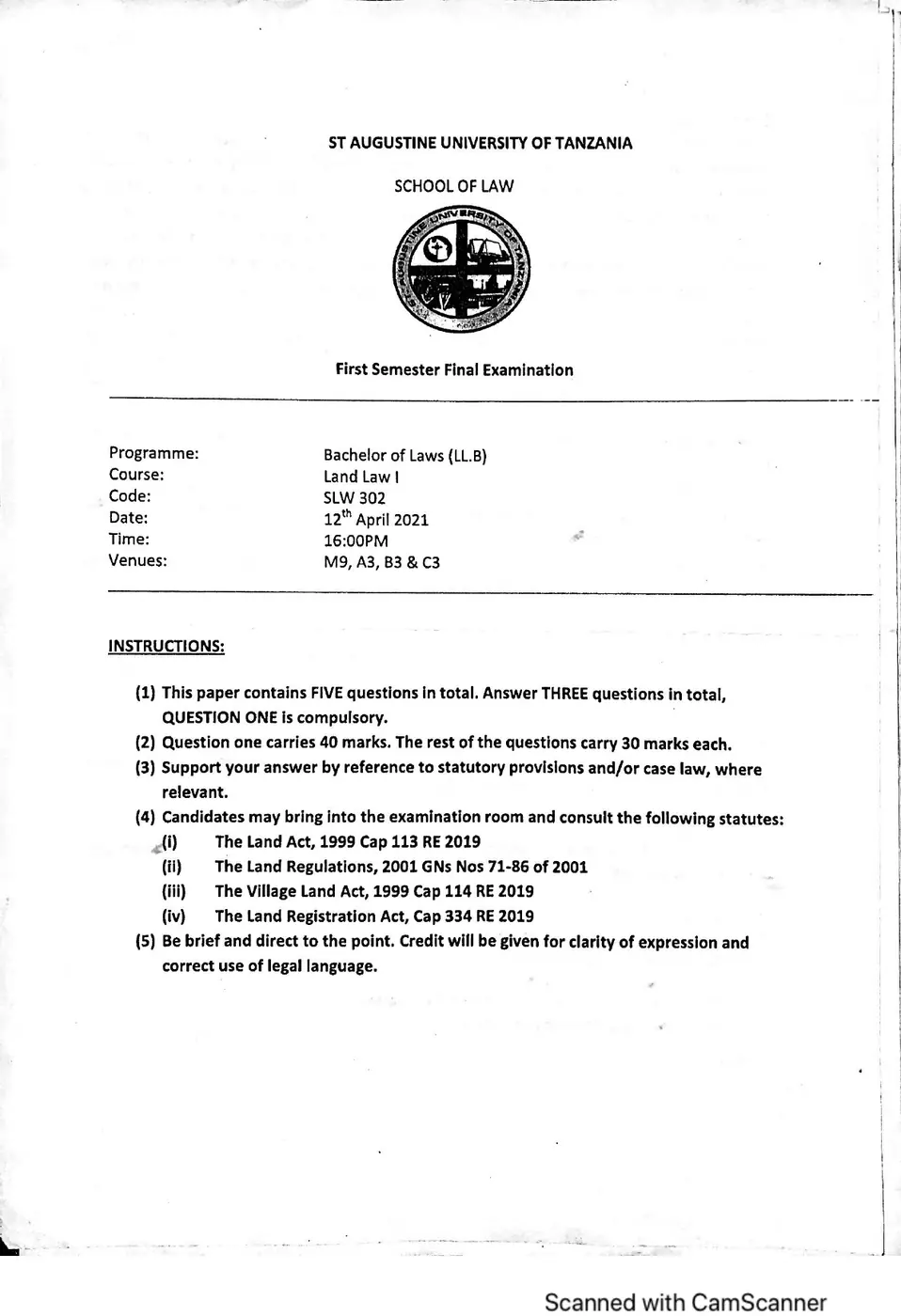
This paper contains FIVE questions in total. Answer THREE questions in total; QUESTION ONE is compulsory. Question one carries 40 marks. The rest of the questions carry 30 marks each. Support your answer by reference to statutory provisions and/or case law, where relevant. Candidates may bring into the examination room and consult: the Land Act, 1999 Cap 113 R.E. 2019; the Land Regulations, 2001 GNs Nos 71-86 of 2001; the Village Land Act, 1999 Cap 114 R.E. 2019; the Land Registration Act, Cap 334 R.E. 2019. Be brief and direct to the point.
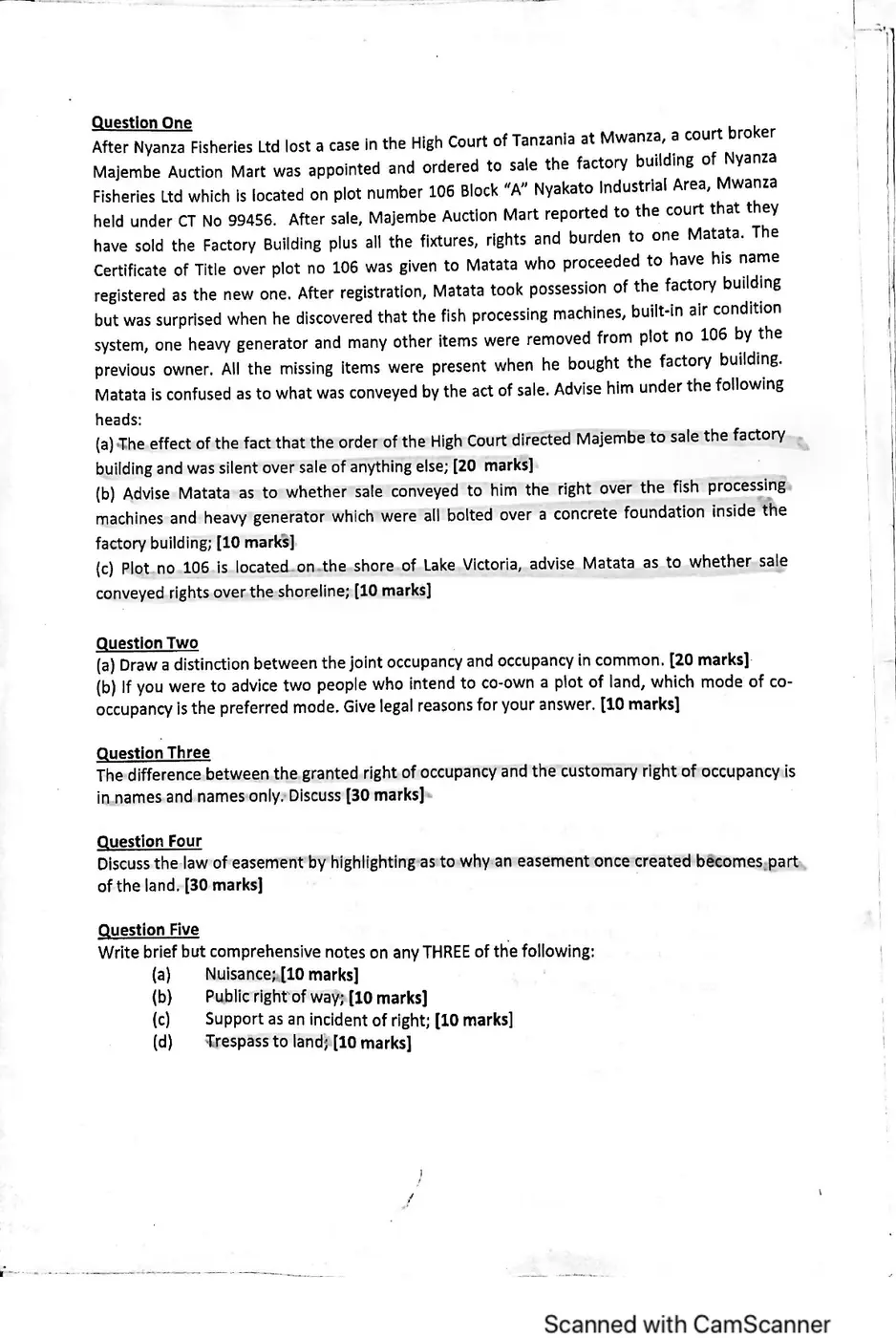
1. After Nyanza Fisheries Ltd lost a case in the High Court of Tanzania at Mwanza, a court broker, Majembe Auction Mart, was appointed and ordered to sell the factory building of Nyanza Fisheries Ltd which is located on Plot No. 106 Block “A” Nyakato Industrial Area, Mwanza, held under CT No. 99456. After the sale, Majembe Auction Mart reported to the court that they had sold the factory building plus all the fixtures, rights and burdens to one Matata. The Certificate of Title over Plot No. 106 was given to Matata, who proceeded to have his name registered as the new owner. After registration, Matata took possession of the factory building but was surprised when he discovered that the fish processing machines, built-in air conditioning system, one heavy generator and many other items had been removed from Plot No. 106 by the previous owner. All the missing items were present when he bought the factory building. Matata is confused as to what was conveyed by the act of sale. Advise him under the following heads: (a) the effect of the fact that the order of the High Court directed Majembe to sell the factory building and was silent over the sale of anything else [20 marks]; (b) whether the sale conveyed to him the right over the fish processing machines and heavy generator which were all bolted onto a concrete foundation inside the factory building [10 marks]; (c) Plot No. 106 is located on the shore of Lake Victoria; advise Matata as to whether the sale conveyed rights over the shoreline [10 marks].
2. (a) Draw a distinction between joint occupancy and occupancy in common. [20 marks] (b) If you were to advise two people who intend to co-own a plot of land, which mode of co-occupancy is the preferred mode? Give legal reasons for your answer. [10 marks]
3. “The difference between the granted right of occupancy and the customary right of occupancy is in names and names only.” Discuss. [30 marks]
4. Discuss the law of easements, highlighting why an easement once created becomes part of the land. [30 marks]
5. Write brief but comprehensive notes on any THREE of the following: (a) Nuisance [10 marks]; (b) Public right of way [10 marks]; (c) Support as an incident of right [10 marks]; (d) Trespass to land [10 marks].
Source: St. Augustine University of Tanzania examination paper, April 2021, shared for revision. Rights holders can ask for removal through our Contact page.
Part 2
Land Law I Past Paper Answers: Model Answers to All 5 Questions
Question 1 is answered in full below, free. Tap any other question to see it and a preview of its answer.
Q1Question 1: What passed on a court-ordered sale: the building, bolted machines and the Lake Victoria shoreline
40 marks · Problem · Compulsory Free answer
The question
After Nyanza Fisheries Ltd lost a case in the High Court of Tanzania at Mwanza, a court broker, Majembe Auction Mart, was appointed and ordered to sell the factory building of Nyanza Fisheries Ltd which is located on Plot No. 106 Block “A” Nyakato Industrial Area, Mwanza, held under CT No. 99456. After the sale, Majembe Auction Mart reported to the court that they had sold the factory building plus all the fixtures, rights and burdens to one Matata. The Certificate of Title over Plot No. 106 was given to Matata, who proceeded to have his name registered as the new owner. After registration, Matata took possession of the factory building but was surprised when he discovered that the fish processing machines, built-in air conditioning system, one heavy generator and many other items had been removed from Plot No. 106 by the previous owner. All the missing items were present when he bought the factory building. Matata is confused as to what was conveyed by the act of sale. Advise him under the following heads: (a) the effect of the fact that the order of the High Court directed Majembe to sell the factory building and was silent over the sale of anything else [20 marks]; (b) whether the sale conveyed to him the right over the fish processing machines and heavy generator which were all bolted onto a concrete foundation inside the factory building [10 marks]; (c) Plot No. 106 is located on the shore of Lake Victoria; advise Matata as to whether the sale conveyed rights over the shoreline [10 marks].
Model answer
The short answer
(a) an order to sell the “factory building” on a registered plot is, in law, an order to sell the judgment debtor’s interest in the land, because land includes buildings and everything permanently affixed to it; so the sale passed the right of occupancy with the building and its fixtures, but not loose chattels. (b) The machines and the generator bolted to a concrete foundation are very probably fixtures that passed to Matata, and the built-in air conditioning certainly is; the previous owner had no right to remove them. (c) The sale did not give Matata exclusive rights over the shoreline: land within 60 metres of the shoreline of an inland lake is hazardous land, a category of reserved land, and the law restricts activities there.
The Land Act sections below are from the current consolidation of Cap. 113. The paper allowed the R.E. 2019 edition; where the numbers differ, the 2019 number is given in brackets.
(a) The effect of an order to sell “the factory building”
- What “land” means: under section 2 of the Land Act, land includes the surface of the earth and the earth below it, things naturally growing on it, and buildings and other structures permanently affixed to or under land. A building on a plot is therefore part of the land, not a separate item; the old maxim quicquid plantatur solo, solo cedit (whatever is attached to the soil belongs to the soil) is reflected in the statutory definition.
- What a sale in execution passes: a court sale of immovable property under Order XXI of the Civil Procedure Code, Cap. 33 passes the judgment debtor’s right, title and interest in the property attached and sold, as described in the proclamation and the certificate of sale. Since a factory building cannot be sold apart from the plot it stands on, the order to sell “the factory building” on Plot No. 106 under CT No. 99456 is effectively an order to sell Nyanza Fisheries’ right of occupancy over the plot, with everything that forms part of the land.
- The court broker’s report: the broker could sell only what the court ordered. His statement that he sold “plus all fixtures, rights and burdens” does not enlarge the order, but it does not reduce what Matata got either: fixtures are part of the land and pass with it whether mentioned or not. Loose chattels (furniture, stock, movable tools) were not ordered to be sold and did not pass.
- Registration: once the transfer on the court sale was registered under the Land Registration Act, Cap. 334, Matata became the registered owner of the right of occupancy, and his title includes the land as defined.
- Advice: Matata owns the plot, the factory building and its fixtures. He should obtain the certificate of sale and the proclamation of sale from the executing court to confirm exactly what was attached and sold, and he can complain to that court or sue Nyanza Fisheries for the return of fixtures removed after the sale.
(b) The bolted machines, the generator and the air conditioning
- Test for fixtures: courts look at (i) the degree of annexation and (ii) the purpose of annexation. In Holland v Hodgson (1872) LR 7 CP 328, looms bolted to the stone floor of a mill were held to be fixtures that passed with the land to the mortgagee: things fixed to the land are presumed to be fixtures, and the burden is on the person claiming they are chattels. In Leigh v Taylor [1902] AC 157, tapestries attached to walls for their own better display remained chattels. The modern emphasis is on purpose: whether the item was fixed to improve the land permanently or merely for better use as a chattel: Elitestone Ltd v Morris [1997] 1 WLR 687.
- Application:
- The built-in air conditioning system is integrated into the building and serves the building itself: a fixture.
- The fish processing machines and the heavy generator are bolted to a concrete foundation inside a building designed as a fish processing factory. Like the looms in Holland v Hodgson, they were fixed to make the factory complete and usable as a factory, so they are presumed to be fixtures. Nyanza Fisheries would have to prove they were attached only temporarily for their own use, which is difficult given the concrete foundations.
- Items that merely rested by their own weight or were plugged in (computers, office furniture, portable equipment) are chattels and did not pass.
- Advice: the removal of the fixtures after the sale was wrongful. Matata may sue Nyanza Fisheries for their return or their value, and for damage caused to the building in removing them, or ask the executing court to deal with the interference with the property sold.
(c) Rights over the shoreline
- Hazardous and reserved land: land within sixty metres of a river bank or the shoreline of an inland lake, beach or coast is hazardous land (Land Act, section 7(1)(d)), and hazardous land is a category of reserved land (section 6(1)(e)). Reserved land is managed under the laws that reserve it, not as part of an ordinary right of occupancy.
- Environmental restrictions: the Environmental Management Act, Cap. 191 (section 57 in the 2019 revised edition) prohibits human activities that may affect the water body within sixty metres of a lake or river, unless permitted.
- Water: the waters of Lake Victoria are a public resource; a right of occupancy does not give ownership of the lake or exclusive control of its shore.
- Advice: Matata acquired only what Nyanza Fisheries held under CT No. 99456, according to the boundaries on the survey plan. Any part of the plot within 60 metres of the shoreline is subject to the hazardous-land and environmental restrictions; he cannot build on or exclude the public from the shoreline, and he needs permits for activities there (such as a jetty or water abstraction). He should check the title’s conditions and survey plan.
What the examiner wants
The statutory meaning of land, what passes on an execution sale, the fixtures tests with leading cases applied to each item, and the hazardous-land and environmental rules for the shoreline.
Common mistakes
- Saying only the building passed because the order did not mention the land or fixtures.
- Treating bolted machinery as automatically a chattel.
- Assuming a lakeside plot includes the shoreline.
Q2Question 2: Joint occupancy v occupancy in common, and which to advise
30 marks · Essay and advice Locked
The question
(a) Draw a distinction between joint occupancy and occupancy in common. [20 marks] (b) If you were to advise two people who intend to co-own a plot of land, which mode of co-occupancy is the preferred mode? Give legal reasons for your answer. [10 marks]
Model answer
Unlock the model answer to Question 2
Get all 4 locked answers on this paper for TSh 3,000. Pay once, keep them in Your Library for life.
Get the solved paper · TSh 3,000Or get every solved paper with Elite
Q3Question 3: Granted v customary rights of occupancy: only a difference in name?
30 marks · Essay Locked
The question
“The difference between the granted right of occupancy and the customary right of occupancy is in names and names only.” Discuss. [30 marks]
Model answer
Unlock the model answer to Question 3
Get all 4 locked answers on this paper for TSh 3,000. Pay once, keep them in Your Library for life.
Get the solved paper · TSh 3,000Or get every solved paper with Elite
Q4Question 4: Easements and why they become part of the land
30 marks · Essay Locked
The question
Discuss the law of easements, highlighting why an easement once created becomes part of the land. [30 marks]
Model answer
Unlock the model answer to Question 4
Get all 4 locked answers on this paper for TSh 3,000. Pay once, keep them in Your Library for life.
Get the solved paper · TSh 3,000Or get every solved paper with Elite
Q5Question 5: Short notes: nuisance, public right of way, support, trespass to land
30 marks · Short notes Locked
The question
Write brief but comprehensive notes on any THREE of the following: (a) Nuisance [10 marks]; (b) Public right of way [10 marks]; (c) Support as an incident of right [10 marks]; (d) Trespass to land [10 marks].
Model answer
Unlock the model answer to Question 5
Get all 4 locked answers on this paper for TSh 3,000. Pay once, keep them in Your Library for life.
Get the solved paper · TSh 3,000Or get every solved paper with Elite
Get the Full Solved Paper
All 5 questions answered with the statutes and cases that apply, what the examiner wants and the mistakes to avoid. TSh 3,000, yours for life in Your Library.
Pata majibu yote ya mtihani huu kwa TSh 3,000 tu.




Statutes and Cases for This Land Law I Past Paper
- Land Act, Cap. 113 (current TanzLII consolidation)Definition of land (s.2), reserved and hazardous land (ss.6-7), easements (ss.153-160), public rights of way (s.161), court powers over easements (ss.167-168), co-occupancy (s.169), spouses (s.171), partition (s.172)
- Village Land Act, Cap. 114Equal status of customary rights (s.18(1)), grant by village council with village assembly approval (ss.8(5), 25), term (s.27)
- Land Registration Act, Cap. 334Registration of transfers and title
- Environmental Management Act, Cap. 191Restrictions on activities near lakes and rivers
- Civil Procedure Code, Cap. 33Sale of immovable property in execution (Order XXI)
- Holland v Hodgson (1872) LR 7 CP 328Fixtures: degree and purpose of annexation
- Leigh v Taylor [1902] AC 157 (HL)Items attached for their own enjoyment remain chattels
- Elitestone Ltd v Morris [1997] 1 WLR 687 (HL)When a structure becomes part of the land
- Attorney General v Lohay Akonaay and Joseph Lohay [1995] TLR 80 (CA)Customary rights are property protected by the Constitution
- Re Ellenborough Park [1956] Ch 131 (CA)Characteristics of an easement
- St Helen's Smelting Co v Tipping (1865) 11 HL Cas 642; Sturges v Bridgman (1879) 11 Ch D 852Nuisance
- Dalton v Angus (1881) 6 App Cas 740 (HL)Right of support
SAUT Land Law I Past Paper: Common Questions
Is this the real SAUT Land Law I exam paper?
Yes. These are scans of the First Semester Final Examination 2020/2021 paper for SLW 302 Land Law I at St. Augustine University of Tanzania, sat on 12 April 2021. Nothing has been retyped or changed.
How many questions do you answer in this Land Law I paper?
Five questions. Answer three; Question 1 is compulsory (40 marks). Other questions carry 30 marks. Listed land statutes allowed.
Are there answers to this past paper?
Yes. All 5 questions have full model answers written to Tanzanian law and reviewed by Isack Kimaro, LL.B, PDLP. The Question 1 answer is free; the full solved paper is TSh 3,000 (TSh 2,000 for Pro members) and is included in Elite.
How do I see every page of the paper?
The first pages are open to everyone. Create a free account to read the whole paper.