

About this paper
Solved answers to all 5 questions
Part 1
SAUT Intellectual Property Law Past Paper (SLW 246): The Full Exam as Set
Five questions. Answer three, including Question 2 (40 marks). Other questions carry 30 marks. Closed book.
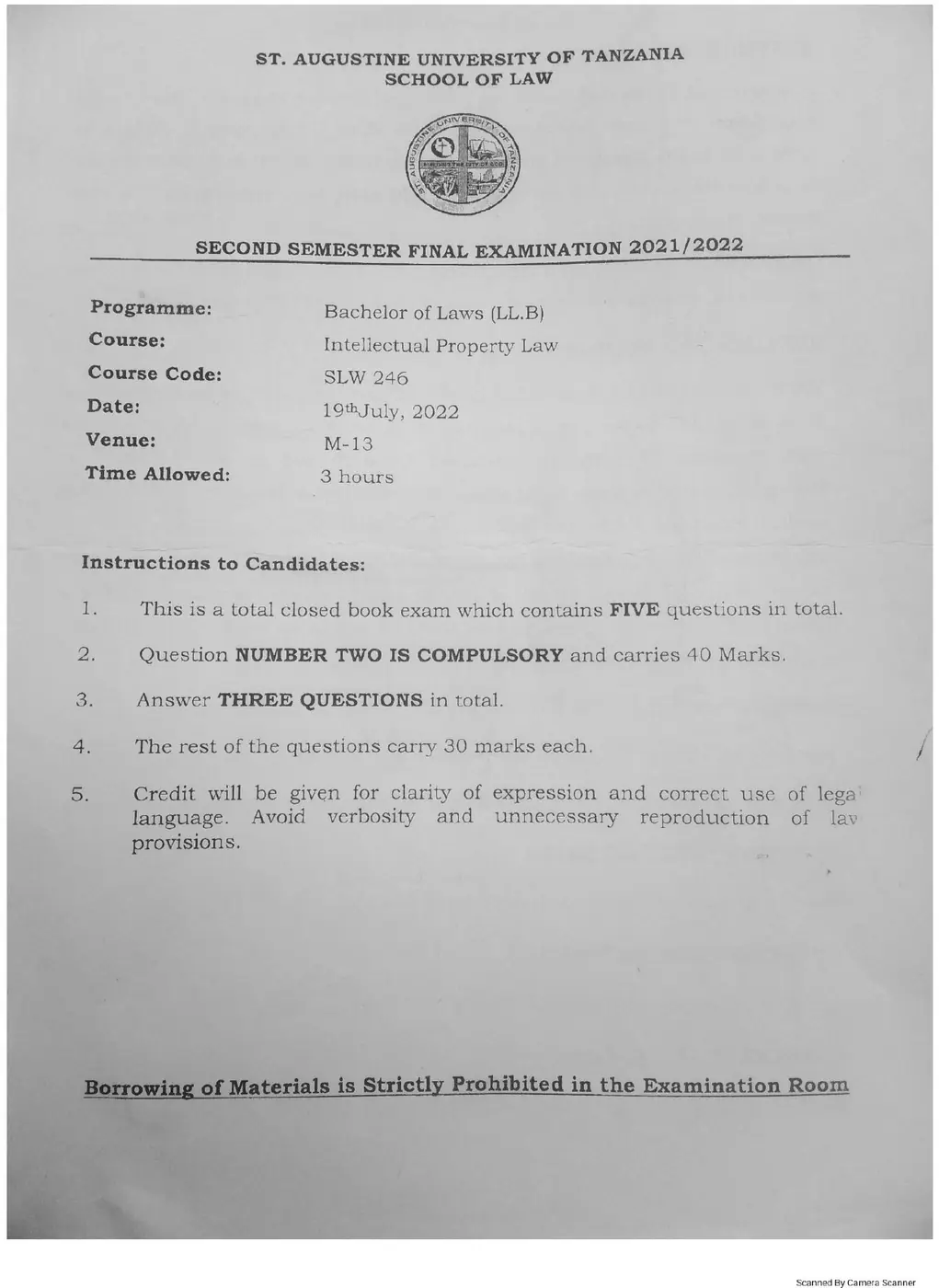
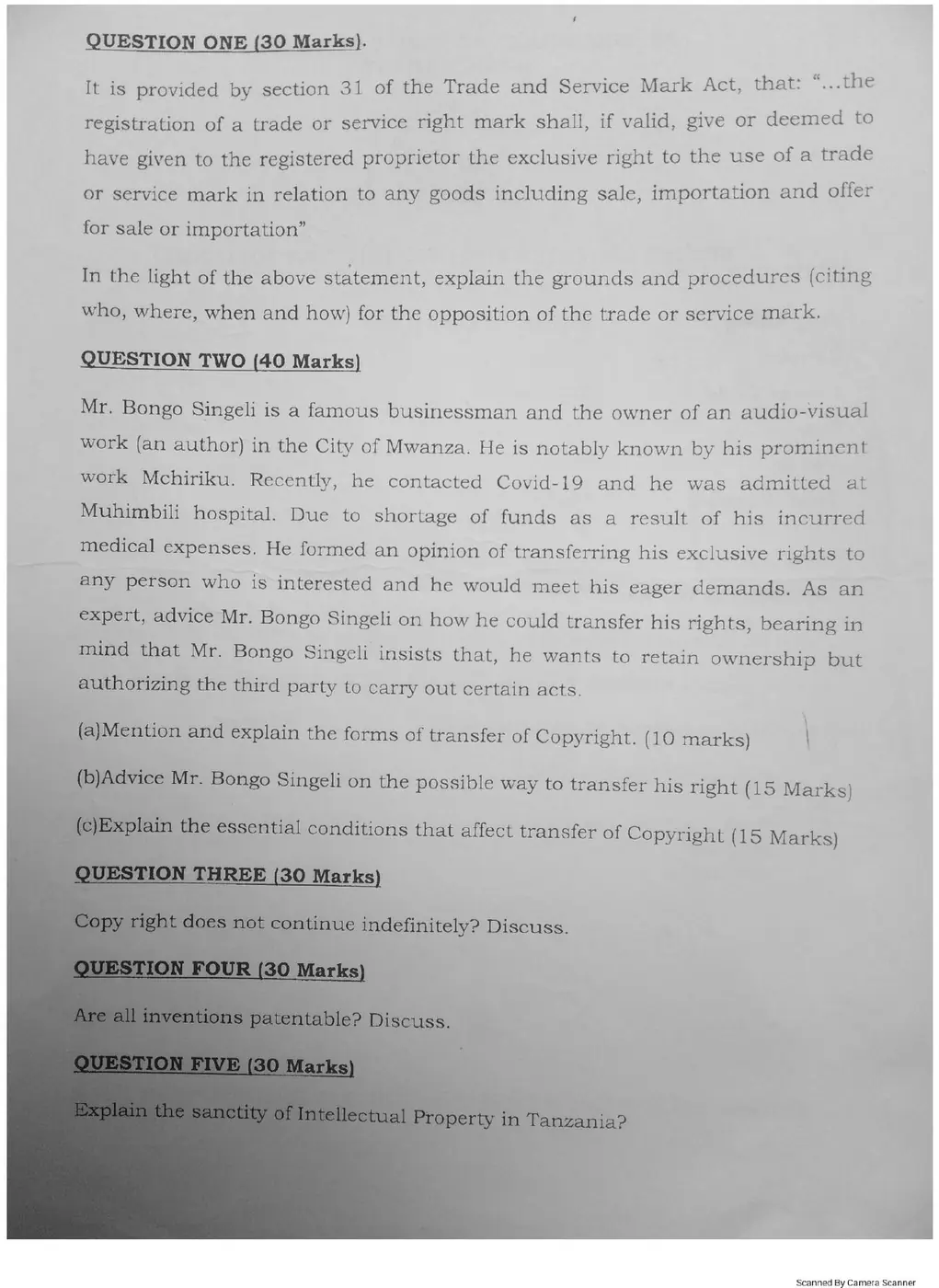
Read the questions as text
1. It is provided by section 31 of the Trade and Service Marks Act, that: “…the registration of a trade or service right mark shall, if valid, give or deemed to have given to the registered proprietor the exclusive right to the use of a trade or service mark in relation to any goods including sale, importation and offer for sale or importation.” In the light of the above statement, explain the grounds and procedures (citing who, where, when and how) for the opposition of the trade or service mark. (30 marks)
2. Mr. Bongo Singeli is a famous businessman and the owner of an audio-visual work (an author) in the City of Mwanza. He is notably known by his prominent work Mchiriku. Recently, he contracted Covid-19 and he was admitted at Muhimbili hospital. Due to shortage of funds as a result of his incurred medical expenses, he formed an opinion of transferring his exclusive rights to any person who is interested and would meet his eager demands. As an expert, advise Mr. Bongo Singeli on how he could transfer his rights, bearing in mind that Mr. Bongo Singeli insists that he wants to retain ownership but authorizing the third party to carry out certain acts.
- Mention and explain the forms of transfer of copyright. (10 marks)
- Advise Mr. Bongo Singeli on the possible way to transfer his right. (15 marks)
- Explain the essential conditions that affect transfer of copyright. (15 marks)
3. Copyright does not continue indefinitely? Discuss. (30 marks)
4. Are all inventions patentable? Discuss. (30 marks)
5. Explain the sanctity of Intellectual Property in Tanzania. (30 marks)
Source: St. Augustine University of Tanzania examination paper, July 2022, shared for revision. Rights holders can ask for removal through our Contact page.
Part 2
Intellectual Property Law Past Paper Answers: Model Answers to All 5 Questions
Question 2 is answered in full below, free. Tap any other question to see it and a preview of its answer.
Q1Question 1: Opposing a trade or service mark: grounds, who, where, when and how
30 marks · essay Locked
The question
It is provided by section 31 of the Trade and Service Marks Act, that: “…the registration of a trade or service right mark shall, if valid, give or deemed to have given to the registered proprietor the exclusive right to the use of a trade or service mark in relation to any goods including sale, importation and offer for sale or importation.” In the light of the above statement, explain the grounds and procedures (citing who, where, when and how) for the opposition of the trade or service mark. (30 marks)
Model answer
Unlock the model answer to Question 1
Get all 4 locked answers on this paper for TSh 3,000. Pay once, keep them in Your Library for life.
Get the solved paper · TSh 3,000Or get every solved paper with Elite
Q2Question 2: Bongo Singeli's audio-visual work: assignment or licence
40 marks · problem Free answer
The question
Mr. Bongo Singeli is a famous businessman and the owner of an audio-visual work (an author) in the City of Mwanza. He is notably known by his prominent work Mchiriku. Recently, he contracted Covid-19 and he was admitted at Muhimbili hospital. Due to shortage of funds as a result of his incurred medical expenses, he formed an opinion of transferring his exclusive rights to any person who is interested and would meet his eager demands. As an expert, advise Mr. Bongo Singeli on how he could transfer his rights, bearing in mind that Mr. Bongo Singeli insists that he wants to retain ownership but authorizing the third party to carry out certain acts.
- Mention and explain the forms of transfer of copyright. (10 marks)
- Advise Mr. Bongo Singeli on the possible way to transfer his right. (15 marks)
- Explain the essential conditions that affect transfer of copyright. (15 marks)
Model answer
The short answer
Copyright can be transferred by assignment (ownership passes), by licence (permission only; the author keeps ownership), or by operation of law such as succession. Because Bongo Singeli wants to keep ownership while letting others use Mchiriku, he should grant a licence, not an assignment. An exclusive licence will earn more money but shuts out everyone else, including him, and must be in a written contract signed by the parties; a non-exclusive licence lets him license several users. The contract must state exactly which rights, territory, term and royalty, and he keeps his moral rights.
(a) Forms of transfer of copyright (10 marks)
- Assignment: the economic rights in s.9 (reproduction, distribution, rental, broadcasting, adaptation, communication to the public and others) may be assigned wholly or partly (Copyright and Neighbouring Rights Act, Cap. 218, s.19(1)). The assignee becomes the owner of the rights assigned. It must be in writing and signed (s.19(2)).
- Licence: the owner authorises another to do specified acts while remaining the owner (s.20(1)).
- Non-exclusive licence: the licensee may act alongside the owner and other licensees (s.20(2)).
- Exclusive licence: the licensee may act to the exclusion of everyone, including the owner, and may sue infringers in his own name (s.20(3)–(4)).
- Transmission by operation of law: on death the rights pass under the law of succession (s.17(7)).
- Transfer in employment and audio-visual works: works made under a contract of employment are deemed assigned to the employer to the extent of the employer’s customary activities, unless otherwise agreed (s.17(4)); contributions to an audio-visual work are presumed assigned to the producer unless the contract says otherwise (s.17(3)).
Note: older editions number these provisions ss.15–18 (ownership, assignment, licences, transfer). Cite the current numbering, but recognise both.
(b) Advice to Bongo Singeli (15 marks)
- Confirm what he owns. In an audio-visual work the economic rights initially belong to the co-authors (script, dialogue, music composer, director), and contributions are presumed assigned to the producer (s.17(2)–(3)). He should check that he holds all the economic rights in Mchiriku, by contracts or assignments from contributors, before licensing.
- Grant a licence, not an assignment. His wish to keep ownership while allowing others to act rules out assignment. A licence lets him remain the owner and receive royalties or a lump sum.
- Choose the type of licence:
- An exclusive licence commands a higher fee, which suits his urgent need for money, but during its term even he cannot exploit the licensed rights. It must be in writing signed by the parties (s.20(8)).
- Non-exclusive licences let him license several users (for example a broadcaster, an online platform and a DVD distributor) and spread his income.
- Draft the contract carefully: identify the work; list the specific rights licensed (for example broadcasting and online distribution); set the territory (Tanzania, East Africa, worldwide); fix the term (if silent, a licence lapses after 15 years: s.20(7)); set the price or royalty and reporting; prohibit sub-licensing without his consent (s.21); include termination for non-payment.
- Protect his moral rights: he keeps the right to be named as author and to object to distortion (s.11); the contract should require attribution and forbid mutilating edits.
- Use COSOTA: he may register the work and the licence with the Copyright Society of Tanzania for evidence and royalty collection.
- Protect against unfair deals: if the fee turns out grossly disproportionate to the licensee’s income from the work, he can ask for an equitable share (s.22). Because he is under financial pressure, he should take legal advice to avoid a hasty, undervalued deal.
(c) Essential conditions affecting transfer (15 marks)
- Writing and signature: an assignment must be in writing and signed (s.19(2)); an exclusive licence must be in a written contract signed by the parties (s.20(8)).
- Scope limited to what is stated: assigning some rights does not transfer others (s.19(3)); a licence covers only the rights expressly mentioned and, if the scope is unclear, only what is reasonably necessary for the parties’ purpose (s.20(5)–(6)).
- Future works: an assignment of rights in future works is void (s.19(4)), although contracts to grant rights in future works are regulated separately (s.24).
- Owning a copy is not owning the copyright: transferring the original or a copy does not transfer copyright (s.19(5)).
- Moral rights stay with the author: transfer provisions cover the s.9 economic rights; the author keeps the moral rights in s.11.
- Duration: only rights still in force can be transferred, and a licence cannot outlast the copyright term (s.16).
- No onward transfer without consent: a user may transfer rights received only with the owner’s consent (s.21).
- General contract law: capacity, free consent, lawful object and consideration (Law of Contract Act, Cap. 345). A transfer obtained by undue influence or misrepresentation, a risk when the author is ill and desperate, is voidable.
What the examiner wants
Clear distinction between assignment and licence, the right recommendation (a licence) linked to his wish to keep ownership, attention to audio-visual ownership, and the statutory conditions.
Common mistakes
- Recommending an assignment when he wants to keep ownership.
- Ignoring the writing requirement and moral rights.
Q3Question 3: Copyright does not last forever: duration and the public domain
30 marks · essay Locked
The question
Copyright does not continue indefinitely? Discuss. (30 marks)
Model answer
Unlock the model answer to Question 3
Get all 4 locked answers on this paper for TSh 3,000. Pay once, keep them in Your Library for life.
Get the solved paper · TSh 3,000Or get every solved paper with Elite
Q4Question 4: Are all inventions patentable?
30 marks · essay Locked
The question
Are all inventions patentable? Discuss. (30 marks)
Model answer
Unlock the model answer to Question 4
Get all 4 locked answers on this paper for TSh 3,000. Pay once, keep them in Your Library for life.
Get the solved paper · TSh 3,000Or get every solved paper with Elite
Q5Question 5: The sanctity of intellectual property in Tanzania
30 marks · essay Locked
The question
Explain the sanctity of Intellectual Property in Tanzania. (30 marks)
Model answer
Unlock the model answer to Question 5
Get all 4 locked answers on this paper for TSh 3,000. Pay once, keep them in Your Library for life.
Get the solved paper · TSh 3,000Or get every solved paper with Elite
Get the Full Solved Paper
All 5 questions answered with the statutes and cases that apply, what the examiner wants and the mistakes to avoid. TSh 3,000, yours for life in Your Library.
Pata majibu yote ya mtihani huu kwa TSh 3,000 tu.




Statutes and Cases for This Intellectual Property Law Past Paper
- Copyright and Neighbouring Rights Act, Cap. 218 (current text)s.9 economic rights, s.11 moral rights, s.16 duration, s.17 ownership, s.19 assignment, s.20 licences, s.21 transfer by user, s.22 disproportionate remuneration (older editions: ss.14–19)
- Trade and Service Marks Act, Cap. 326 R.E. 2002Part IV registrability (incl. s.20 resembling marks), s.27 opposition, s.29 term and renewal, s.31 rights of the registered proprietor
- Trade and Service Marks Regulations, GN No. 40 of 2000regs 34–39 opposition, notice, counter-statement and evidence
- Patents (Registration) Act, Cap. 217 R.E. 2002s.7 definition and exclusions, s.8 patentable invention, ss.9–11 novelty, inventive step, industrial application, s.12 public order and morality, s.13 temporary exclusion
- Merchandise Marks Act, Cap. 85Counterfeit goods
- Constitution of the United Republic of Tanzania, 1977Art. 24 (right to own property)
- TRIPS Agreement (WTO)Minimum standards of IP protection
SAUT Intellectual Property Law Past Paper: Common Questions
Is this the real SAUT Intellectual Property Law exam paper?
Yes. These are scans of the Second Semester Final Examination 2021/2022 paper for SLW 246 Intellectual Property Law at St. Augustine University of Tanzania, sat on 19 July 2022. Nothing has been retyped or changed.
How many questions do you answer in this Intellectual Property Law paper?
Five questions. Answer three, including Question 2 (40 marks). Other questions carry 30 marks. Closed book.
Are there answers to this past paper?
Yes. All 5 questions have full model answers written to Tanzanian law and reviewed by Isack Kimaro, LL.B, PDLP. The Question 1 answer is free; the full solved paper is TSh 3,000 (TSh 2,000 for Pro members) and is included in Elite.
How do I see every page of the paper?
The first pages are open to everyone. Create a free account to read the whole paper.