

About this paper
Solved answers to all 5 questions
Part 1
SAUT Human Rights Law Past Paper (SLW 127): The Full Exam as Set
Five questions. Answer three, including Question 1 (40 marks). Other questions carry 30 marks. Partial open book.
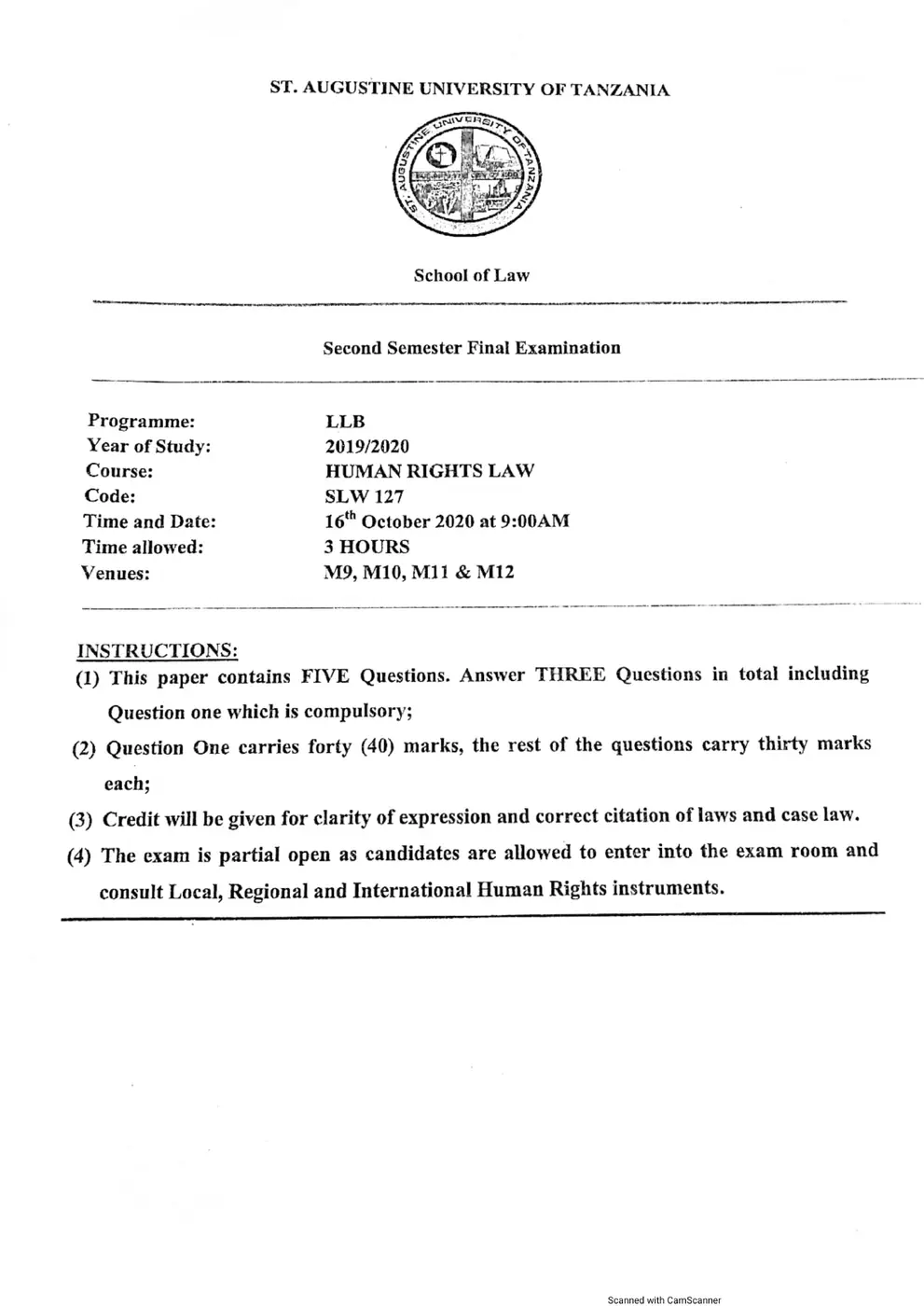
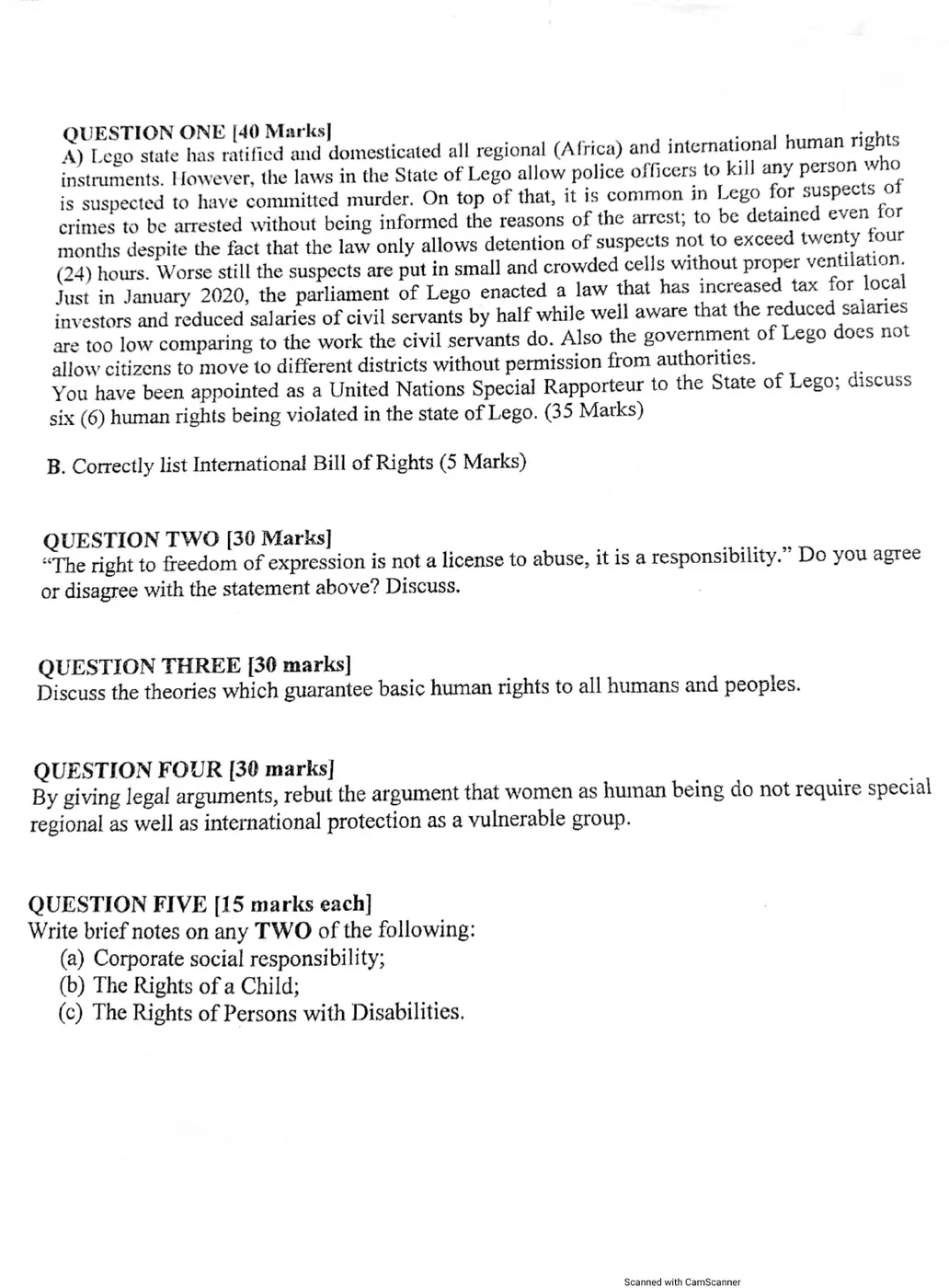
Read the questions as text
This paper contains FIVE questions. Answer THREE questions in total including Question One, which is compulsory. Question One carries forty (40) marks; the rest of the questions carry thirty marks each. Credit will be given for clarity of expression and correct citation of laws and case law. The exam is partial open: candidates may consult local, regional and international human rights instruments.
1. (40 marks) (A) Lego state has ratified and domesticated all regional (Africa) and international human rights instruments. However, the laws in the State of Lego allow police officers to kill any person who is suspected to have committed murder. On top of that, it is common in Lego for suspects of crimes to be arrested without being informed of the reasons for the arrest, and to be detained even for months despite the fact that the law only allows detention of suspects not to exceed twenty-four (24) hours. Worse still, the suspects are put in small and crowded cells without proper ventilation. Just in January 2020, the parliament of Lego enacted a law that has increased tax for local investors and reduced salaries of civil servants by half, while well aware that the reduced salaries are too low compared to the work the civil servants do. Also the government of Lego does not allow citizens to move to different districts without permission from authorities. You have been appointed as a United Nations Special Rapporteur to the State of Lego; discuss six (6) human rights being violated in the State of Lego. (35 marks) (B) Correctly list the International Bill of Rights. (5 marks)
2. (30 marks) “The right to freedom of expression is not a licence to abuse; it is a responsibility.” Do you agree or disagree with the statement above? Discuss.
3. (30 marks) Discuss the theories which guarantee basic human rights to all humans and peoples.
4. (30 marks) By giving legal arguments, rebut the argument that women as human beings do not require special regional as well as international protection as a vulnerable group.
5. (15 marks each) Write brief notes on any TWO of the following: (a) Corporate social responsibility; (b) The rights of a child; (c) The rights of persons with disabilities.
Source: St. Augustine University of Tanzania examination paper, October 2020, shared for revision. Rights holders can ask for removal through our Contact page.
Part 2
Human Rights Law Past Paper Answers: Model Answers to All 5 Questions
Question 1 is answered in full below, free. Tap any other question to see it and a preview of its answer.
Q1Question 1: Special Rapporteur's report on six rights violated in Lego; the International Bill of Rights
40 marks · Problem · Compulsory Free answer
The question
(40 marks) (A) Lego state has ratified and domesticated all regional (Africa) and international human rights instruments. However, the laws in the State of Lego allow police officers to kill any person who is suspected to have committed murder. On top of that, it is common in Lego for suspects of crimes to be arrested without being informed of the reasons for the arrest, and to be detained even for months despite the fact that the law only allows detention of suspects not to exceed twenty-four (24) hours. Worse still, the suspects are put in small and crowded cells without proper ventilation. Just in January 2020, the parliament of Lego enacted a law that has increased tax for local investors and reduced salaries of civil servants by half, while well aware that the reduced salaries are too low compared to the work the civil servants do. Also the government of Lego does not allow citizens to move to different districts without permission from authorities. You have been appointed as a United Nations Special Rapporteur to the State of Lego; discuss six (6) human rights being violated in the State of Lego. (35 marks) (B) Correctly list the International Bill of Rights. (5 marks)
Model answer
The short answer
Lego violates (1) the right to life, (2) freedom from torture and cruel, inhuman or degrading treatment, (3) the right to liberty and security of person, (4) the right of detainees to humane treatment, (5) the right to just and favourable conditions of work (with a possible property and non-discrimination issue from the investor tax), and (6) freedom of movement. Because Lego has ratified and domesticated the instruments, it cannot rely on its own laws to excuse these violations. The International Bill of Rights is the UDHR, the ICCPR with its two Optional Protocols, and the ICESCR (with its Optional Protocol).
(A) Six rights violated
Preliminary point: a state that has ratified a treaty must perform it in good faith and may not invoke its internal law as a justification for failing to do so (Vienna Convention on the Law of Treaties, 1969, articles 26 and 27). Lego’s domestic laws therefore offer no defence.
- The right to life. A law allowing police to kill anyone merely suspected of murder authorises arbitrary deprivation of life. Every human being has the inherent right to life, and no one shall be arbitrarily deprived of it (ICCPR art. 6; African Charter art. 4; UDHR art. 3; Tanzanian Constitution art. 14). International standards allow intentional lethal force only when strictly unavoidable to protect life (UN Basic Principles on the Use of Force and Firearms by Law Enforcement Officials, 1990, principle 9). Suspicion of a past crime is never enough; a suspect must be arrested and tried. Recommendation: repeal the law and prosecute unlawful killings.
- The right to liberty and security of person, including to be told the reasons for arrest. Anyone arrested must be informed at the time of arrest of the reasons and promptly of any charges, and must be brought promptly before a judge (ICCPR art. 9(1) to (3); African Charter art. 6; Tanzanian Constitution art. 15). Arrests without reasons and detention for months, against Lego’s own 24-hour limit, are arbitrary detention. (In Tanzania, the Criminal Procedure Act similarly requires a suspect to be brought before a court within 24 hours where practicable.) Recommendation: release or charge detainees, and allow judicial review of detention (habeas corpus).
- Freedom from torture and cruel, inhuman or degrading treatment. Holding people in small, crowded, unventilated cells for months may amount to inhuman or degrading treatment (ICCPR art. 7; African Charter art. 5; UN Convention against Torture, 1984; Tanzanian Constitution art. 13(6)(e)).
- The right of detainees to humane treatment and dignity. All persons deprived of liberty must be treated with humanity and respect for their inherent dignity (ICCPR art. 10(1)). The UN Standard Minimum Rules for the Treatment of Prisoners (the Nelson Mandela Rules, 2015) require adequate space, ventilation, light and sanitation. Recommendation: decongest cells and set up independent inspection.
- The right to just and favourable conditions of work. Halving civil servants’ salaries to a level the government knows is too low for the work done violates the right to fair wages and a decent living (ICESCR arts. 6 and 7; African Charter art. 15, which guarantees work under equitable and satisfactory conditions and equal pay for equal work; Tanzanian Constitution art. 23, the right to just remuneration). Economic hardship may justify temporary measures, but they must be necessary, proportionate, non-discriminatory and adopted after consultation, and must not fall below a minimum core. On the investor tax: taxation is a legitimate state power, so higher tax alone is not a violation; it would raise issues only if it were arbitrary, confiscatory or discriminatory against local investors (African Charter arts. 2, 3 and 14 on non-discrimination, equality and property).
- Freedom of movement. Everyone lawfully within a state has the right to move freely within it and choose their residence (ICCPR art. 12(1); African Charter art. 12(1); UDHR art. 13; Tanzanian Constitution art. 17). Restrictions are allowed only if provided by law and necessary for national security, public order, public health or morals, or the rights of others (ICCPR art. 12(3)). A general requirement to obtain permission to move between districts is disproportionate.
The Special Rapporteur should report these findings to the UN Human Rights Council with recommendations, and Lego remains bound to provide effective remedies to victims (ICCPR art. 2(3)).
(B) The International Bill of Rights
- The Universal Declaration of Human Rights, 1948.
- The International Covenant on Civil and Political Rights, 1966, with its First Optional Protocol, 1966 (individual complaints) and Second Optional Protocol, 1989 (abolition of the death penalty).
- The International Covenant on Economic, Social and Cultural Rights, 1966 (with its Optional Protocol, 2008).
What the examiner wants
Six distinct rights, each with the facts that violate it, the international, regional and Tanzanian provisions, any permitted limitations, and recommendations; then an accurate list of the International Bill of Rights.
Common mistakes
- Listing rights without linking them to the facts.
- Treating any tax increase as a human rights violation.
- Leaving the Optional Protocols out of the International Bill of Rights.
Q2Question 2: Freedom of expression: a right with responsibilities
30 marks · Essay Locked
The question
(30 marks) “The right to freedom of expression is not a licence to abuse; it is a responsibility.” Do you agree or disagree with the statement above? Discuss.
Model answer
Unlock the model answer to Question 2
Get all 4 locked answers on this paper for TSh 3,000. Pay once, keep them in Your Library for life.
Get the solved paper · TSh 3,000Or get every solved paper with Elite
Q3Question 3: Theories of human rights
30 marks · Essay Locked
The question
(30 marks) Discuss the theories which guarantee basic human rights to all humans and peoples.
Model answer
Unlock the model answer to Question 3
Get all 4 locked answers on this paper for TSh 3,000. Pay once, keep them in Your Library for life.
Get the solved paper · TSh 3,000Or get every solved paper with Elite
Q4Question 4: Why women need special regional and international protection
30 marks · Essay Locked
The question
(30 marks) By giving legal arguments, rebut the argument that women as human beings do not require special regional as well as international protection as a vulnerable group.
Model answer
Unlock the model answer to Question 4
Get all 4 locked answers on this paper for TSh 3,000. Pay once, keep them in Your Library for life.
Get the solved paper · TSh 3,000Or get every solved paper with Elite
Q5Question 5: Short notes: corporate social responsibility, rights of the child, rights of persons with disabilities
30 marks · Short notes Locked
The question
(15 marks each) Write brief notes on any TWO of the following: (a) Corporate social responsibility; (b) The rights of a child; (c) The rights of persons with disabilities.
Model answer
Unlock the model answer to Question 5
Get all 4 locked answers on this paper for TSh 3,000. Pay once, keep them in Your Library for life.
Get the solved paper · TSh 3,000Or get every solved paper with Elite
Get the Full Solved Paper
All 5 questions answered with the statutes and cases that apply, what the examiner wants and the mistakes to avoid. TSh 3,000, yours for life in Your Library.
Pata majibu yote ya mtihani huu kwa TSh 3,000 tu.




Statutes and Cases for This Human Rights Law Past Paper
- Universal Declaration of Human Rights, 1948Foundational statement of rights
- International Covenant on Civil and Political Rights, 1966Life (art. 6), torture (art. 7), liberty (art. 9), humane detention (art. 10), movement (art. 12), expression (arts. 19-20)
- International Covenant on Economic, Social and Cultural Rights, 1966Work and just conditions of work (arts. 6-7)
- African Charter on Human and Peoples' Rights, 1981Life (art. 4), dignity (art. 5), liberty (art. 6), expression (art. 9), movement (art. 12), property (art. 14), work and equal pay (art. 15), women (art. 18(3)), duties (arts. 27-29)
- Convention on the Elimination of All Forms of Discrimination against Women, 1979; Maputo Protocol, 2003Women's rights
- Convention on the Rights of the Child, 1989; African Charter on the Rights and Welfare of the Child, 1990Children's rights
- Convention on the Rights of Persons with Disabilities, 2006; Persons with Disabilities Act, 2010Disability rights
- Constitution of the United Republic of Tanzania, 1977Basic rights (arts. 12-24), limitations (art. 30)
- UN Basic Principles on the Use of Force and Firearms by Law Enforcement Officials, 1990Lethal force only to protect life
- UN Guiding Principles on Business and Human Rights, 2011Corporate responsibility to respect human rights
- Lohé Issa Konaté v Burkina Faso (African Court, 2014)Criminal defamation and freedom of expression
- Attorney General v Rebeca Z. Gyumi [2019] TZCA 348Child marriage provisions unconstitutional
SAUT Human Rights Law Past Paper: Common Questions
Is this the real SAUT Human Rights Law exam paper?
Yes. These are scans of the Second Semester Final Examination 2019/2020 paper for SLW 127 Human Rights Law at St. Augustine University of Tanzania, sat on 16 October 2020. Nothing has been retyped or changed.
How many questions do you answer in this Human Rights Law paper?
Five questions. Answer three, including Question 1 (40 marks). Other questions carry 30 marks. Partial open book.
Are there answers to this past paper?
Yes. All 5 questions have full model answers written to Tanzanian law and reviewed by Isack Kimaro, LL.B, PDLP. The Question 1 answer is free; the full solved paper is TSh 3,000 (TSh 2,000 for Pro members) and is included in Elite.
How do I see every page of the paper?
The first pages are open to everyone. Create a free account to read the whole paper.