

About this paper
Solved answers to all 5 questions
Part 1
SAUT Civil Procedure II Past Paper (SLW 221): The Full Exam as Set
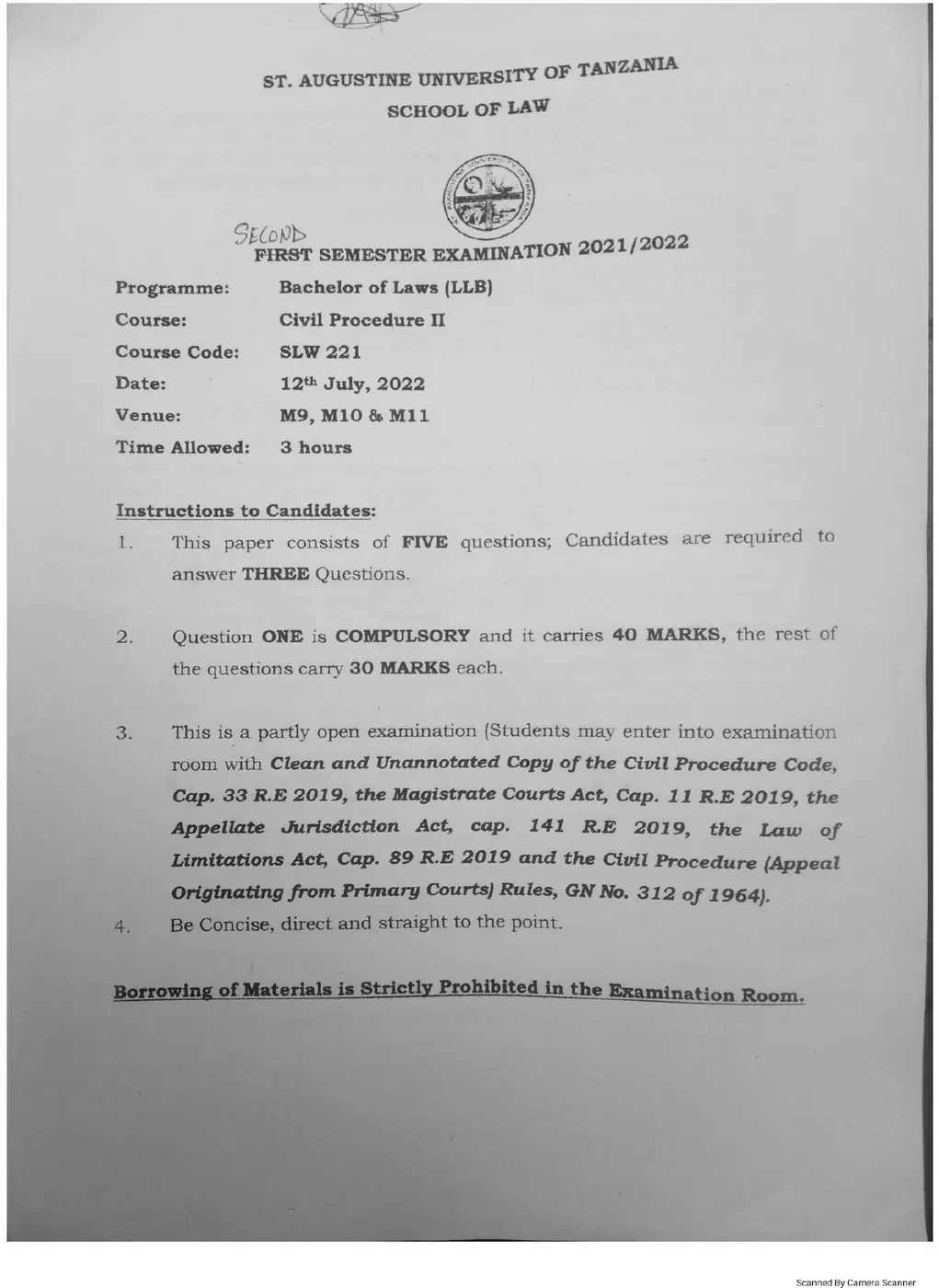
Five questions. Answer three. Question 1 is compulsory (40 marks); the rest carry 30 marks. The Civil Procedure Code allowed.
Read the questions as text
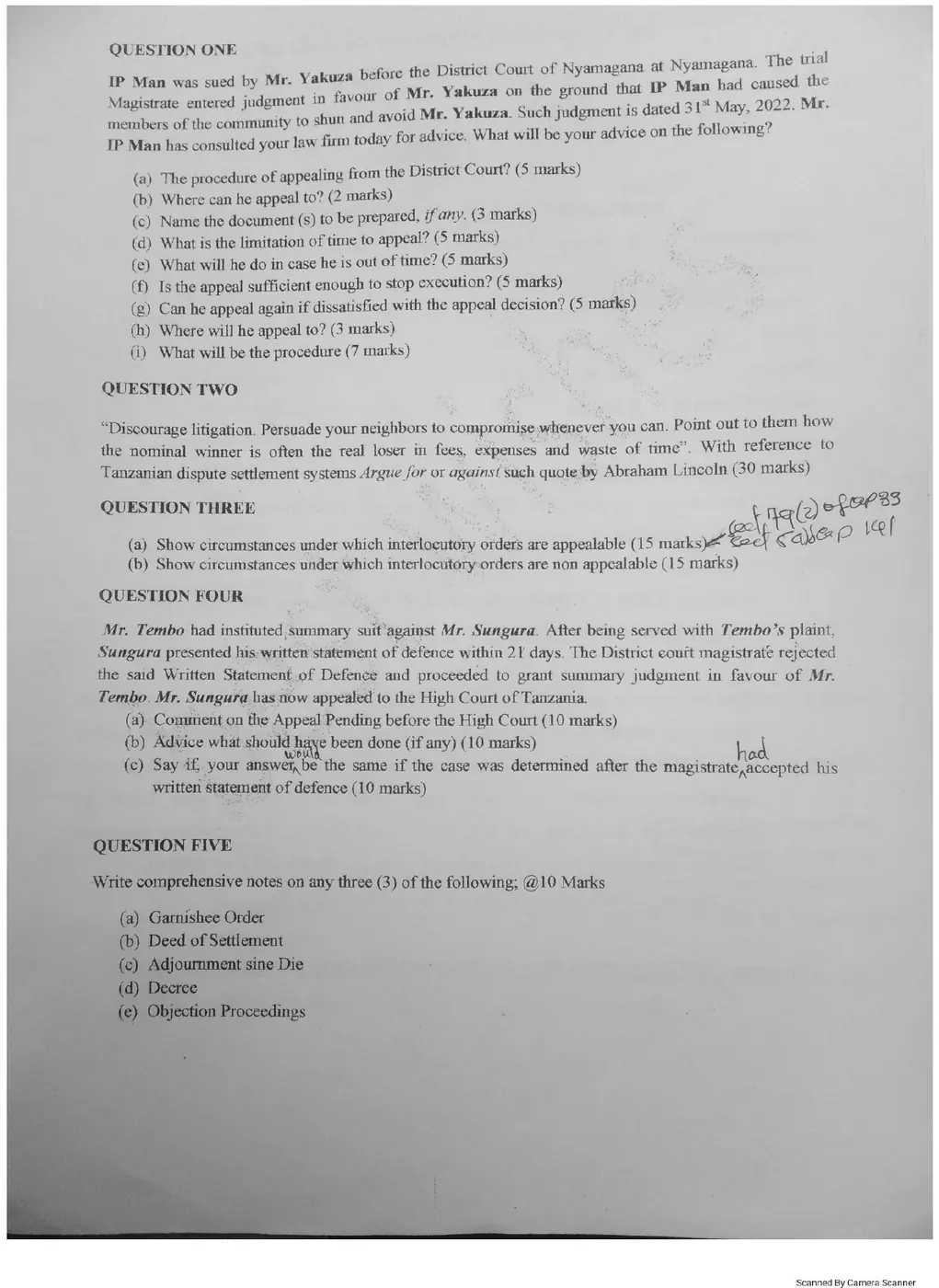
1. IP Man was sued by Mr. Yakuza before the District Court of Nyamagana at Nyamagana. The trial Magistrate entered judgment in favour of Mr. Yakuza on the ground that IP Man had caused the members of the community to shun and avoid Mr. Yakuza. Such judgment is dated 31st May, 2022. Mr. IP Man has consulted your law firm today for advice. What will be your advice on the following?
- The procedure of appealing from the District Court? (5 marks)
- Where can he appeal to? (2 marks)
- Name the document(s) to be prepared, if any. (3 marks)
- What is the limitation of time to appeal? (5 marks)
- What will he do in case he is out of time? (5 marks)
- Is the appeal sufficient enough to stop execution? (5 marks)
- Can he appeal again if dissatisfied with the appeal decision? (5 marks)
- Where will he appeal to? (3 marks)
- What will be the procedure? (7 marks)
2. “Discourage litigation. Persuade your neighbors to compromise whenever you can. Point out to them how the nominal winner is often the real loser in fees, expenses and waste of time.” With reference to Tanzanian dispute settlement systems, argue for or against such quote by Abraham Lincoln. (30 marks)
3. (a) Show circumstances under which interlocutory orders are appealable. (15 marks)
(b) Show circumstances under which interlocutory orders are non-appealable. (15 marks)
4. Mr. Tembo had instituted a summary suit against Mr. Sungura. After being served with Tembo’s plaint, Sungura presented his written statement of defence within 21 days. The District Court magistrate rejected the said Written Statement of Defence and proceeded to grant summary judgment in favour of Mr. Tembo. Mr. Sungura has now appealed to the High Court of Tanzania.
- Comment on the appeal pending before the High Court. (10 marks)
- Advise what should have been done (if any). (10 marks)
- Say if your answer would be the same if the case was determined after the magistrate had accepted his written statement of defence. (10 marks)
5. Write comprehensive notes on any three (3) of the following (10 marks each): (a) Garnishee order; (b) Deed of settlement; (c) Adjournment sine die; (d) Decree; (e) Objection proceedings.
Source: St. Augustine University of Tanzania examination paper, July 2022, shared for revision. Rights holders can ask for removal through our Contact page.
Part 2
Civil Procedure II Past Paper Answers: Model Answers to All 5 Questions
Question 1 is answered in full below, free. Tap any other question to see it and a preview of its answer.
Q1Question 1: IP Man's appeal: from the District Court to the High Court and on to the Court of Appeal
40 marks · problem Free answer
The question
IP Man was sued by Mr. Yakuza before the District Court of Nyamagana at Nyamagana. The trial Magistrate entered judgment in favour of Mr. Yakuza on the ground that IP Man had caused the members of the community to shun and avoid Mr. Yakuza. Such judgment is dated 31st May, 2022. Mr. IP Man has consulted your law firm today for advice. What will be your advice on the following?
- The procedure of appealing from the District Court? (5 marks)
- Where can he appeal to? (2 marks)
- Name the document(s) to be prepared, if any. (3 marks)
- What is the limitation of time to appeal? (5 marks)
- What will he do in case he is out of time? (5 marks)
- Is the appeal sufficient enough to stop execution? (5 marks)
- Can he appeal again if dissatisfied with the appeal decision? (5 marks)
- Where will he appeal to? (3 marks)
- What will be the procedure? (7 marks)
Model answer
The short answer
IP Man lost a defamation suit decided by the District Court in its original jurisdiction, so he appeals to the High Court as of right by filing a memorandum of appeal with a copy of the decree within 90 days (time spent waiting for copies is excluded). If he is late he applies to the High Court for extension of time under s.14(1) of the Law of Limitation Act. Filing an appeal does not stop execution; he must apply for a stay. If he loses in the High Court he can appeal to the Court of Appeal by lodging a notice of appeal within 30 days and then a record of appeal. Since 1 December 2023 no leave is needed for that second appeal.
(a) Procedure for appealing from the District Court (5 marks)
- Write to the District Court asking for certified copies of the judgment, decree and proceedings. Keep a copy of the letter: the time taken to supply the copies is excluded from the limitation period (Law of Limitation Act, Cap. 89, s.19(2)).
- Prepare a memorandum of appeal setting out, in numbered paragraphs, the grounds of objection to the decision, without argument or narrative (CPC, Order XXXIX r.1).
- Lodge the memorandum in the High Court registry with a copy of the decree appealed from (and, in practice, the judgment), pay the filing fees, and have the appeal admitted.
- Serve the respondent (Mr. Yakuza); the High Court then fixes the appeal for hearing, which may be oral or by written submissions.
(b) Where can he appeal to? (2 marks)
To the High Court of Tanzania (here the High Court registry for Mwanza). An appeal lies from every decree passed by a court exercising original jurisdiction (CPC, s.70). The suit started in the District Court, so the appeal is a first appeal to the High Court.
(c) Documents to be prepared (3 marks)
- A letter requesting certified copies of the judgment, decree and proceedings.
- A memorandum of appeal (Order XXXIX r.1).
- The certified copy of the decree (and judgment) to be attached; without the decree the appeal is incompetent.
- If needed: a chamber summons and affidavit for extension of time or for stay of execution.
(d) Limitation of time (5 marks)
- An appeal under the CPC for which no other period is set must be lodged within 90 days of the decision (Law of Limitation Act, Schedule, Part II, item 1).
- Judgment was delivered on 31 May 2022, so the 90 days run to about 29 August 2022.
- The time spent obtaining the copies of the judgment and decree is excluded (s.19(2)).
- An appeal filed out of time is dismissed whether or not the respondent raises limitation (s.3(1)).
(e) If he is out of time (5 marks)
- He must first apply to the High Court for extension of time under s.14(1) of the Law of Limitation Act, by chamber summons supported by an affidavit.
- He must show sufficient (good) cause. The Court of Appeal in Lyamuya Construction Co. Ltd v Board of Registered Trustees of YWCA, Civil Application No. 2 of 2010, set the factors: account for every day of delay; the delay must not be inordinate; the applicant must have been diligent, not negligent or sloppy; and an important point of law, such as illegality of the decision, may itself be good cause.
- If extension is granted, he files the appeal within the time the court allows.
(f) Does the appeal stop execution? (5 marks)
- No. An appeal does not operate as a stay of proceedings under the decree (CPC, Order XXXIX r.5(1)). Mr. Yakuza may execute unless a stay is ordered.
- IP Man must apply for stay of execution to the District Court or the High Court. The court will grant a stay only if satisfied that (i) substantial loss may result unless the order is made, (ii) the application was made without unreasonable delay, and (iii) security has been given for due performance of the decree (Order XXXIX r.5(3)).
(g) Can he appeal again if he loses in the High Court? (5 marks)
- Yes. A party aggrieved by a decision of the High Court in its appellate jurisdiction may appeal to the Court of Appeal (Appellate Jurisdiction Act, Cap. 141, s.5(1)).
- Current law: the Legal Sector Laws (Miscellaneous Amendments) Act No. 11 of 2023, in force from 1 December 2023, replaced s.5(1) and removed the requirement of leave in civil appeals from the High Court. High Court decisions since then treat leave as no longer required.
- When this paper was set (2022): a second appeal needed leave of the High Court or the Court of Appeal under the old s.5(1)(c), granted where the appeal raised an arguable point or a matter needing the Court of Appeal’s guidance. Mention both positions in an exam.
- He cannot appeal against an interlocutory decision of the High Court unless it finally determines the case (s.5(2)(d)).
(h) Where will he appeal to? (3 marks)
To the Court of Appeal of Tanzania, the final appellate court. The notice of appeal is lodged in the High Court registry that decided the appeal (here Mwanza), and the appeal itself is heard by the Court of Appeal.
(i) Procedure for the second appeal (7 marks)
- Notice of appeal: lodge a written notice of appeal in the High Court registry within 30 days of the decision (Tanzania Court of Appeal Rules, 2009). The notice institutes the appeal.
- Serve the notice on the respondent.
- Request for copies: within 30 days, write to the Registrar of the High Court asking for copies of the proceedings, judgment and decree, and copy the letter to the respondent; this lets the time spent preparing the copies be excluded.
- Record and memorandum of appeal: lodge the record of appeal (with the memorandum of appeal) in the Court of Appeal registry within 60 days of the notice, pay the fees and lodge security for costs.
- Service: serve the record on the respondent; the parties file written submissions as the Rules require, and the appeal is fixed for hearing.
- If any step is missed, apply to the Court of Appeal for extension of time (Appellate Jurisdiction Act, s.11 or the Rules) showing good cause.
- Under the pre-December 2023 law, he would first have applied for leave to appeal before lodging the record.
What the examiner wants
Correct forum (s.70 CPC), the memorandum and decree (Order XXXIX r.1), the 90-day period with s.19(2), extension under s.14 with the Lyamuya factors, stay under Order XXXIX r.5, and the Court of Appeal steps.
Common mistakes
- Applying the 30-day period for matters from primary courts (Magistrates’ Courts Act s.25) to a case that started in the District Court.
- Assuming an appeal automatically stops execution.
- Forgetting that the decree must accompany the memorandum of appeal.
Q2Question 2: Lincoln's 'discourage litigation': ADR in Tanzania
30 marks · essay Locked
The question
“Discourage litigation. Persuade your neighbors to compromise whenever you can. Point out to them how the nominal winner is often the real loser in fees, expenses and waste of time.” With reference to Tanzanian dispute settlement systems, argue for or against such quote by Abraham Lincoln. (30 marks)
Model answer
Unlock the model answer to Question 2
Get all 4 locked answers on this paper for TSh 3,000. Pay once, keep them in Your Library for life.
Get the solved paper · TSh 3,000Or get every solved paper with Elite
Q3Question 3: When interlocutory orders are and are not appealable
30 marks · essay Locked
The question
(a) Show circumstances under which interlocutory orders are appealable. (15 marks)
(b) Show circumstances under which interlocutory orders are non-appealable. (15 marks)
Model answer
Unlock the model answer to Question 3
Get all 4 locked answers on this paper for TSh 3,000. Pay once, keep them in Your Library for life.
Get the solved paper · TSh 3,000Or get every solved paper with Elite
Q4Question 4: Summary suit: written statement of defence filed without leave
30 marks · problem Locked
The question
Mr. Tembo had instituted a summary suit against Mr. Sungura. After being served with Tembo’s plaint, Sungura presented his written statement of defence within 21 days. The District Court magistrate rejected the said Written Statement of Defence and proceeded to grant summary judgment in favour of Mr. Tembo. Mr. Sungura has now appealed to the High Court of Tanzania.
- Comment on the appeal pending before the High Court. (10 marks)
- Advise what should have been done (if any). (10 marks)
- Say if your answer would be the same if the case was determined after the magistrate had accepted his written statement of defence. (10 marks)
Model answer
Unlock the model answer to Question 4
Get all 4 locked answers on this paper for TSh 3,000. Pay once, keep them in Your Library for life.
Get the solved paper · TSh 3,000Or get every solved paper with Elite
Q5Question 5: Short notes: garnishee order, deed of settlement, adjournment sine die, decree, objection proceedings
30 marks · short notes Locked
The question
Write comprehensive notes on any three (3) of the following (10 marks each): (a) Garnishee order; (b) Deed of settlement; (c) Adjournment sine die; (d) Decree; (e) Objection proceedings.
Model answer
Unlock the model answer to Question 5
Get all 4 locked answers on this paper for TSh 3,000. Pay once, keep them in Your Library for life.
Get the solved paper · TSh 3,000Or get every solved paper with Elite
Get the Full Solved Paper
All 5 questions answered with the statutes and cases that apply, what the examiner wants and the mistakes to avoid. TSh 3,000, yours for life in Your Library.
Pata majibu yote ya mtihani huu kwa TSh 3,000 tu.




Statutes and Cases for This Civil Procedure II Past Paper
- Civil Procedure Code, Cap. 33 R.E. 2019s.3 (decree), s.70 (appeal from original decree), s.73, s.74 (appealable orders; s.74(2) interlocutory bar), s.79 (revision), O.XVII, O.XXI rr.45 and 57–62, O.XXIII r.3, O.XXXV, O.XXXIX rr.1 and 5, O.XL
- Law of Limitation Act, Cap. 89 R.E. 2019s.3, s.14(1) (extension), s.19(2) (time for copies), Schedule Part II item 1 (90 days)
- Appellate Jurisdiction Act, Cap. 141s.5(1) (as amended by Act No. 11 of 2023), s.5(2)(d) (interlocutory orders)
- Tanzania Court of Appeal Rules, 2009Notice of appeal, request for copies, record of appeal
- Constitution of the United Republic of Tanzania, 1977Art. 107A(2)(d) (promote reconciliation)
- Arbitration Act, Cap. 15 R.E. 2020Arbitration and its enforcement
- Lyamuya Construction Co. Ltd v Board of Registered Trustees of YWCA, Civil Application No. 2 of 2010 (CA)Factors for extension of time
- Bozson v Altrincham UDC [1903] 1 KB 547Test for a final order
SAUT Civil Procedure II Past Paper: Common Questions
Is this the real SAUT Civil Procedure II exam paper?
Yes. These are scans of the Second Semester Examination 2021/2022 paper for SLW 221 Civil Procedure II at St. Augustine University of Tanzania, sat on 12 July 2022. Nothing has been retyped or changed.
How many questions do you answer in this Civil Procedure II paper?
Five questions. Answer three. Question 1 is compulsory (40 marks); the rest carry 30 marks. The Civil Procedure Code allowed.
Are there answers to this past paper?
Yes. All 5 questions have full model answers written to Tanzanian law and reviewed by Isack Kimaro, LL.B, PDLP. The Question 1 answer is free; the full solved paper is TSh 3,000 (TSh 2,000 for Pro members) and is included in Elite.
How do I see every page of the paper?
The first pages are open to everyone. Create a free account to read the whole paper.