

About this paper
Solved answers to all 5 questions
Part 1
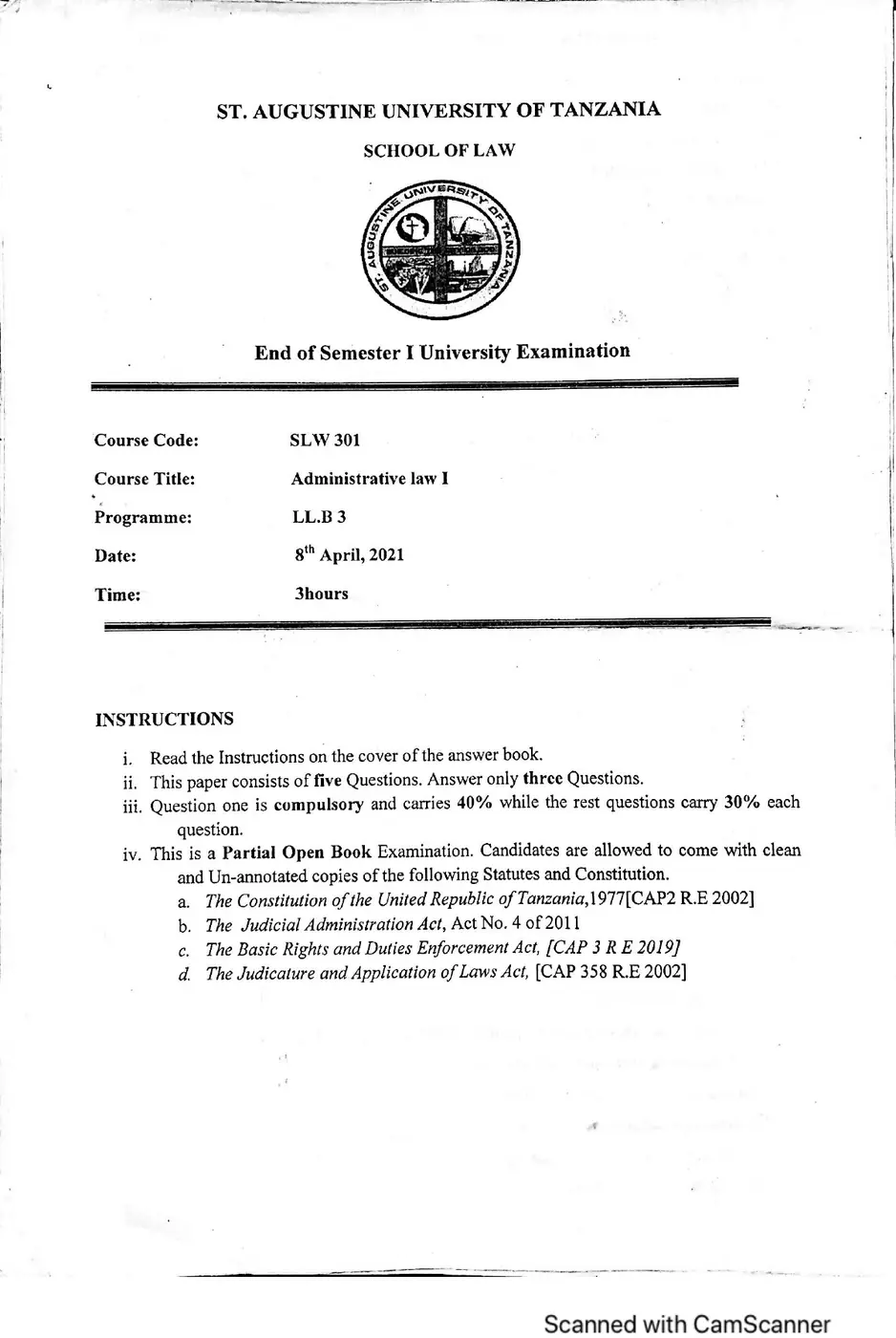
SAUT Administrative Law I Past Paper (SLW 301): The Full Exam as Set
Five questions. Answer three. Question 1 is compulsory (40%); the rest carry 30% each. Partial open book.
Read the questions as text
This paper consists of five questions. Answer only three questions. Question one is compulsory and carries 40% while the rest of the questions carry 30% each. This is a partial open book examination. Candidates are allowed to come with clean and un-annotated copies of: the Constitution of the United Republic of Tanzania, 1977 [Cap 2 R.E. 2002]; the Judicial Administration Act, Act No. 4 of 2011; the Basic Rights and Duties Enforcement Act [Cap 3 R.E. 2019]; the Judicature and Application of Laws Act [Cap 358 R.E. 2002].
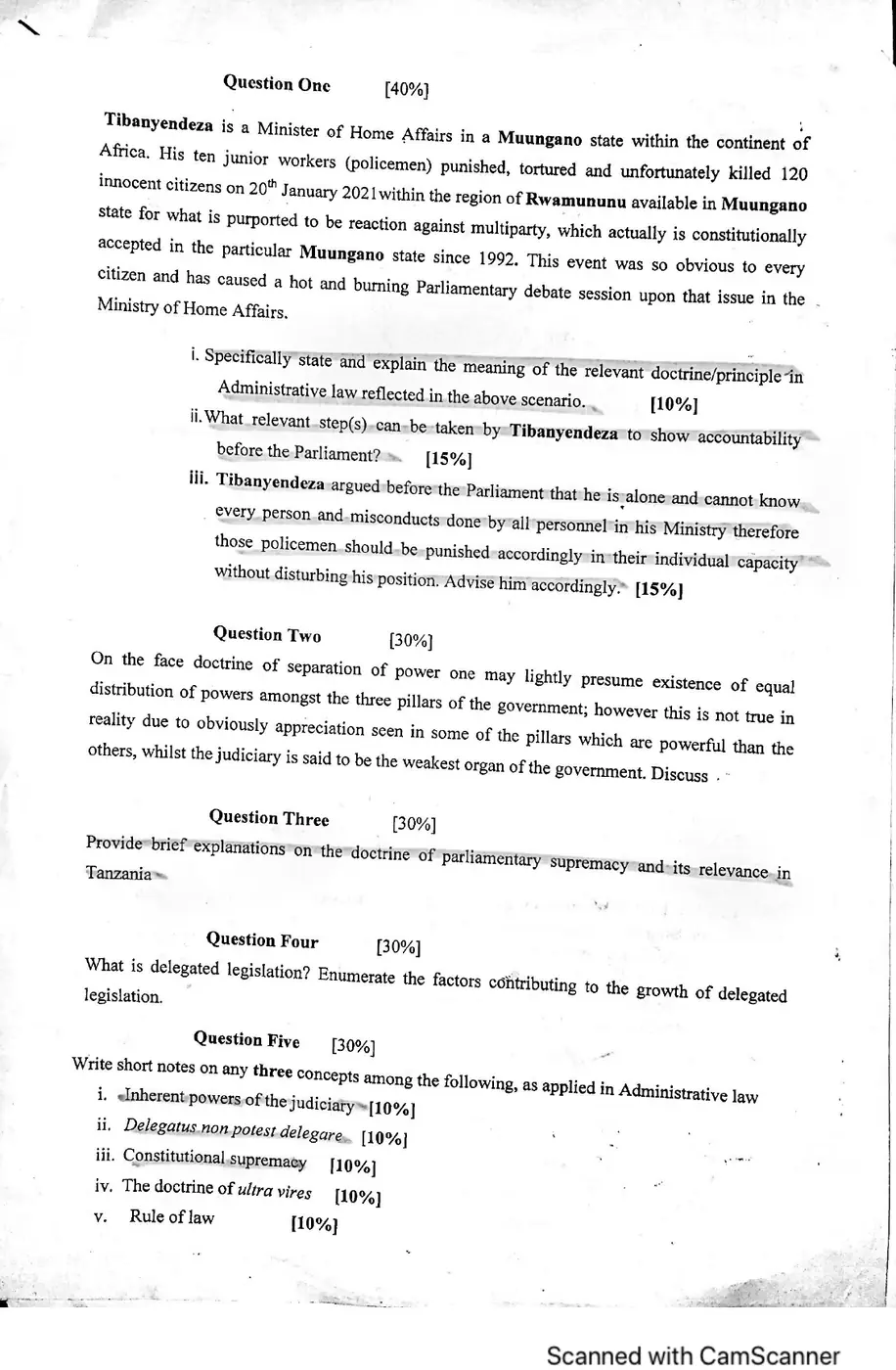
1. [40%] Tibanyendeza is a Minister of Home Affairs in a Muungano state within the continent of Africa. His ten junior workers (policemen) punished, tortured and unfortunately killed 120 innocent citizens on 20th January 2021 within the region of Rwamununu in Muungano state, in what is purported to be a reaction against multiparty politics, which actually has been constitutionally accepted in the particular Muungano state since 1992. This event was so obvious to every citizen and has caused a hot and burning parliamentary debate session upon that issue in the Ministry of Home Affairs. (i) Specifically state and explain the meaning of the relevant doctrine/principle in administrative law reflected in the above scenario. [10%] (ii) What relevant step(s) can be taken by Tibanyendeza to show accountability before Parliament? [15%] (iii) Tibanyendeza argued before Parliament that he is alone and cannot know every person and misconduct done by all personnel in his Ministry; therefore those policemen should be punished accordingly in their individual capacity without disturbing his position. Advise him accordingly. [15%]
2. [30%] On the face of it, the doctrine of separation of powers may lead one lightly to presume the existence of an equal distribution of powers among the three pillars of government; however, this is not true in reality, as some of the pillars are obviously more powerful than the others, while the judiciary is said to be the weakest organ of government. Discuss.
3. [30%] Provide brief explanations on the doctrine of parliamentary supremacy and its relevance in Tanzania.
4. [30%] What is delegated legislation? Enumerate the factors contributing to the growth of delegated legislation.
5. [30%] Write short notes on any three concepts among the following, as applied in administrative law: (i) Inherent powers of the judiciary [10%]; (ii) Delegatus non potest delegare [10%]; (iii) Constitutional supremacy [10%]; (iv) The doctrine of ultra vires [10%]; (v) Rule of law [10%].
Source: St. Augustine University of Tanzania examination paper, April 2021, shared for revision. Rights holders can ask for removal through our Contact page.
Part 2
Administrative Law I Past Paper Answers: Model Answers to All 5 Questions
Question 1 is answered in full below, free. Tap any other question to see it and a preview of its answer.
Q1Question 1: Ministerial responsibility: the Minister of Home Affairs and the Rwamununu killings
40% · Problem · Compulsory Free answer
The question
[40%] Tibanyendeza is a Minister of Home Affairs in a Muungano state within the continent of Africa. His ten junior workers (policemen) punished, tortured and unfortunately killed 120 innocent citizens on 20th January 2021 within the region of Rwamununu in Muungano state, in what is purported to be a reaction against multiparty politics, which actually has been constitutionally accepted in the particular Muungano state since 1992. This event was so obvious to every citizen and has caused a hot and burning parliamentary debate session upon that issue in the Ministry of Home Affairs. (i) Specifically state and explain the meaning of the relevant doctrine/principle in administrative law reflected in the above scenario. [10%] (ii) What relevant step(s) can be taken by Tibanyendeza to show accountability before Parliament? [15%] (iii) Tibanyendeza argued before Parliament that he is alone and cannot know every person and misconduct done by all personnel in his Ministry; therefore those policemen should be punished accordingly in their individual capacity without disturbing his position. Advise him accordingly. [15%]
Model answer
The short answer
(i) the scenario raises ministerial responsibility: a minister answers to Parliament for everything done in his ministry, individually, and the Cabinet answers collectively for government policy. (ii) Tibanyendeza should make a full statement to Parliament, accept responsibility, set up an independent inquiry, suspend and ensure prosecution of the officers, compensate victims, reform the police, and resign if the failure is grave. (iii) His argument is misconceived: individual criminal liability of the policemen does not cancel his political accountability, and the state is vicariously liable for their acts; in a tragedy of this scale, resignation is the expected constitutional response.
(i) The doctrine: ministerial responsibility
- Collective responsibility: the Cabinet is collectively responsible to Parliament for the government’s policies; ministers must publicly support Cabinet decisions or resign. The Constitution of Tanzania provides for the Cabinet’s collective responsibility (Article 53) and for a vote of no confidence in the Prime Minister (Article 53A).
- Individual responsibility: each minister is answerable to Parliament for the conduct of his ministry and its officials, including their mistakes, even if he did not personally know of them. He must explain, take corrective action, and, where the failure is serious, resign. The classic illustration is the Crichel Down affair (1954) in the United Kingdom, where the minister resigned over officials’ misconduct he had not authorised.
- Purpose: it makes the executive accountable to the people’s representatives (Parliament’s oversight role, Article 63) and is part of the separation of powers and the rule of law.
(ii) Steps to show accountability before Parliament
- Make a full and truthful statement to Parliament explaining what happened, answering questions and providing information to any parliamentary committee investigating.
- Accept responsibility on behalf of the ministry and apologise to the victims’ families and the nation.
- Order an independent inquiry (for example, a commission of inquiry or investigation by the Commission for Human Rights and Good Governance) and publish its findings.
- Suspend the officers and refer them for prosecution for murder and torture, so that the criminal law is enforced independently.
- Compensate victims and their families, and provide support.
- Institutional reform: review police command, training, use-of-force rules and oversight to prevent recurrence; report back to Parliament on progress.
- Resign if the failure is so grave that confidence cannot be restored, or if Parliament’s inquiry finds ministerial failings. Tanzania has precedents: Prime Minister Edward Lowassa resigned in 2008 after the parliamentary report on the Richmond contract, and in 2013 several ministers were removed after a parliamentary report on abuses during Operation Tokomeza.
(iii) Advice on his “I cannot know everything” argument
- Partly true but not a defence to accountability: a minister is not expected to know every act of every officer, and the officers are personally liable for their crimes. But ministerial responsibility does not depend on personal fault; it requires the minister to answer for his ministry’s conduct and the systems he oversees.
- Systemic failure: the killing of 120 people in a coordinated reaction against lawful political activity points to failures of command, policy, training or supervision, which are the minister’s responsibility.
- Two kinds of liability co-exist: the policemen face individual criminal liability; the state is vicariously liable in civil law for the wrongful acts of its servants in the course of duty (Government Proceedings Act, Cap. 5); and the minister bears political accountability to Parliament. One does not cancel the others.
- Constitutional rights at stake: the right to life (Article 14), freedom from torture (Article 13(6)(e)) and freedom of association and multiparty politics are fundamental. Victims’ families may petition the High Court under Article 30(3) and the Basic Rights and Duties Enforcement Act, Cap. 3.
- Advice: he should not hide behind the officers. He should take the steps in (ii) and consider resigning; insisting on staying while blaming juniors is likely to provoke a motion against him or the Government.
What the examiner wants
Identification and explanation of ministerial responsibility (individual and collective), practical steps of accountability, and a reasoned rebuttal of the minister’s argument distinguishing criminal, civil and political responsibility.
Common mistakes
- Discussing vicarious liability only, without ministerial responsibility.
- Accepting the minister’s argument because he lacked personal knowledge.
Q2Question 2: Separation of powers: is the judiciary the weakest organ?
30% · Essay Locked
The question
[30%] On the face of it, the doctrine of separation of powers may lead one lightly to presume the existence of an equal distribution of powers among the three pillars of government; however, this is not true in reality, as some of the pillars are obviously more powerful than the others, while the judiciary is said to be the weakest organ of government. Discuss.
Model answer
Unlock the model answer to Question 2
Get all 4 locked answers on this paper for TSh 3,000. Pay once, keep them in Your Library for life.
Get the solved paper · TSh 3,000Or get every solved paper with Elite
Q3Question 3: Parliamentary supremacy and its relevance in Tanzania
30% · Essay Locked
The question
[30%] Provide brief explanations on the doctrine of parliamentary supremacy and its relevance in Tanzania.
Model answer
Unlock the model answer to Question 3
Get all 4 locked answers on this paper for TSh 3,000. Pay once, keep them in Your Library for life.
Get the solved paper · TSh 3,000Or get every solved paper with Elite
Q4Question 4: Delegated legislation and why it has grown
30% · Essay Locked
The question
[30%] What is delegated legislation? Enumerate the factors contributing to the growth of delegated legislation.
Model answer
Unlock the model answer to Question 4
Get all 4 locked answers on this paper for TSh 3,000. Pay once, keep them in Your Library for life.
Get the solved paper · TSh 3,000Or get every solved paper with Elite
Q5Question 5: Short notes: inherent powers, delegatus non potest delegare, constitutional supremacy, ultra vires, rule of law
30% · Short notes Locked
The question
[30%] Write short notes on any three concepts among the following, as applied in administrative law: (i) Inherent powers of the judiciary [10%]; (ii) Delegatus non potest delegare [10%]; (iii) Constitutional supremacy [10%]; (iv) The doctrine of ultra vires [10%]; (v) Rule of law [10%].
Model answer
Unlock the model answer to Question 5
Get all 4 locked answers on this paper for TSh 3,000. Pay once, keep them in Your Library for life.
Get the solved paper · TSh 3,000Or get every solved paper with Elite
Get the Full Solved Paper
All 5 questions answered with the statutes and cases that apply, what the examiner wants and the mistakes to avoid. TSh 3,000, yours for life in Your Library.
Pata majibu yote ya mtihani huu kwa TSh 3,000 tu.




Statutes and Cases for This Administrative Law I Past Paper
- Constitution of the United Republic of Tanzania, 1977Organs of state (art. 4), collective responsibility of the Cabinet (art. 53), vote of no confidence in the Prime Minister (art. 53A), oversight by Parliament (art. 63), constitutional amendment (art. 98), constitutional supremacy (art. 64(5)), judiciary (arts. 107A-107B), right to challenge (art. 26), enforcement of rights (art. 30(3))
- Basic Rights and Duties Enforcement Act, Cap. 3Procedure for constitutional petitions
- Judicial Administration Act, 2011Administration of the judiciary
- Judicature and Application of Laws Act, Cap. 358Reception of law and jurisdiction of the High Court
- Interpretation of Laws Act, Cap. 1Making and validity of subsidiary legislation
- Government Proceedings Act, Cap. 5Liability of the Government
- Civil Procedure Code, Cap. 33Inherent powers of the court (s.95)
- Attorney General v Rev. Christopher Mtikila, Civil Appeal No. 45 of 2009 (CA)Courts' approach to constitutional amendments by Parliament
- Kukutia Ole Pumbun v Attorney General [1993] TLR 159 (CA)Access to court against the Government
- DPP v Daudi Pete [1993] TLR 22 (CA)Laws limiting rights
- Barnard v National Dock Labour Board [1953] 2 QB 18 (CA)Delegatus non potest delegare
- Carltona Ltd v Commissioners of Works [1943] 2 All ER 560 (CA)Officials acting in the minister's name
- Attorney General v Fulham Corporation [1921] 1 Ch 440Ultra vires
SAUT Administrative Law I Past Paper: Common Questions
Is this the real SAUT Administrative Law I exam paper?
Yes. These are scans of the End of Semester I Examination 2020/2021 paper for SLW 301 Administrative Law I at St. Augustine University of Tanzania, sat on 8 April 2021. Nothing has been retyped or changed.
How many questions do you answer in this Administrative Law I paper?
Five questions. Answer three. Question 1 is compulsory (40%); the rest carry 30% each. Partial open book.
Are there answers to this past paper?
Yes. All 5 questions have full model answers written to Tanzanian law and reviewed by Isack Kimaro, LL.B, PDLP. The Question 1 answer is free; the full solved paper is TSh 3,000 (TSh 2,000 for Pro members) and is included in Elite.
How do I see every page of the paper?
The first pages are open to everyone. Create a free account to read the whole paper.