

About this paper
Solved answers to all 6 questions
Part 1
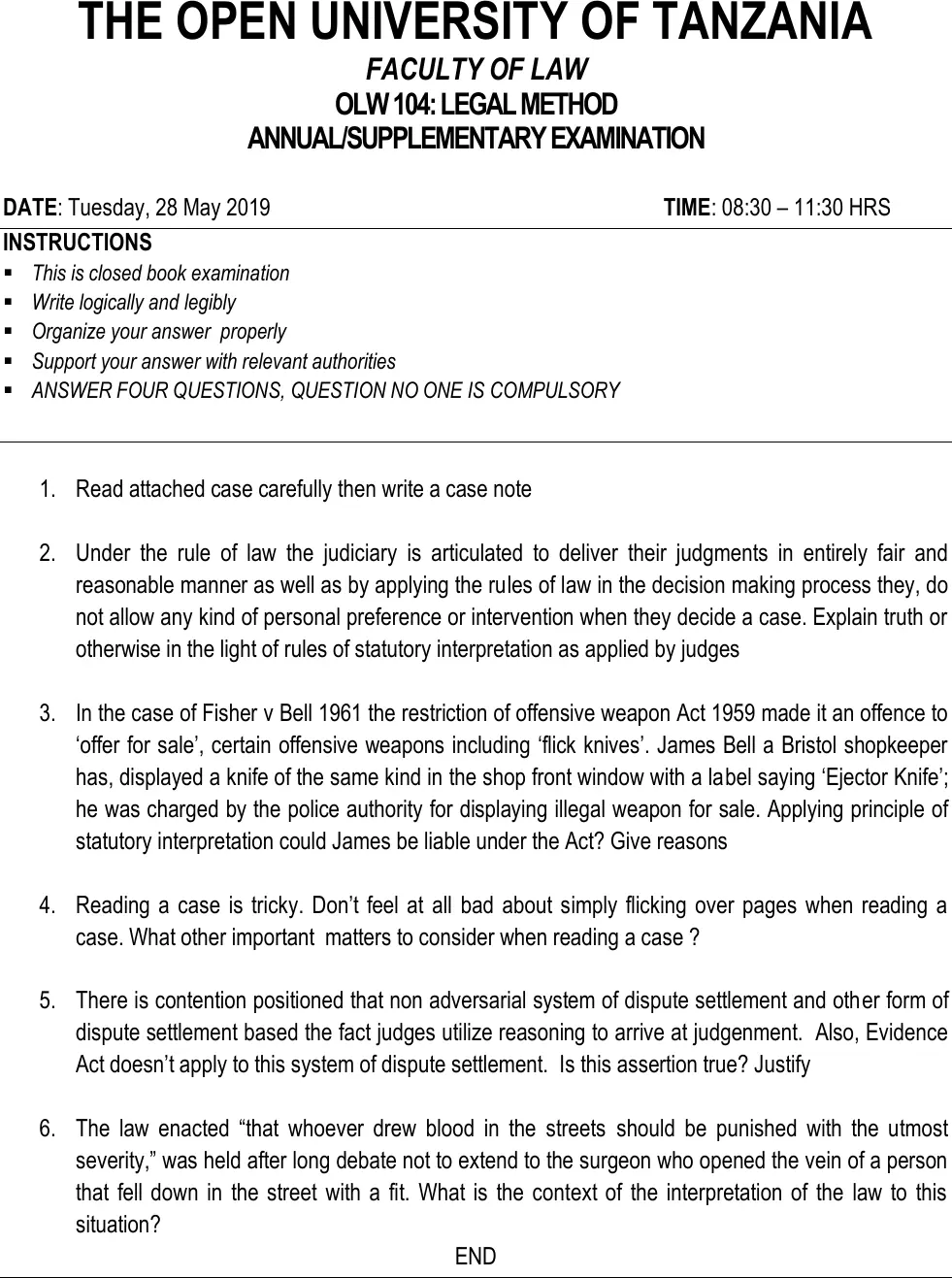
OUT Legal Method Past Paper (OLW 104): The Full Exam as Set
Answer four questions; Question 1 is compulsory and is based on the attached High Court judgment. Closed book.
 Full size
 Full size
Page 3 of 5
Create a free account to see the whole paper. It takes a minute.
Create a free accountAlready a member? Log in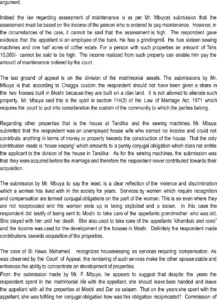
Page 4 of 5
Create a free account to see the whole paper. It takes a minute.
Create a free accountAlready a member? Log in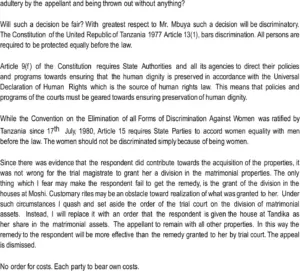
Page 5 of 5
Create a free account to see the whole paper. It takes a minute.
Create a free accountAlready a member? Log inRead the questions as text
This is a closed book examination. Write logically and legibly. Organise your answer properly. Support your answer with relevant authorities. ANSWER FOUR QUESTIONS; QUESTION NO. ONE IS COMPULSORY.
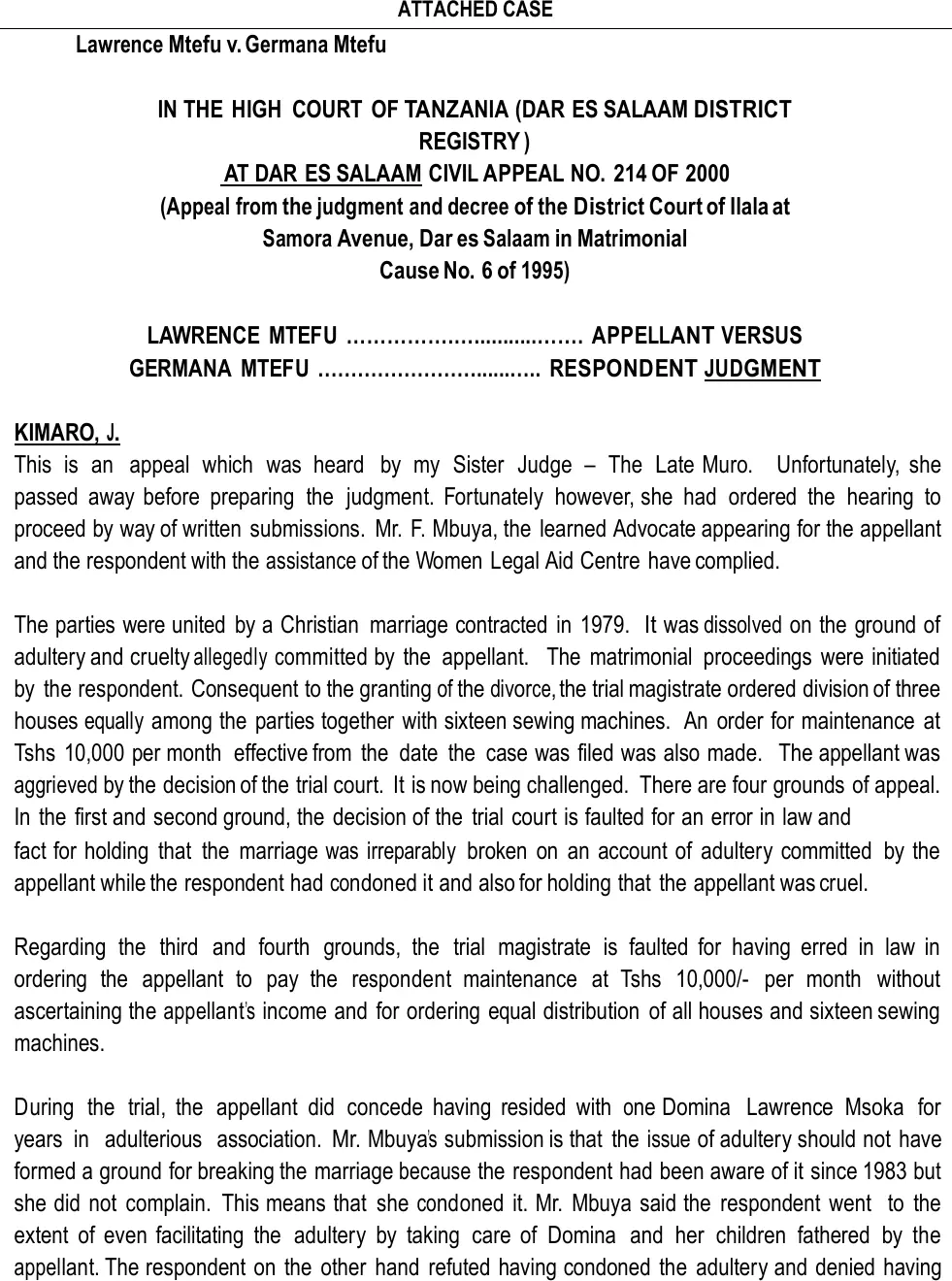
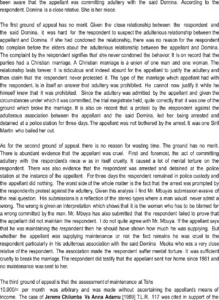
1. Read the attached case carefully, then write a case note. [The attached case is Lawrence Mtefu v Germana Mtefu, High Court of Tanzania (Dar es Salaam District Registry), Civil Appeal No. 214 of 2000, Kimaro J., on appeal from the District Court of Ilala in Matrimonial Cause No. 6 of 1995. The full judgment appears on pages 2 to 5 of the scanned paper above.]
2. Under the rule of law the judiciary is articulated to deliver their judgments in an entirely fair and reasonable manner, as well as by applying the rules of law in the decision-making process; they do not allow any kind of personal preference or intervention when they decide a case. Explain the truth or otherwise of this in the light of the rules of statutory interpretation as applied by judges.
3. In the case of Fisher v Bell (1961), the Restriction of Offensive Weapons Act 1959 made it an offence to “offer for sale” certain offensive weapons, including “flick knives”. James Bell, a Bristol shopkeeper, displayed a knife of the same kind in the shop front window with a label saying “Ejector Knife”; he was charged by the police authority with displaying an illegal weapon for sale. Applying the principles of statutory interpretation, could James be liable under the Act? Give reasons.
4. Reading a case is tricky. Don’t feel at all bad about simply flicking over pages when reading a case. What other important matters should be considered when reading a case?
5. There is a contention that non-adversarial systems of dispute settlement and other forms of dispute settlement are based on the fact that judges utilise reasoning to arrive at judgment. Also, the Evidence Act doesn’t apply to these systems of dispute settlement. Is this assertion true? Justify.
6. The law enacted “that whoever drew blood in the streets should be punished with the utmost severity” was held, after long debate, not to extend to the surgeon who opened the vein of a person that fell down in the street with a fit. What is the context of the interpretation of the law in this situation?
Source: The Open University of Tanzania examination paper, May 2019, shared for revision. Rights holders can ask for removal through our Contact page.
Part 2
Legal Method Past Paper Answers: Model Answers to All 6 Questions
Question 1 is answered in full below, free. Tap any other question to see it and a preview of its answer.
Q1Question 1: Case note on Lawrence Mtefu v Germana Mtefu (HC, Civil Appeal No. 214 of 2000)
Case note · Compulsory Free answer
The question
Read the attached case carefully, then write a case note. [The attached case is Lawrence Mtefu v Germana Mtefu, High Court of Tanzania (Dar es Salaam District Registry), Civil Appeal No. 214 of 2000, Kimaro J., on appeal from the District Court of Ilala in Matrimonial Cause No. 6 of 1995. The full judgment appears on pages 2 to 5 of the scanned paper above.]
Model answer
The short answer
The High Court (Kimaro J) dismissed a husband’s appeal against a divorce decree. It held that the wife had not condoned his adultery with her niece, that his conduct amounted to cruelty, that TSh 10,000 a month maintenance was reasonable given his property, and that the wife’s domestic and farm work was a contribution entitling her to a share of matrimonial assets. Because clan land at Moshi could cause practical difficulty, the court substituted an order giving her the Tandika house. The case is notable for applying the Constitution and CEDAW to reject a discriminatory argument that housework is a mere “conjugal obligation”.
Citation and court
Lawrence Mtefu v Germana Mtefu, High Court of Tanzania (Dar es Salaam District Registry), Civil Appeal No. 214 of 2000, Kimaro J. Appeal from the District Court of Ilala in Matrimonial Cause No. 6 of 1995. The appeal had been heard by Muro J, who died before writing the judgment; it proceeded on written submissions.
Facts
- The parties married under Christian rites in 1979.
- The husband lived for years in an adulterous association with the wife’s niece, Domina, and had children with her. When the wife protested to elders, she was arrested and detained at a police station for three days at his instance, and he did nothing to help her.
- He sent her away in 1981 and did not maintain her. She lived in Moshi looking after his elderly grandmother until her death and worked his farm (kihamba) and cows, whose income was used to develop the houses.
- The District Court granted divorce on grounds of adultery and cruelty, divided three houses (two in Moshi on clan land and one at Tandika, Dar es Salaam) and sixteen sewing machines equally, and ordered maintenance of TSh 10,000 a month.
Issues
- Whether the wife had condoned the adultery, so that it could not be a ground of breakdown.
- Whether the husband was cruel.
- Whether maintenance was fixed without considering his means.
- Whether the wife, as a housewife without income, was entitled to a share of the matrimonial assets, and whether clan land at Moshi could be divided.
Arguments
For the husband, Mr Mbuya argued that the wife had known of the adultery since 1983 and even cared for Domina’s children, so she condoned it; that maintenance ignored his income (Jereme Chilumba v Anna Adamu [1989] TLR 117); that under Chagga custom clan land could not be given to her (relying on the custom-related part of section 114(2) of the Law of Marriage Act, 1971); and that housekeeping was only a “conjugal obligation” and the sewing machines pre-dated the marriage. The wife denied condonation and relied on her contributions.
Decision and reasoning
- No condonation: because Domina was her close relative, the wife could not easily suspect the relationship, and her complaint to the elders showed she never condoned it. In a monogamous Christian marriage the husband knew adultery was prohibited and could not justify it.
- Cruelty: adultery with the wife’s niece caused mental torture, and causing her arrest for protesting was cruel. This was enough for breakdown.
- Maintenance: although maintenance must be based on the payer’s income, TSh 10,000 a month was not excessive for a bank employee who owned a grinding mill, sixteen sewing machines and a coffee farm.
- Matrimonial assets: the court rejected the “conjugal obligation” argument as reflecting discrimination against women. Following Bi Hawa Mohamed v Ally Sefu [1983] TLR 32 (CA), domestic services are a contribution that enables the other spouse to acquire property. The wife’s care of the grandmother and her farm work contributed directly. Denying her a share would be discriminatory, contrary to Article 13(1) of the Constitution (equality before the law), Article 9(f) (human dignity in line with the UDHR) and Article 15 of CEDAW (equality before the law).
- Order: because customary rules on clan land might prevent the wife from enjoying a share of the Moshi houses, the court set aside the equal division and instead gave her the Tandika house; the husband kept the rest. The appeal was dismissed, with no order as to costs.
Ratio decidendi
A spouse’s domestic services and other non-monetary work are contributions to the acquisition of matrimonial assets, and treating them as mere conjugal obligations would discriminate against women contrary to the Constitution and CEDAW; complaining of adultery to family elders negates condonation.
Obiter and comment
- The remarks about stereotypes in the advocate’s submissions and the nature of Christian marriage are obiter.
- Strengths: the judgment uses the Constitution and international law to interpret family law, reflects the purposive approach, and crafts a practical remedy that the wife can actually enjoy.
- Points to note: the judgment states that Tanzania ratified CEDAW on 17 July 1980; that is the date Tanzania signed CEDAW, while ratification followed in 1985. The court’s substitution of the Tandika house could be questioned as departing from a division based on each party’s proportionate contribution, but it was justified by practicality. The Law of Marriage Act sections cited follow the numbering used at the time.
- Significance: it follows and extends Bi Hawa Mohamed, and anticipates the Court of Appeal’s later protection of women’s equality in cases such as Attorney General v Rebeca Z. Gyumi [2019] TZCA 348.
What the examiner wants
A structured case note: citation, court and judge, facts, issues, arguments, decision, reasoning, ratio, obiter, and your own critical comment.
Common mistakes
- Retelling the judgment instead of analysing it.
- Missing the ratio or confusing it with the final order.
Q2Question 2: Do judges decide without personal preference? The rules of statutory interpretation
Essay Locked
The question
Under the rule of law the judiciary is articulated to deliver their judgments in an entirely fair and reasonable manner, as well as by applying the rules of law in the decision-making process; they do not allow any kind of personal preference or intervention when they decide a case. Explain the truth or otherwise of this in the light of the rules of statutory interpretation as applied by judges.
Model answer
Unlock the model answer to Question 2
Get all 5 locked answers on this paper for TSh 3,000. Pay once, keep them in Your Library for life.
Get the solved paper · TSh 3,000Or get every solved paper with Elite
Q3Question 3: Fisher v Bell: is a knife in a shop window "offered for sale"?
Problem Locked
The question
In the case of Fisher v Bell (1961), the Restriction of Offensive Weapons Act 1959 made it an offence to “offer for sale” certain offensive weapons, including “flick knives”. James Bell, a Bristol shopkeeper, displayed a knife of the same kind in the shop front window with a label saying “Ejector Knife”; he was charged by the police authority with displaying an illegal weapon for sale. Applying the principles of statutory interpretation, could James be liable under the Act? Give reasons.
Model answer
Unlock the model answer to Question 3
Get all 5 locked answers on this paper for TSh 3,000. Pay once, keep them in Your Library for life.
Get the solved paper · TSh 3,000Or get every solved paper with Elite
Q4Question 4: How to read a case properly
Essay Locked
The question
Reading a case is tricky. Don’t feel at all bad about simply flicking over pages when reading a case. What other important matters should be considered when reading a case?
Model answer
Unlock the model answer to Question 4
Get all 5 locked answers on this paper for TSh 3,000. Pay once, keep them in Your Library for life.
Get the solved paper · TSh 3,000Or get every solved paper with Elite
Q5Question 5: Non-adversarial dispute settlement and the Evidence Act
Essay Locked
The question
There is a contention that non-adversarial systems of dispute settlement and other forms of dispute settlement are based on the fact that judges utilise reasoning to arrive at judgment. Also, the Evidence Act doesn’t apply to these systems of dispute settlement. Is this assertion true? Justify.
Model answer
Unlock the model answer to Question 5
Get all 5 locked answers on this paper for TSh 3,000. Pay once, keep them in Your Library for life.
Get the solved paper · TSh 3,000Or get every solved paper with Elite
Q6Question 6: The Bologna surgeon: interpreting "whoever drew blood in the streets"
Essay Locked
The question
The law enacted “that whoever drew blood in the streets should be punished with the utmost severity” was held, after long debate, not to extend to the surgeon who opened the vein of a person that fell down in the street with a fit. What is the context of the interpretation of the law in this situation?
Model answer
Unlock the model answer to Question 6
Get all 5 locked answers on this paper for TSh 3,000. Pay once, keep them in Your Library for life.
Get the solved paper · TSh 3,000Or get every solved paper with Elite
Get the Full Solved Paper
All 6 questions answered with the statutes and cases that apply, what the examiner wants and the mistakes to avoid. TSh 3,000, yours for life in Your Library.
Pata majibu yote ya mtihani huu kwa TSh 3,000 tu.




Statutes and Cases for This Legal Method Past Paper
- Law of Marriage Act, Cap. 29Divorce on proof of breakdown; division of matrimonial assets (s.114 in the numbering used in the judgment)
- Constitution of the United Republic of Tanzania, 1977Equality and non-discrimination (art. 13), human dignity (art. 9(f)), judicial independence (arts. 107A-107B)
- Convention on the Elimination of All Forms of Discrimination against Women, 1979Equality before the law (art. 15)
- Evidence Act, Cap. 6Application of the Act (s.2)
- Interpretation of Laws Act, Cap. 1Statutory interpretation in Tanzania
- Arbitration Act, 2020 (Cap. 15)Arbitral procedure
- Bi Hawa Mohamed v Ally Sefu [1983] TLR 32 (CA)Domestic work as contribution to matrimonial assets
- Fisher v Bell [1961] 1 QB 394Literal rule; display in a shop window is an invitation to treat
- Whiteley v Chappell (1868) LR 4 QB 147Literal rule
- Adler v George [1964] 2 QB 7; R v Sigsworth [1935] Ch 89Golden rule
- Heydon's Case (1584) 3 Co Rep 7a; Smith v Hughes [1960] 1 WLR 830Mischief rule
- Pepper v Hart [1993] AC 593 (HL)Purposive approach and Hansard
OUT Legal Method Past Paper: Common Questions
Is this the real OUT Legal Method exam paper?
Yes. These are scans of the Annual/Supplementary Examination, May 2019 paper for OLW 104 Legal Method at The Open University of Tanzania, sat on 28 May 2019. Nothing has been retyped or changed.
How many questions do you answer in this Legal Method paper?
Answer four questions; Question 1 is compulsory and is based on the attached High Court judgment. Closed book.
Are there answers to this past paper?
Yes. All 6 questions have full model answers written to Tanzanian law and reviewed by Isack Kimaro, LL.B, PDLP. The Question 1 answer is free; the full solved paper is TSh 3,000 (TSh 2,000 for Pro members) and is included in Elite.
How do I see every page of the paper?
The first pages are open to everyone. Create a free account to read the whole paper.