

About this paper
Solved answers to all 6 questions
Part 1
OUT Law of Contract Past Paper (OLW 103): The Full Exam as Set
Six questions. Answer four. Totally closed book.
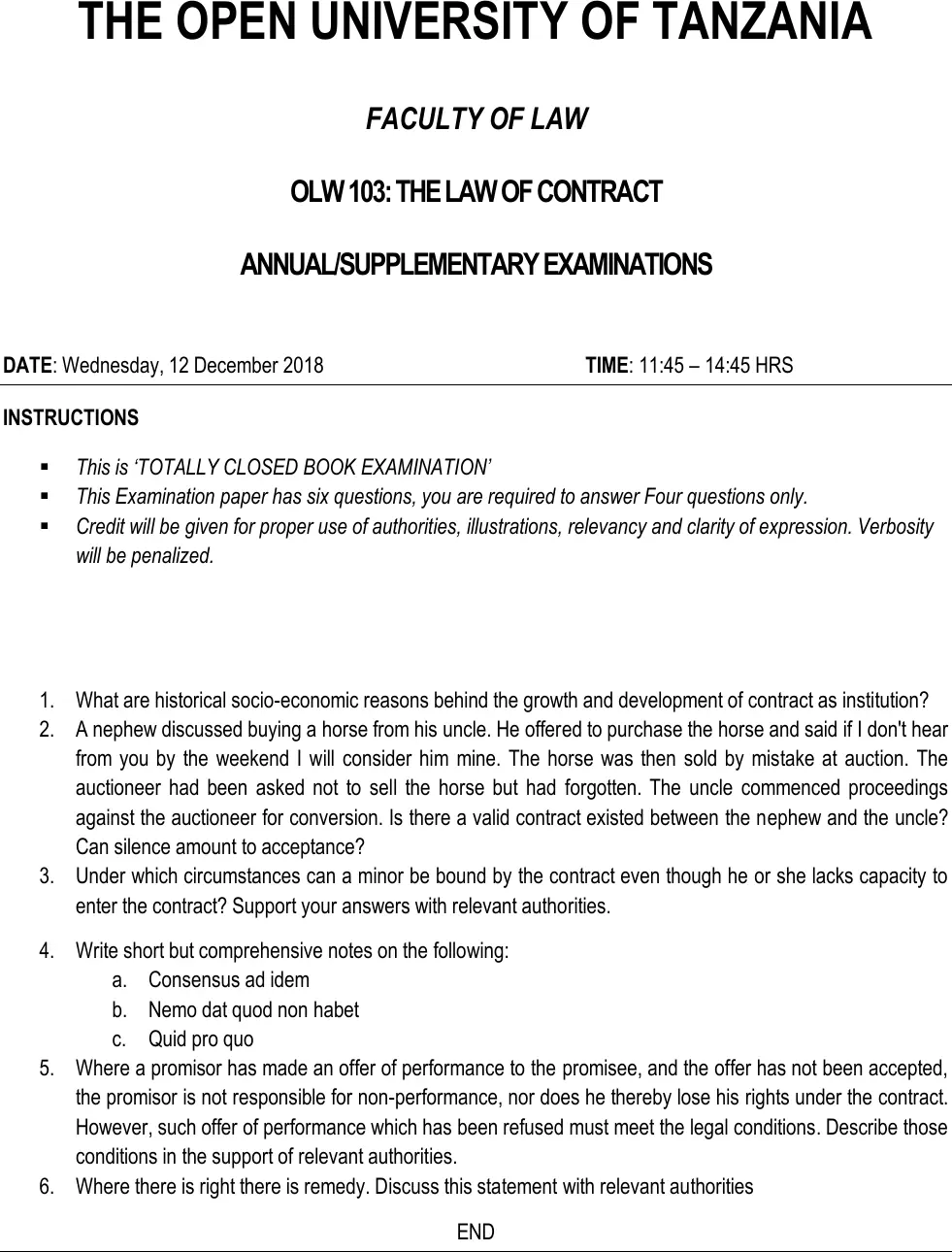
Read the questions as text
1. What are historical socio-economic reasons behind the growth and development of contract as institution?
2. A nephew discussed buying a horse from his uncle. He offered to purchase the horse and said if I don’t hear from you by the weekend I will consider him mine. The horse was then sold by mistake at auction. The auctioneer had been asked not to sell the horse but had forgotten. The uncle commenced proceedings against the auctioneer for conversion. Is there a valid contract existed between the nephew and the uncle? Can silence amount to acceptance?
3. Under which circumstances can a minor be bound by the contract even though he or she lacks capacity to enter the contract? Support your answers with relevant authorities.
4. Write short but comprehensive notes on the following: (a) Consensus ad idem; (b) Nemo dat quod non habet; (c) Quid pro quo.
5. Where a promisor has made an offer of performance to the promisee, and the offer has not been accepted, the promisor is not responsible for non-performance, nor does he thereby lose his rights under the contract. However, such offer of performance which has been refused must meet the legal conditions. Describe those conditions in the support of relevant authorities.
6. Where there is right there is remedy. Discuss this statement with relevant authorities.
Source: The Open University of Tanzania examination paper, December 2018, shared for revision. Rights holders can ask for removal through our Contact page.
Part 2
Law of Contract Past Paper Answers: Model Answers to All 6 Questions
Question 2 is answered in full below, free. Tap any other question to see it and a preview of its answer.
Q1Question 1: Why contract grew as an institution: the socio-economic history
essay Locked
The question
What are historical socio-economic reasons behind the growth and development of contract as institution?
Model answer
Unlock the model answer to Question 1
Get all 5 locked answers on this paper for TSh 3,000. Pay once, keep them in Your Library for life.
Get the solved paper · TSh 3,000Or get every solved paper with Elite
Q2Question 2: The nephew, the uncle and the horse: can silence be acceptance?
problem Free answer
The question
A nephew discussed buying a horse from his uncle. He offered to purchase the horse and said if I don’t hear from you by the weekend I will consider him mine. The horse was then sold by mistake at auction. The auctioneer had been asked not to sell the horse but had forgotten. The uncle commenced proceedings against the auctioneer for conversion. Is there a valid contract existed between the nephew and the uncle? Can silence amount to acceptance?
Model answer
The short answer
No contract existed between the nephew and the uncle, because the uncle never communicated acceptance; his silence could not be imposed on him as acceptance. These are the facts of Felthouse v Bindley (1862), where the court held that an offeror cannot make the offeree’s silence amount to acceptance. In Tanzania, acceptance must be signified (Law of Contract Act s.2(1)(b)) and be absolute and expressed in a usual and reasonable manner (s.7). Silence can count as acceptance only in exceptional cases, for example where the offeree himself agreed that silence would bind him or a course of dealing shows it.
Issue
Was there a concluded contract for the sale of the horse between the uncle (seller) and the nephew (buyer)? Can the uncle’s silence be acceptance? Note: the paper reverses the roles in Felthouse v Bindley, where the uncle was the buyer and the nephew the seller; the principle is the same.
Rule
- A proposal becomes a promise when the person to whom it is made signifies his assent (Law of Contract Act, Cap. 345, s.2(1)(b)). Acceptance must be absolute and unqualified and expressed in some usual and reasonable manner (s.7).
- Acceptance must be communicated to the offeror. An offeror cannot impose a contract by declaring that silence will be taken as acceptance: Felthouse v Bindley (1862) 11 CBNS 869. There, the uncle offered to buy his nephew’s horse and wrote that if he heard no more he would consider the horse his; the nephew intended to accept and told the auctioneer to keep the horse out of the sale, but never told the uncle. The court held there was no contract, so the property had not passed.
- Acceptance by conduct is possible where the offer invites it, by performing the conditions of the proposal (s.8).
Application
- The nephew made an offer and said he would consider the horse his if he did not hear by the weekend. The uncle said nothing.
- Even if the uncle intended to accept (shown by telling the auctioneer not to sell), that intention stayed in his mind and was not communicated. Instructions to his own auctioneer are not communication to the offeror.
- No conduct by the uncle amounted to performance of the conditions of the proposal. So there was no contract and no transfer of ownership to the nephew.
- Consequently, the horse never became the nephew’s property; it remained the uncle’s until the auction. The nephew has no claim to the horse or against the uncle. On the actual Felthouse facts, the buyer who sued the auctioneer failed precisely because the horse had never become his. Here, ownership stayed with the uncle, so any claim over the wrongful sale belongs to the uncle (against his auctioneer for selling contrary to instructions), not to the nephew.
Can silence ever be acceptance?
- General rule: no. The rule protects offerees from being forced to reply to unwanted offers.
- Exceptions: where the offeree himself has indicated that silence will mean acceptance (the protection is for the offeree, so he can waive it); where a previous course of dealing shows that silence means acceptance; and where the offeree takes the benefit of goods or services knowing they are offered for payment (acceptance by conduct).
Conclusion
No valid contract was formed. Silence, without more, does not amount to acceptance.
What the examiner wants
Recognition of Felthouse v Bindley, the statutory requirement of communicated acceptance, application to the facts, and the exceptions.
Common mistakes
- Treating the uncle’s private intention as acceptance.
- Discussing the auctioneer’s liability at length instead of formation of the contract.
Q3Question 3: When a minor can be bound despite lack of capacity
essay Locked
The question
Under which circumstances can a minor be bound by the contract even though he or she lacks capacity to enter the contract? Support your answers with relevant authorities.
Model answer
Unlock the model answer to Question 3
Get all 5 locked answers on this paper for TSh 3,000. Pay once, keep them in Your Library for life.
Get the solved paper · TSh 3,000Or get every solved paper with Elite
Q4Question 4: Short notes: consensus ad idem, nemo dat quod non habet, quid pro quo
short notes Locked
The question
Write short but comprehensive notes on the following: (a) Consensus ad idem; (b) Nemo dat quod non habet; (c) Quid pro quo.
Model answer
Unlock the model answer to Question 4
Get all 5 locked answers on this paper for TSh 3,000. Pay once, keep them in Your Library for life.
Get the solved paper · TSh 3,000Or get every solved paper with Elite
Q5Question 5: Conditions for a valid offer of performance (tender)
essay Locked
The question
Where a promisor has made an offer of performance to the promisee, and the offer has not been accepted, the promisor is not responsible for non-performance, nor does he thereby lose his rights under the contract. However, such offer of performance which has been refused must meet the legal conditions. Describe those conditions in the support of relevant authorities.
Model answer
Unlock the model answer to Question 5
Get all 5 locked answers on this paper for TSh 3,000. Pay once, keep them in Your Library for life.
Get the solved paper · TSh 3,000Or get every solved paper with Elite
Q6Question 6: 'Where there is a right there is a remedy'
essay Locked
The question
Where there is right there is remedy. Discuss this statement with relevant authorities.
Model answer
Unlock the model answer to Question 6
Get all 5 locked answers on this paper for TSh 3,000. Pay once, keep them in Your Library for life.
Get the solved paper · TSh 3,000Or get every solved paper with Elite
Get the Full Solved Paper
All 6 questions answered with the statutes and cases that apply, what the examiner wants and the mistakes to avoid. TSh 3,000, yours for life in Your Library.
Pata majibu yote ya mtihani huu kwa TSh 3,000 tu.




Statutes and Cases for This Law of Contract Past Paper
- Law of Contract Act, Cap. 345 R.E. 2019s.2(1)(b) and (d), s.7, s.10, s.11 (competency; agreement by incompetent person void), s.13 (consent), s.20, s.25, s.38 (refused offer of performance), s.39, s.68 (necessaries), s.73, s.74
- Sale of Goods Act, Cap. 214s.4 (necessaries to minors), ss.23–27 (transfer of title by non-owners)
- Judicature and Application of Laws Act, Cap. 358s.2(3) (reception of common law and equity)
- Felthouse v Bindley (1862) 11 CBNS 869Silence is not acceptance
- Mohori Bibee v Dharmodas Ghose (1903) 30 IA 114 (PC)A minor's agreement is void
- Nash v Inman [1908] 2 KB 1Necessaries
- Raffles v Wichelhaus (1864) 2 H & C 906No consensus ad idem
- Currie v Misa (1875) LR 10 Ex 153Consideration
- Startup v Macdonald (1843) 6 Man & G 593Valid tender
- Ashby v White (1703) 2 Ld Raym 938Ubi jus ibi remedium
- Hadley v Baxendale (1854) 9 Ex 341Remoteness of damage
OUT Law of Contract Past Paper: Common Questions
Is this the real OUT Law of Contract exam paper?
Yes. These are scans of the Annual/Supplementary Examination, December 2018 paper for OLW 103 Law of Contract at The Open University of Tanzania, sat on 12 December 2018. Nothing has been retyped or changed.
How many questions do you answer in this Law of Contract paper?
Six questions. Answer four. Totally closed book.
Are there answers to this past paper?
Yes. All 6 questions have full model answers written to Tanzanian law and reviewed by Isack Kimaro, LL.B, PDLP. The Question 1 answer is free; the full solved paper is TSh 3,000 (TSh 2,000 for Pro members) and is included in Elite.
How do I see every page of the paper?
The first pages are open to everyone. Create a free account to read the whole paper.