

About this paper
Solved answers to all 6 questions
Part 1
OUT Constitutions and Legal Systems of East Africa Past Paper (OLW 101): The Full Exam as Set
Six questions. Attempt four. Closed book.
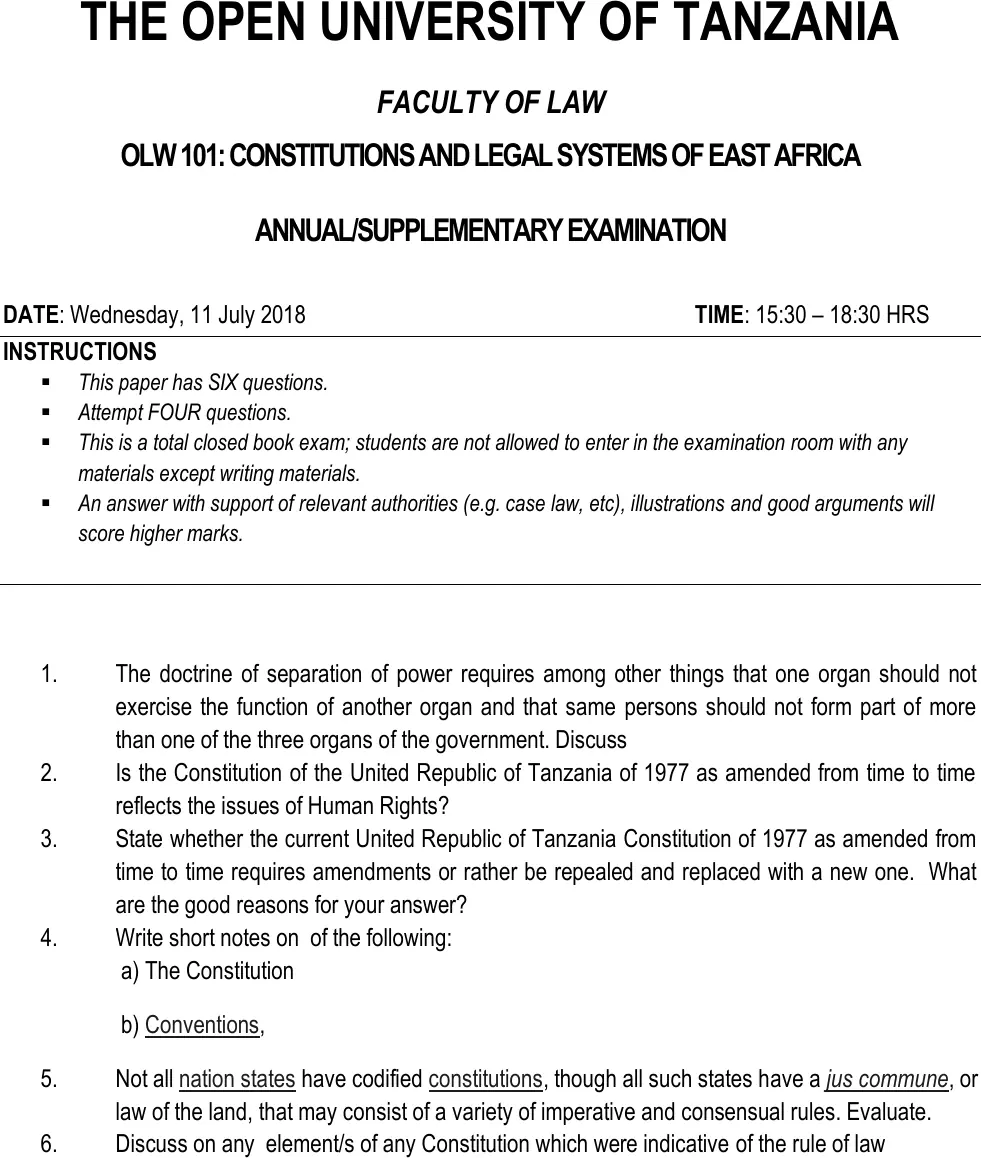
Read the questions as text
1. The doctrine of separation of power requires among other things that one organ should not exercise the function of another organ and that same persons should not form part of more than one of the three organs of the government. Discuss.
2. Is the Constitution of the United Republic of Tanzania of 1977 as amended from time to time reflects the issues of Human Rights?
3. State whether the current United Republic of Tanzania Constitution of 1977 as amended from time to time requires amendments or rather be repealed and replaced with a new one. What are the good reasons for your answer?
4. Write short notes on the following: (a) The Constitution; (b) Conventions.
5. Not all nation states have codified constitutions, though all such states have a jus commune, or law of the land, that may consist of a variety of imperative and consensual rules. Evaluate.
6. Discuss on any element/s of any Constitution which were indicative of the rule of law.
Source: The Open University of Tanzania examination paper, July 2018, shared for revision. Rights holders can ask for removal through our Contact page.
Part 2
Constitutions and Legal Systems of East Africa Past Paper Answers: Model Answers to All 6 Questions
Question 1 is answered in full below, free. Tap any other question to see it and a preview of its answer.
Q1Question 1: Separation of powers: theory and the Tanzanian reality
essay Free answer
The question
The doctrine of separation of power requires among other things that one organ should not exercise the function of another organ and that same persons should not form part of more than one of the three organs of the government. Discuss.
Model answer
The short answer
In its pure form (Montesquieu), separation of powers means three things: separate organs (legislature, executive, judiciary), separate functions, and separate personnel. Tanzania’s Constitution establishes the three organs (art. 4) and protects judicial independence (art. 107B), but it does not follow the pure doctrine: ministers must be Members of Parliament (art. 55(4)), the President is part of Parliament (art. 62(1)) and may nominate MPs (art. 66(1)(e)), the executive makes delegated legislation, and the President appoints judges. Tanzania practises a partial separation with checks and balances rather than strict separation.
The doctrine
- Montesquieu (The Spirit of the Laws, 1748) argued that liberty is lost where the same person or body makes laws, executes them and judges disputes.
- The pure doctrine has three parts: (1) organs: three distinct branches; (2) functions: no branch performs another’s function; (3) persons: no person is a member of more than one branch.
- In practice, most constitutions combine separation with checks and balances, so each organ can limit the others (for example, presidential veto, parliamentary oversight, judicial review).
Tanzania: where the Constitution separates
- Art. 4 vests state authority in the executive, legislature and judiciary, each with defined functions.
- The judiciary is the final authority in dispensing justice (art. 107A) and is independent, bound only by the Constitution and the law (art. 107B).
- Parliament oversees the government and may remove the President or pass a vote of no confidence in the Prime Minister in defined circumstances.
Tanzania: where the organs overlap
- Personnel: ministers and deputy ministers are appointed from among Members of Parliament (art. 55(4)), so the same persons belong to the executive and the legislature (a Westminster feature).
- President in Parliament: Parliament consists of the President and the National Assembly (art. 62(1)); bills become law only with the President’s assent; the President may nominate up to ten MPs (art. 66(1)(e)).
- Functions: the executive makes subsidiary legislation under powers delegated by Parliament; ministers and tribunals decide disputes (quasi-judicial functions).
- Appointments: the President appoints the Chief Justice and judges (on advice of the Judicial Service Commission), which raises questions about independence.
Checks and balances
- Courts review executive and legislative action: in DPP v Daudi Pete [1993] TLR 22, the Court of Appeal held that the Bill of Rights is enforceable and that laws restricting rights must be lawful and proportionate.
- Parliament controls the budget and questions ministers; the President’s veto can be overridden by Parliament in defined cases.
Evaluation
- Strict separation is neither achieved nor practical; overlap allows coordinated government.
- But strong presidential powers (appointments, nominations, assent) and party dominance in Parliament weaken checks, which explains calls for constitutional reform.
Conclusion
The statement describes the pure doctrine. Tanzania adopts its spirit by creating separate organs and an independent judiciary, but departs from it on personnel and functions, relying instead on checks and balances.
What the examiner wants
The three elements of the doctrine, its origin, the constitutional provisions showing separation and overlap, checks and balances, and evaluation.
Common mistakes
- Describing the doctrine without applying it to Tanzania.
- Claiming Tanzania has a strict separation.
Q2Question 2: Does the 1977 Constitution reflect human rights?
essay Locked
The question
Is the Constitution of the United Republic of Tanzania of 1977 as amended from time to time reflects the issues of Human Rights?
Model answer
Unlock the model answer to Question 2
Get all 5 locked answers on this paper for TSh 3,000. Pay once, keep them in Your Library for life.
Get the solved paper · TSh 3,000Or get every solved paper with Elite
Q3Question 3: Amend the 1977 Constitution or replace it?
essay Locked
The question
State whether the current United Republic of Tanzania Constitution of 1977 as amended from time to time requires amendments or rather be repealed and replaced with a new one. What are the good reasons for your answer?
Model answer
Unlock the model answer to Question 3
Get all 5 locked answers on this paper for TSh 3,000. Pay once, keep them in Your Library for life.
Get the solved paper · TSh 3,000Or get every solved paper with Elite
Q4Question 4: Short notes: the constitution and constitutional conventions
short notes Locked
The question
Write short notes on the following: (a) The Constitution; (b) Conventions.
Model answer
Unlock the model answer to Question 4
Get all 5 locked answers on this paper for TSh 3,000. Pay once, keep them in Your Library for life.
Get the solved paper · TSh 3,000Or get every solved paper with Elite
Q5Question 5: Uncodified constitutions and the jus commune
essay Locked
The question
Not all nation states have codified constitutions, though all such states have a jus commune, or law of the land, that may consist of a variety of imperative and consensual rules. Evaluate.
Model answer
Unlock the model answer to Question 5
Get all 5 locked answers on this paper for TSh 3,000. Pay once, keep them in Your Library for life.
Get the solved paper · TSh 3,000Or get every solved paper with Elite
Q6Question 6: Elements of a constitution that show the rule of law
essay Locked
The question
Discuss on any element/s of any Constitution which were indicative of the rule of law.
Model answer
Unlock the model answer to Question 6
Get all 5 locked answers on this paper for TSh 3,000. Pay once, keep them in Your Library for life.
Get the solved paper · TSh 3,000Or get every solved paper with Elite
Get the Full Solved Paper
All 6 questions answered with the statutes and cases that apply, what the examiner wants and the mistakes to avoid. TSh 3,000, yours for life in Your Library.
Pata majibu yote ya mtihani huu kwa TSh 3,000 tu.




Statutes and Cases for This Constitutions and Legal Systems of East Africa Past Paper
- Constitution of the United Republic of Tanzania, 1977Art. 4 (organs of state), arts 12–29 (Bill of Rights), art. 30 (limitations and enforcement), art. 53, art. 55(4), art. 62(1), art. 64(5), art. 66(1)(e), art. 98 (amendment), art. 107A, art. 107B, art. 129
- Basic Rights and Duties Enforcement Act, Cap. 3Procedure for enforcing basic rights
- Constitutional Review Act, 2011Constitutional review process (2011–2014)
- DPP v Daudi Pete [1993] TLR 22 (CA)Bill of Rights enforceable; limitations must be lawful and proportionate
- AG v Lohay Akonaay [1995] TLR 80 (CA)Customary land rights are property protected by art. 24
- Bi Hawa Mohamed v Ally Sefu [1983] TLR 32 (CA)Courts developing the law
OUT Constitutions and Legal Systems of East Africa Past Paper: Common Questions
Is this the real OUT Constitutions and Legal Systems of East Africa exam paper?
Yes. These are scans of the Annual/Supplementary Examination, July 2018 paper for OLW 101 Constitutions and Legal Systems of East Africa at The Open University of Tanzania, sat on 11 July 2018. Nothing has been retyped or changed.
How many questions do you answer in this Constitutions and Legal Systems of East Africa paper?
Six questions. Attempt four. Closed book.
Are there answers to this past paper?
Yes. All 6 questions have full model answers written to Tanzanian law and reviewed by Isack Kimaro, LL.B, PDLP. The Question 1 answer is free; the full solved paper is TSh 3,000 (TSh 2,000 for Pro members) and is included in Elite.
How do I see every page of the paper?
The first pages are open to everyone. Create a free account to read the whole paper.