

About this paper
Solved answers to all 5 questions
Part 1
Mzumbe Public International Law Past Paper (LAW 229): The Full Exam as Set
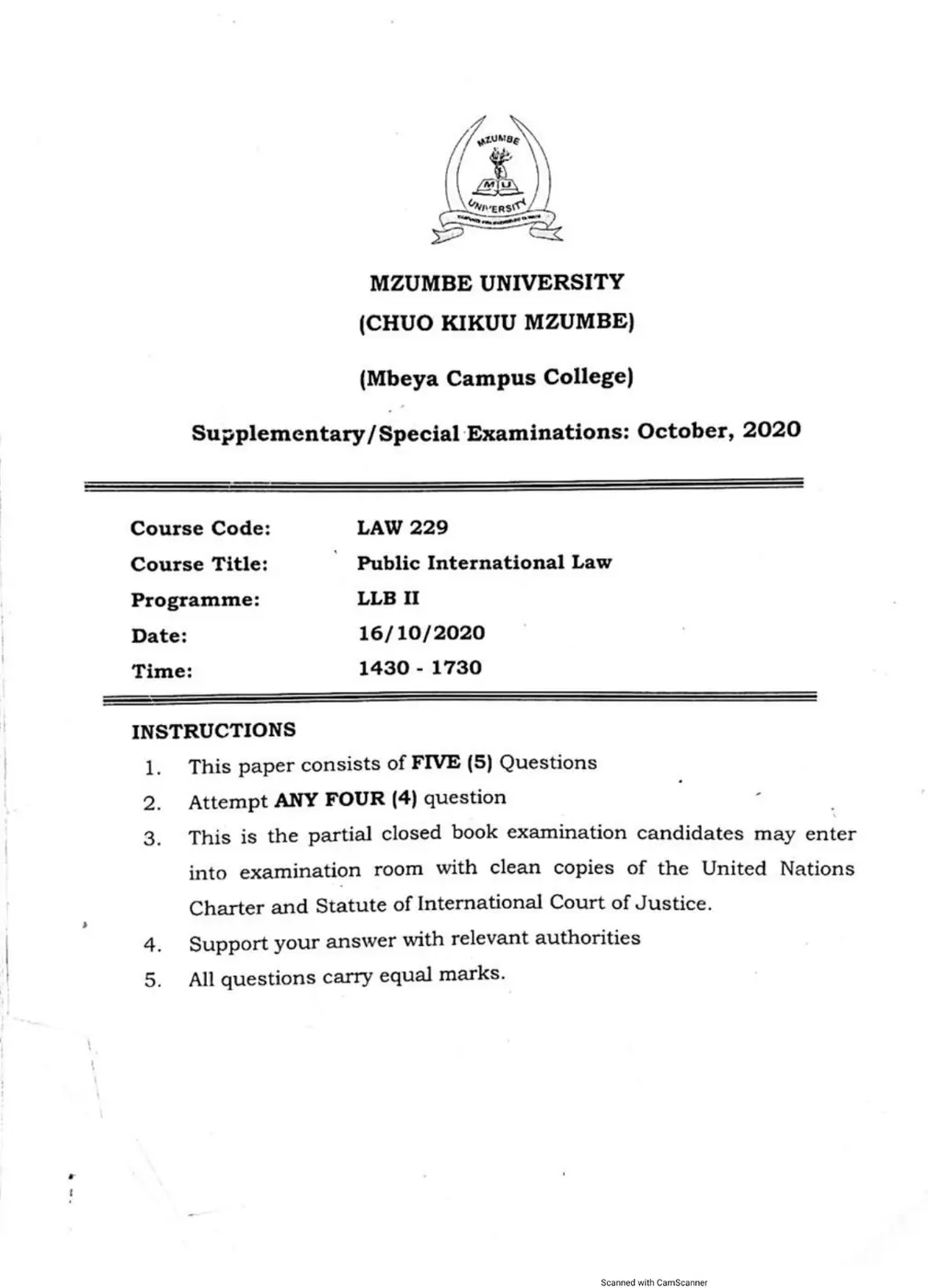
Five questions. Attempt any four. Partial closed book: the UN Charter and the ICJ Statute allowed. All questions carry equal marks.
 Full size
 Full size
Page 3 of 4
Create a free account to see the whole paper. It takes a minute.
Create a free accountAlready a member? Log in
Page 4 of 4
Create a free account to see the whole paper. It takes a minute.
Create a free accountAlready a member? Log inRead the questions as text
This paper consists of FIVE (5) questions. Attempt ANY FOUR (4) questions. This is a partial closed book examination; candidates may enter the examination room with clean copies of the United Nations Charter and the Statute of the International Court of Justice. Support your answer with relevant authorities. All questions carry equal marks.
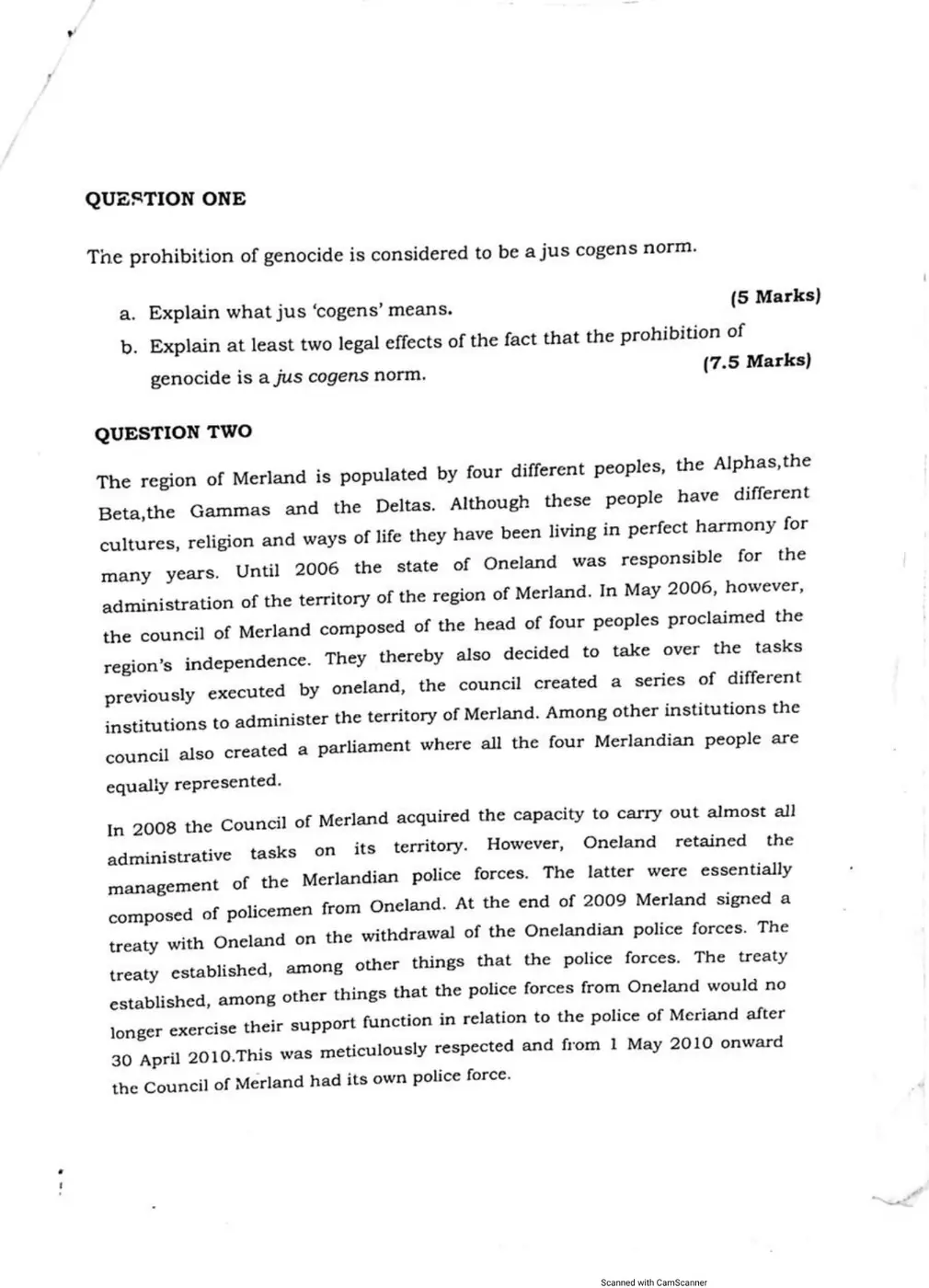
1. The prohibition of genocide is considered to be a jus cogens norm. (a) Explain what jus cogens means. (5 marks) (b) Explain at least two legal effects of the fact that the prohibition of genocide is a jus cogens norm. (7.5 marks)
2. The region of Merland is populated by four different peoples, the Alphas, the Betas, the Gammas and the Deltas. Although these peoples have different cultures, religions and ways of life, they have been living in perfect harmony for many years. Until 2006 the state of Oneland was responsible for the administration of the territory of the region of Merland. In May 2006, however, the Council of Merland, composed of the heads of the four peoples, proclaimed the region’s independence. They thereby also decided to take over the tasks previously executed by Oneland; the Council created a series of different institutions to administer the territory of Merland. Among other institutions the Council also created a parliament where all four Merlandian peoples are equally represented. In 2008 the Council of Merland acquired the capacity to carry out almost all administrative tasks on its territory. However, Oneland retained the management of the Merlandian police forces. The latter were essentially composed of policemen from Oneland. At the end of 2009 Merland signed a treaty with Oneland on the withdrawal of the Onelandian police forces. The treaty established, among other things, that the police forces from Oneland would no longer exercise their support function in relation to the police of Merland after 30 April 2010. This was meticulously respected and from 1 May 2010 onward the Council of Merland had its own police force. At the same time, during 2009, Merland became a party to several international conventions and signed different bilateral treaties, especially of a commercial nature, with various states. At the end of 2010 the majority of the international community had recognised Merland as an independent state. Can it be said that Merland is a state according to international law? If yes, from when onwards? (12.5 marks)
3. The reality of international law, that is to say, the actual use of rules described as rules of international law by governments, is not to be questioned. All normal governments employ experts to provide routine and other advice on matters of international law and constantly define their relations with other states in terms of international law. Governments and their officials routinely use rules which they have for a very long time called “law of nations” or “international law”. The law delimits the competence of states. No journey by air could take place within reasonable limits if it were not for a network of legal structures involving the jurisdiction of states. Treaties reflect the freedom of the classical state and the sovereignty-based international legal system. Is this statement correct? (12.5 marks)
4. State territory is a basis for statehood. Germany acquired the state territory of Tanzania in the 1960s by the subjugation method following decolonisation; various ethnic groups in Tanzania want to be given separate statehood on the basis of self-determination. Furthermore, Malawi, Zambia and Kenya, bordering Tanzania, are in serious border disputes founded during the colonial era. As an international law expert, show how you can solve such disputes. (12.5 marks)
5. States are considered the original and principal legal subjects of public international law. Provide and discuss two examples illustrating the fact that states possess the most full-blown form of legal personality under international law. (12.5 marks)
Source: Mzumbe University examination paper, October 2020, shared for revision. Rights holders can ask for removal through our Contact page.
Part 2
Public International Law Past Paper Answers: Model Answers to All 5 Questions
Question 1 is answered in full below, free. Tap any other question to see it and a preview of its answer.
Q1Question 1: Jus cogens and the legal effects of the prohibition of genocide
12.5 marks · Essay Free answer
The question
The prohibition of genocide is considered to be a jus cogens norm. (a) Explain what jus cogens means. (5 marks) (b) Explain at least two legal effects of the fact that the prohibition of genocide is a jus cogens norm. (7.5 marks)
Model answer
The short answer
(a) jus cogens means a peremptory norm of general international law, accepted and recognised by the international community of states as a whole as a norm from which no derogation is permitted. (b) Because the prohibition of genocide is such a norm: any treaty conflicting with it is void; it creates obligations owed to the international community as a whole, so any state may invoke a breach; no circumstance such as consent or necessity can justify genocide; and states must not recognise or assist a situation created by a serious breach.
(a) Meaning
- Article 53 of the Vienna Convention on the Law of Treaties, 1969 (VCLT) defines a peremptory norm of general international law as a norm accepted and recognised by the international community of states as a whole as one from which no derogation is permitted and which can be modified only by a later norm of the same character.
- Such norms protect fundamental values of the international community. Generally accepted examples include the prohibitions of genocide, aggression, slavery, torture, racial discrimination and apartheid, crimes against humanity, and the right of peoples to self-determination.
- The International Court of Justice confirmed that the prohibition of genocide is a peremptory norm in Armed Activities on the Territory of the Congo (Democratic Republic of the Congo v Rwanda) (Jurisdiction and Admissibility, 2006).
(b) Legal effects
- Invalidity of conflicting treaties: a treaty that conflicts with a peremptory norm at the time of its conclusion is void (VCLT art. 53); an existing treaty that conflicts with a newly emerged peremptory norm becomes void and terminates (art. 64). A treaty between two states agreeing to destroy a minority group would be void from the start.
- Obligations erga omnes: the prohibition of genocide is owed to the international community as a whole (Barcelona Traction, Light and Power Co (Belgium v Spain), ICJ 1970). Every state has a legal interest in its observance, so a state not directly injured may bring a claim. In The Gambia v Myanmar (Preliminary Objections, 2022), the ICJ accepted The Gambia’s standing to bring a case under the Genocide Convention although its own nationals were not affected.
- No justification: under the International Law Commission’s Articles on State Responsibility (2001), circumstances such as consent, necessity or countermeasures cannot justify conduct that breaches a peremptory norm (art. 26). A state cannot claim another state consented to genocide on its territory.
- Duties of all states after a serious breach: states must cooperate to bring the breach to an end through lawful means, and must not recognise as lawful a situation created by it or give aid or assistance in maintaining it (Articles on State Responsibility, arts. 40 and 41).
- Individual criminal responsibility and jurisdiction: genocide is punishable under the Genocide Convention, 1948 and the Rome Statute of the International Criminal Court; it is widely accepted that it may be prosecuted under universal jurisdiction, and official position is no defence before international courts.
What the examiner wants
An accurate definition from article 53 VCLT, examples, and at least two clearly explained effects with authority.
Common mistakes
- Confusing jus cogens with obligations erga omnes without explaining their relationship (jus cogens concerns the hierarchy of norms; erga omnes concerns to whom obligations are owed).
- Giving only one effect.
Q2Question 2: Is Merland a state, and from when?
12.5 marks · Problem Locked
The question
The region of Merland is populated by four different peoples, the Alphas, the Betas, the Gammas and the Deltas. Although these peoples have different cultures, religions and ways of life, they have been living in perfect harmony for many years. Until 2006 the state of Oneland was responsible for the administration of the territory of the region of Merland. In May 2006, however, the Council of Merland, composed of the heads of the four peoples, proclaimed the region’s independence. They thereby also decided to take over the tasks previously executed by Oneland; the Council created a series of different institutions to administer the territory of Merland. Among other institutions the Council also created a parliament where all four Merlandian peoples are equally represented. In 2008 the Council of Merland acquired the capacity to carry out almost all administrative tasks on its territory. However, Oneland retained the management of the Merlandian police forces. The latter were essentially composed of policemen from Oneland. At the end of 2009 Merland signed a treaty with Oneland on the withdrawal of the Onelandian police forces. The treaty established, among other things, that the police forces from Oneland would no longer exercise their support function in relation to the police of Merland after 30 April 2010. This was meticulously respected and from 1 May 2010 onward the Council of Merland had its own police force. At the same time, during 2009, Merland became a party to several international conventions and signed different bilateral treaties, especially of a commercial nature, with various states. At the end of 2010 the majority of the international community had recognised Merland as an independent state. Can it be said that Merland is a state according to international law? If yes, from when onwards? (12.5 marks)
Model answer
Unlock the model answer to Question 2
Get all 4 locked answers on this paper for TSh 3,000. Pay once, keep them in Your Library for life.
Get the solved paper · TSh 3,000Or get every solved paper with Elite
Q3Question 3: Is international law real law?
12.5 marks · Essay Locked
The question
The reality of international law, that is to say, the actual use of rules described as rules of international law by governments, is not to be questioned. All normal governments employ experts to provide routine and other advice on matters of international law and constantly define their relations with other states in terms of international law. Governments and their officials routinely use rules which they have for a very long time called “law of nations” or “international law”. The law delimits the competence of states. No journey by air could take place within reasonable limits if it were not for a network of legal structures involving the jurisdiction of states. Treaties reflect the freedom of the classical state and the sovereignty-based international legal system. Is this statement correct? (12.5 marks)
Model answer
Unlock the model answer to Question 3
Get all 4 locked answers on this paper for TSh 3,000. Pay once, keep them in Your Library for life.
Get the solved paper · TSh 3,000Or get every solved paper with Elite
Q4Question 4: Territory, self-determination and colonial border disputes
12.5 marks · Problem Locked
The question
State territory is a basis for statehood. Germany acquired the state territory of Tanzania in the 1960s by the subjugation method following decolonisation; various ethnic groups in Tanzania want to be given separate statehood on the basis of self-determination. Furthermore, Malawi, Zambia and Kenya, bordering Tanzania, are in serious border disputes founded during the colonial era. As an international law expert, show how you can solve such disputes. (12.5 marks)
Model answer
Unlock the model answer to Question 4
Get all 4 locked answers on this paper for TSh 3,000. Pay once, keep them in Your Library for life.
Get the solved paper · TSh 3,000Or get every solved paper with Elite
Q5Question 5: Why states have the fullest international legal personality
12.5 marks · Essay Locked
The question
States are considered the original and principal legal subjects of public international law. Provide and discuss two examples illustrating the fact that states possess the most full-blown form of legal personality under international law. (12.5 marks)
Model answer
Unlock the model answer to Question 5
Get all 4 locked answers on this paper for TSh 3,000. Pay once, keep them in Your Library for life.
Get the solved paper · TSh 3,000Or get every solved paper with Elite
Get the Full Solved Paper
All 5 questions answered with the statutes and cases that apply, what the examiner wants and the mistakes to avoid. TSh 3,000, yours for life in Your Library.
Pata majibu yote ya mtihani huu kwa TSh 3,000 tu.




Statutes and Cases for This Public International Law Past Paper
- Charter of the United Nations, 1945Sovereign equality (art. 2(1)), peaceful settlement (arts. 2(3), 33), prohibition of force (art. 2(4)), compliance with ICJ judgments (art. 94)
- Statute of the International Court of JusticeSources of international law (art. 38), only states as parties in contentious cases (art. 34(1))
- Vienna Convention on the Law of Treaties, 1969Capacity of states (art. 6), pacta sunt servanda (art. 26), jus cogens (arts. 53, 64)
- Montevideo Convention on the Rights and Duties of States, 1933Criteria for statehood (art. 1), declaratory recognition (art. 3)
- Convention on the Prevention and Punishment of the Crime of Genocide, 1948Prohibition and punishment of genocide
- Constitutive Act of the African Union, 2000Respect for borders existing at independence (art. 4(b))
- Armed Activities on the Territory of the Congo (DRC v Rwanda), ICJ 2006Prohibition of genocide is jus cogens
- Barcelona Traction (Belgium v Spain), ICJ 1970Obligations erga omnes
- Frontier Dispute (Burkina Faso/Mali), ICJ 1986Uti possidetis juris
- Reparation for Injuries Suffered in the Service of the United Nations, ICJ 1949Personality of international organisations compared with states
- Accordance with International Law of the Unilateral Declaration of Independence in respect of Kosovo, ICJ 2010Declarations of independence
- S.S. Lotus (France v Turkey), PCIJ 1927Sovereignty-based view of international law
Mzumbe Public International Law Past Paper: Common Questions
Is this the real Mzumbe Public International Law exam paper?
Yes. These are scans of the Supplementary/Special Examination, October 2020 paper for LAW 229 Public International Law at Mzumbe University, sat on 16 October 2020. Nothing has been retyped or changed.
How many questions do you answer in this Public International Law paper?
Five questions. Attempt any four. Partial closed book: the UN Charter and the ICJ Statute allowed. All questions carry equal marks.
Are there answers to this past paper?
Yes. All 5 questions have full model answers written to Tanzanian law and reviewed by Isack Kimaro, LL.B, PDLP. The Question 1 answer is free; the full solved paper is TSh 3,000 (TSh 2,000 for Pro members) and is included in Elite.
How do I see every page of the paper?
The first pages are open to everyone. Create a free account to read the whole paper.