

About this paper
Solved answers to all 5 questions
Part 1
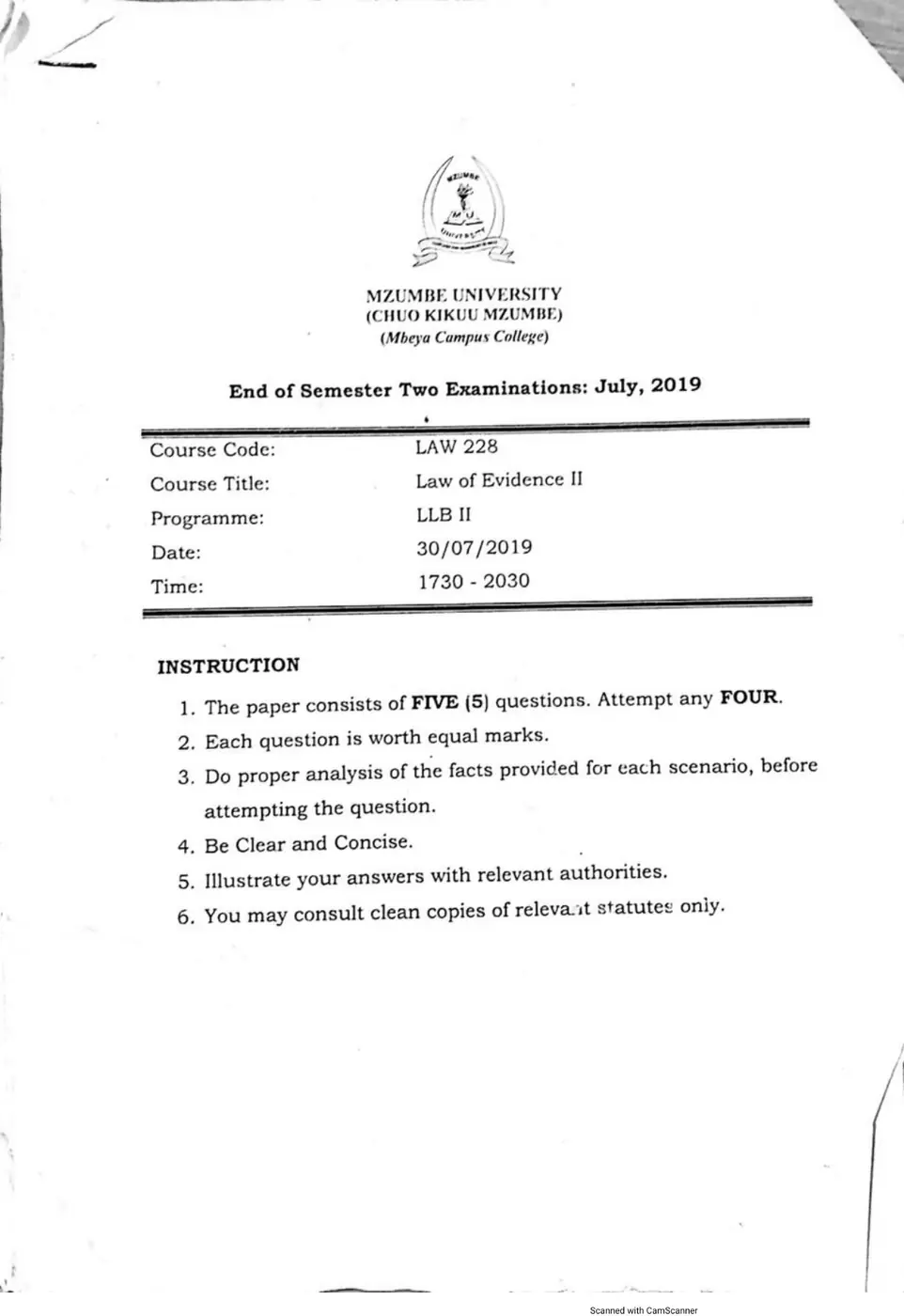
Mzumbe Law of Evidence II Past Paper (LAW 228): The Full Exam as Set
Five questions. Attempt any four. Each question carries equal marks. Illustrate your answers with relevant authorities.
 Full size
 Full size
Page 3 of 5
Create a free account to see the whole paper. It takes a minute.
Create a free accountAlready a member? Log in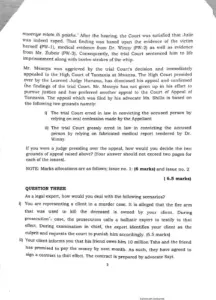
Page 4 of 5
Create a free account to see the whole paper. It takes a minute.
Create a free accountAlready a member? Log in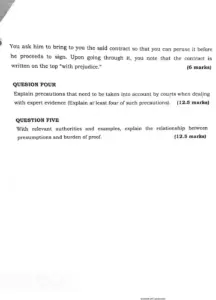
Page 5 of 5
Create a free account to see the whole paper. It takes a minute.
Create a free accountAlready a member? Log inRead the questions as text
The paper consists of FIVE (5) questions. Attempt any FOUR. Each question is worth equal marks. Do proper analysis of the facts provided for each scenario before attempting the question. Be clear and concise. Illustrate your answers with relevant authorities. You may consult clean copies of relevant statutes only.
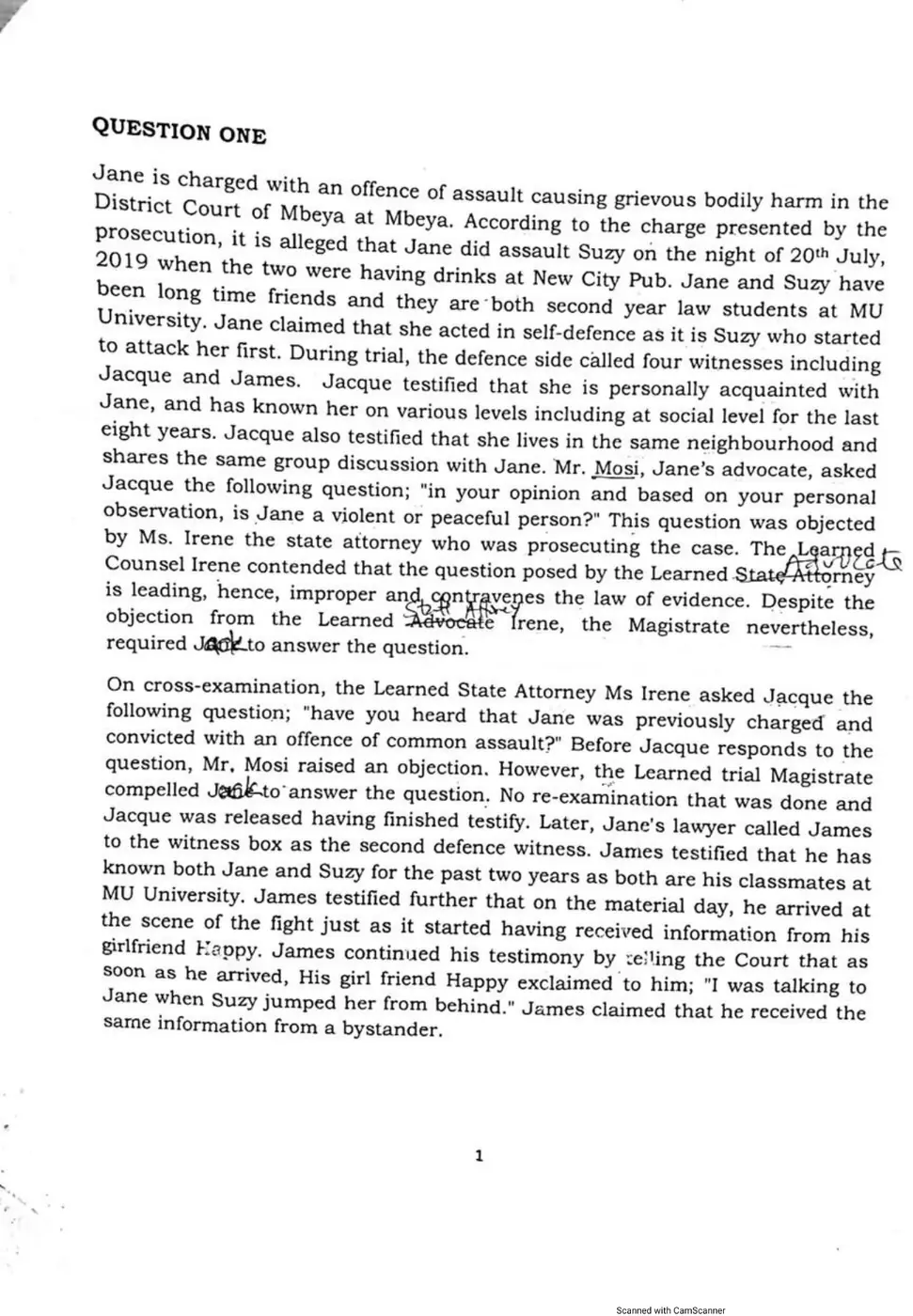
1. Jane is charged with an offence of assault causing grievous bodily harm in the District Court of Mbeya at Mbeya. According to the charge presented by the prosecution, it is alleged that Jane did assault Suzy on the night of 20th July, 2019 when the two were having drinks at New City Pub. Jane and Suzy have been long time friends and they are both second year law students at MU University. Jane claimed that she acted in self-defence as it is Suzy who started to attack her first. During trial, the defence side called four witnesses including Jacque and James. Jacque testified that she is personally acquainted with Jane, and has known her on various levels including at social level for the last eight years. Jacque also testified that she lives in the same neighbourhood and shares the same group discussion with Jane. Mr. Mosi, Jane’s advocate, asked Jacque the following question: “in your opinion and based on your personal observation, is Jane a violent or peaceful person?” This question was objected by Ms. Irene the State Attorney who was prosecuting the case. The Learned State Attorney Irene contended that the question posed by the Learned Advocate is leading, hence improper and contravenes the law of evidence. Despite the objection from the Learned State Attorney Irene, the Magistrate nevertheless required Jacque to answer the question. On cross-examination, the Learned State Attorney Ms Irene asked Jacque the following question: “have you heard that Jane was previously charged and convicted with an offence of common assault?” Before Jacque responds to the question, Mr. Mosi raised an objection. However, the Learned trial Magistrate compelled Jacque to answer the question. No re-examination was done and Jacque was released having finished testifying. Later, Jane’s lawyer called James to the witness box as the second defence witness. James testified that he has known both Jane and Suzy for the past two years as both are his classmates at MU University. James testified further that on the material day, he arrived at the scene of the fight just as it started having received information from his girlfriend Happy. James continued his testimony by telling the Court that as soon as he arrived, his girlfriend Happy exclaimed to him: “I was talking to Jane when Suzy jumped her from behind.” James claimed that he received the same information from a bystander. With reasons and relevant authorities address the following issues: (i) Was the Learned Magistrate’s ruling on the objection by the State Attorney proper? (4 marks) (ii) Was the Learned Magistrate’s ruling on the objection by Jane’s advocate proper? (4 marks) (iii) If you were the State Attorney, is there anything that you would do to convince the Court not to accept James’s testimony and on what legal basis? (4.5 marks)
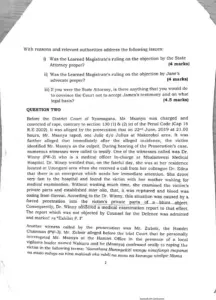
2. Before the District Court of Nyamagana, Mr. Msanya was charged and convicted of rape, contrary to section 130(1) & (2)(e) of the Penal Code (Cap 16 R.E. 2002). It was alleged by the prosecution that on 22nd June, 2019 at 21.00 hours, Mr. Msanya raped one Julie d/o Julius at Makoroboi area. It was further alleged that immediately after the alleged incident, the victim identified Mr. Msanya as the culprit. During hearing of the prosecution’s case, numerous witnesses were called to testify. One of the witnesses called was Dr. Winny (PW-2), who is a medical officer in-charge at Mbalamwezi Medical Hospital. Dr. Winny testified that, on the fateful day, she was at her residence located at Uzunguni area when she received a call from her colleague Dr. Edna that there was an emergency which needed her immediate attention. She drove very fast to the hospital and found the victim with her mother waiting for medical examination. Without wasting much time, she examined the victim’s private parts and established, inter alia, that they were ruptured and blood was oozing therefrom. According to Dr. Winny, this situation was caused by a forced penetration into the victim’s private parts of a blunt object. Consequently, Dr. Winny tendered a medical examination report to that effect. The report, which was not objected to by counsel for the defence, was admitted and marked as “Exhibit P.1”. Another witness called by the prosecution was Mr. Zubeir, the Hamlet Chairman (PW-3). Mr. Zubeir alleged before the trial court that he personally interrogated Mr. Msanya at the Hamlet Office in the presence of a local vigilante leader named Wakuru, and he (Msanya) confessed orally to raping the victim in the following terms: “Samahani Mwenyekiti wangu nimefanya mapenzi na mtoto mdogo na nina mahindi eka mbili na nusu na karanga nimlipe Mama mwenye mtoto ili yaishe.” After the hearing, the court was satisfied that Julie was indeed raped. That finding was based upon the evidence of the victim herself (PW-1), medical evidence from Dr. Winny (PW-2) as well as evidence from Mr. Zubeir (PW-3). Consequently, the trial court sentenced him to life imprisonment along with twelve strokes of the whip. Mr. Msanya was aggrieved by the trial court’s decision and immediately appealed to the High Court of Tanzania at Mwanza. The High Court, presided over by the Learned Judge Huruma, dismissed his appeal and confirmed the findings of the trial court. Mr. Msanya has preferred another appeal to the Court of Appeal of Tanzania. The appeal, filed by his advocate Ms. Shilla, is based on the following two grounds: (i) The trial court erred in law in convicting the accused person by relying on an oral confession made by the appellant; (ii) The trial court grossly erred in law in convicting the accused person by relying on a fabricated medical report tendered by Dr. Winny. If you were a judge presiding over the appeal, how would you decide the two grounds of appeal raised above? (Your answer should not exceed two pages for each of the issues.) Issue no. 1: (6 marks); issue no. 2: (6.5 marks).
3. As a legal expert, how would you deal with the following scenarios? (i) You are representing a client in a murder case. It is alleged that the firearm that was used to kill the deceased is owned by your client. During the prosecution’s case, the prosecution calls a ballistic expert to testify to that effect. During examination in chief, the expert identifies your client as the culprit and requests the court to punish him accordingly. (6.5 marks) (ii) Your client informs you that his friend owes him 10 million Tshs and the friend has promised to pay the money by next month. As such, they have agreed to sign a contract to that effect. The contract is prepared by advocate Sayi. You ask him to bring to you the said contract so that you can peruse it before he proceeds to sign. Upon going through it, you note that the contract is written on the top “with prejudice.” (6 marks)
4. Explain precautions that need to be taken into account by courts when dealing with expert evidence (explain at least four of such precautions). (12.5 marks)
5. With relevant authorities and examples, explain the relationship between presumptions and burden of proof. (12.5 marks)
Source: Mzumbe University examination paper, July 2019, shared for revision. Rights holders can ask for removal through our Contact page.
Part 2
Law of Evidence II Past Paper Answers: Model Answers to All 5 Questions
Question 1 is answered in full below, free. Tap any other question to see it and a preview of its answer.
Q1Question 1: Character evidence, leading questions and hearsay in Jane's assault trial
12.5 marks · Problem Free answer
The question
Jane is charged with an offence of assault causing grievous bodily harm in the District Court of Mbeya at Mbeya. According to the charge presented by the prosecution, it is alleged that Jane did assault Suzy on the night of 20th July, 2019 when the two were having drinks at New City Pub. Jane and Suzy have been long time friends and they are both second year law students at MU University. Jane claimed that she acted in self-defence as it is Suzy who started to attack her first. During trial, the defence side called four witnesses including Jacque and James. Jacque testified that she is personally acquainted with Jane, and has known her on various levels including at social level for the last eight years. Jacque also testified that she lives in the same neighbourhood and shares the same group discussion with Jane. Mr. Mosi, Jane’s advocate, asked Jacque the following question: “in your opinion and based on your personal observation, is Jane a violent or peaceful person?” This question was objected by Ms. Irene the State Attorney who was prosecuting the case. The Learned State Attorney Irene contended that the question posed by the Learned Advocate is leading, hence improper and contravenes the law of evidence. Despite the objection from the Learned State Attorney Irene, the Magistrate nevertheless required Jacque to answer the question. On cross-examination, the Learned State Attorney Ms Irene asked Jacque the following question: “have you heard that Jane was previously charged and convicted with an offence of common assault?” Before Jacque responds to the question, Mr. Mosi raised an objection. However, the Learned trial Magistrate compelled Jacque to answer the question. No re-examination was done and Jacque was released having finished testifying. Later, Jane’s lawyer called James to the witness box as the second defence witness. James testified that he has known both Jane and Suzy for the past two years as both are his classmates at MU University. James testified further that on the material day, he arrived at the scene of the fight just as it started having received information from his girlfriend Happy. James continued his testimony by telling the Court that as soon as he arrived, his girlfriend Happy exclaimed to him: “I was talking to Jane when Suzy jumped her from behind.” James claimed that he received the same information from a bystander. With reasons and relevant authorities address the following issues: (i) Was the Learned Magistrate’s ruling on the objection by the State Attorney proper? (4 marks) (ii) Was the Learned Magistrate’s ruling on the objection by Jane’s advocate proper? (4 marks) (iii) If you were the State Attorney, is there anything that you would do to convince the Court not to accept James’s testimony and on what legal basis? (4.5 marks)
Model answer
The short answer
(i) the Magistrate was right to let Jacque answer: a question that offers both alternatives (“violent or peaceful”) does not suggest the answer, and an accused may call evidence of her good character. (ii) The Magistrate was mostly right: once the defence put Jane’s good character in issue, the prosecution could reply with her bad character, including a previous conviction. The words “charged and” should have been ruled out, because a mere charge proves nothing. (iii) As State Attorney you would object that Happy’s words and the bystander’s words are hearsay, insist that Happy be called herself, and attack James’s credibility.
Sections below are from the Evidence Act, Cap. 6 R.E. 2023. The 2023 revision renumbered the Act, so older textbooks use different numbers.
Note on the facts: the paper mixes up the titles. The objection in (i) came from Ms. Irene, the State Attorney, against a question asked by Mr. Mosi, Jane’s advocate. The answer treats it that way.
(i) The State Attorney’s objection: was the question leading?
- Rule: a leading question is one that suggests the answer the person asking wishes or expects to receive (section 159). It may not be asked in examination-in-chief if the other side objects, unless the court allows it (section 160).
- Application: Mr. Mosi asked whether Jane is “a violent or peaceful person”. The question puts both possible answers to the witness and does not indicate which one is wanted. That is not a leading question.
- Was the evidence itself admissible? In criminal proceedings, the fact that the accused is of good character is relevant (section 60). Character includes both reputation and disposition (section 62). Jacque has known Jane for eight years as a neighbour and classmate, so she can speak to Jane’s general disposition. She must not narrate particular past incidents; section 62 limits character evidence to general reputation and disposition. At common law, too, character evidence was confined to general reputation: R v Rowton (1865) Le & Ca 520.
- Conclusion: the ruling was proper. The question was not leading, and good-character evidence is admissible for the accused, especially where she pleads self-defence and says Suzy was the aggressor.
(ii) The defence objection: may the prosecution ask about a previous conviction?
- Rule: bad character of the accused is irrelevant in criminal proceedings, unless evidence has been given that she is of good character, in which case it becomes relevant (section 61(1)). A previous conviction is relevant as evidence of bad character (section 61(3)). A witness may be asked questions in cross-examination that test her veracity or shake her credit (section 164), and the court decides whether she must answer (section 167).
- Application: the defence opened the door by calling Jacque to say Jane is peaceful. The prosecution may then test the basis of that opinion: if Jacque has heard of a conviction for assault and still calls Jane peaceful, her evidence is weakened; if she has not heard of it, her knowledge of Jane is shown to be limited.
- The flaw: the question asked whether Jane was “previously charged and convicted”. A conviction is evidence of bad character; a bare charge is not, because a charge that ended in acquittal or withdrawal proves nothing. The House of Lords held in Maxwell v DPP [1935] AC 309 that questions about a previous charge which did not end in conviction are improper. The Magistrate should have confined the question to the conviction.
- Conclusion: the ruling was substantially proper. The question was permissible in reply to good-character evidence, but the reference to a mere charge should have been excluded.
(iii) Attacking James’s testimony as State Attorney
- Object that it is hearsay. Oral evidence must be direct: a fact that could be seen must be proved by the person who saw it (section 67(1)). James arrived as the fight started; he did not see how it began. He is repeating what Happy and a bystander told him, offered to prove that Suzy attacked first. That is hearsay and inadmissible.
- Answer the “same transaction” argument. The defence will say Happy’s exclamation is admissible because it was so connected with the fight as to form part of the same transaction (section 8). Statements made spontaneously in the heat of the event, with no chance to concoct, can be admitted on this basis: Ratten v R [1972] AC 378 (PC); R v Andrews [1987] AC 281 (HL). You would argue that Happy’s words were a narrative of what had already happened (“I was talking to Jane when Suzy jumped her”), told to her boyfriend, who is friendly with the accused, so the possibility of concoction cannot be excluded.
- Insist on the best evidence. Happy is alive and available. None of the exceptions for statements by persons who cannot be called applies (section 34). If the defence wants her account, it must call her so that she can be cross-examined.
- The bystander’s statement is from an unidentified person and is plain hearsay with no exception. It should be excluded entirely.
- Impeach James’s credit (section 173): he is a classmate of the accused, he came to the scene because his girlfriend called him, and he has no first-hand knowledge of who started the fight.
What the examiner wants
The definition of a leading question, the good-character and bad-character rules and how they interact, the difference between a charge and a conviction, and a clear hearsay analysis with the same-transaction exception.
Common mistakes
- Calling every question with a yes/no flavour “leading”. A question offering both options is not.
- Saying bad character can never be raised. Section 61(1) allows it once good character is put in issue.
- Treating Happy’s words as automatically admissible res gestae without testing spontaneity.
Q2Question 2: Appeal on an oral confession to a hamlet chairman and a medical report
12.5 marks · Problem Locked
The question
Before the District Court of Nyamagana, Mr. Msanya was charged and convicted of rape, contrary to section 130(1) & (2)(e) of the Penal Code (Cap 16 R.E. 2002). It was alleged by the prosecution that on 22nd June, 2019 at 21.00 hours, Mr. Msanya raped one Julie d/o Julius at Makoroboi area. It was further alleged that immediately after the alleged incident, the victim identified Mr. Msanya as the culprit. During hearing of the prosecution’s case, numerous witnesses were called to testify. One of the witnesses called was Dr. Winny (PW-2), who is a medical officer in-charge at Mbalamwezi Medical Hospital. Dr. Winny testified that, on the fateful day, she was at her residence located at Uzunguni area when she received a call from her colleague Dr. Edna that there was an emergency which needed her immediate attention. She drove very fast to the hospital and found the victim with her mother waiting for medical examination. Without wasting much time, she examined the victim’s private parts and established, inter alia, that they were ruptured and blood was oozing therefrom. According to Dr. Winny, this situation was caused by a forced penetration into the victim’s private parts of a blunt object. Consequently, Dr. Winny tendered a medical examination report to that effect. The report, which was not objected to by counsel for the defence, was admitted and marked as “Exhibit P.1”. Another witness called by the prosecution was Mr. Zubeir, the Hamlet Chairman (PW-3). Mr. Zubeir alleged before the trial court that he personally interrogated Mr. Msanya at the Hamlet Office in the presence of a local vigilante leader named Wakuru, and he (Msanya) confessed orally to raping the victim in the following terms: “Samahani Mwenyekiti wangu nimefanya mapenzi na mtoto mdogo na nina mahindi eka mbili na nusu na karanga nimlipe Mama mwenye mtoto ili yaishe.” After the hearing, the court was satisfied that Julie was indeed raped. That finding was based upon the evidence of the victim herself (PW-1), medical evidence from Dr. Winny (PW-2) as well as evidence from Mr. Zubeir (PW-3). Consequently, the trial court sentenced him to life imprisonment along with twelve strokes of the whip. Mr. Msanya was aggrieved by the trial court’s decision and immediately appealed to the High Court of Tanzania at Mwanza. The High Court, presided over by the Learned Judge Huruma, dismissed his appeal and confirmed the findings of the trial court. Mr. Msanya has preferred another appeal to the Court of Appeal of Tanzania. The appeal, filed by his advocate Ms. Shilla, is based on the following two grounds: (i) The trial court erred in law in convicting the accused person by relying on an oral confession made by the appellant; (ii) The trial court grossly erred in law in convicting the accused person by relying on a fabricated medical report tendered by Dr. Winny. If you were a judge presiding over the appeal, how would you decide the two grounds of appeal raised above? (Your answer should not exceed two pages for each of the issues.) Issue no. 1: (6 marks); issue no. 2: (6.5 marks).
Model answer
Unlock the model answer to Question 2
Get all 4 locked answers on this paper for TSh 3,000. Pay once, keep them in Your Library for life.
Get the solved paper · TSh 3,000Or get every solved paper with Elite
Q3Question 3: A ballistic expert who names the culprit, and a debt contract marked "with prejudice"
12.5 marks · Problem Locked
The question
As a legal expert, how would you deal with the following scenarios? (i) You are representing a client in a murder case. It is alleged that the firearm that was used to kill the deceased is owned by your client. During the prosecution’s case, the prosecution calls a ballistic expert to testify to that effect. During examination in chief, the expert identifies your client as the culprit and requests the court to punish him accordingly. (6.5 marks) (ii) Your client informs you that his friend owes him 10 million Tshs and the friend has promised to pay the money by next month. As such, they have agreed to sign a contract to that effect. The contract is prepared by advocate Sayi. You ask him to bring to you the said contract so that you can peruse it before he proceeds to sign. Upon going through it, you note that the contract is written on the top “with prejudice.” (6 marks)
Model answer
Unlock the model answer to Question 3
Get all 4 locked answers on this paper for TSh 3,000. Pay once, keep them in Your Library for life.
Get the solved paper · TSh 3,000Or get every solved paper with Elite
Q4Question 4: Precautions courts take with expert evidence
12.5 marks · Essay Locked
The question
Explain precautions that need to be taken into account by courts when dealing with expert evidence (explain at least four of such precautions). (12.5 marks)
Model answer
Unlock the model answer to Question 4
Get all 4 locked answers on this paper for TSh 3,000. Pay once, keep them in Your Library for life.
Get the solved paper · TSh 3,000Or get every solved paper with Elite
Q5Question 5: How presumptions relate to the burden of proof
12.5 marks · Essay Locked
The question
With relevant authorities and examples, explain the relationship between presumptions and burden of proof. (12.5 marks)
Model answer
Unlock the model answer to Question 5
Get all 4 locked answers on this paper for TSh 3,000. Pay once, keep them in Your Library for life.
Get the solved paper · TSh 3,000Or get every solved paper with Elite
Get the Full Solved Paper
All 5 questions answered with the statutes and cases that apply, what the examiner wants and the mistakes to avoid. TSh 3,000, yours for life in Your Library.
Pata majibu yote ya mtihani huu kwa TSh 3,000 tu.




Statutes and Cases for This Law of Evidence II Past Paper
- Evidence Act, Cap. 6 R.E. 2023Same transaction (s.8), admissions without prejudice (s.25), confessions (ss.3, 27-30), expert opinion (ss.52-53, 58), character (ss.60-62), direct oral evidence (s.67), burden of proof and presumptions (ss.4-6, 117-130), victim's evidence (s.135(6)), leading questions (ss.159-161), cross-examination and credit (ss.164, 167, 173)
- Criminal Procedure Act, Cap. 20Medical reports and the right to call the maker (s.240)
- Alex Ndendya v Republic, Criminal Appeal No. 207 of 2018 [2020] TZCA 202Oral confession before reliable civilian witnesses may found a conviction if the accused was a free agent
- Selemani Makumba v Republic [2006] TLR 379 (CA)True evidence of rape comes from the victim
- Goodluck Kyando v Republic [2006] TLR 363 (CA)Every witness is entitled to credence
- DPP v Jaffari Mfaume Kawawa [1981] TLR 149 (CA)Second appellate court and concurrent findings of fact
- R v Rowton (1865) Le & Ca 520Character evidence means general reputation
- Maxwell v DPP [1935] AC 309 (HL)A charge that did not end in conviction is not evidence of bad character
- Ratten v R [1972] AC 378 (PC); R v Andrews [1987] AC 281 (HL)Spontaneous statements forming part of the event
- Davie v Edinburgh Magistrates 1953 SC 34The court is not bound by expert opinion
- Woolmington v DPP [1935] AC 462 (HL)The prosecution bears the burden of proof
Mzumbe Law of Evidence II Past Paper: Common Questions
Is this the real Mzumbe Law of Evidence II exam paper?
Yes. These are scans of the End of Semester Two Examination, July 2019 paper for LAW 228 Law of Evidence II at Mzumbe University, sat on 30 July 2019. Nothing has been retyped or changed.
How many questions do you answer in this Law of Evidence II paper?
Five questions. Attempt any four. Each question carries equal marks. Illustrate your answers with relevant authorities.
Are there answers to this past paper?
Yes. All 5 questions have full model answers written to Tanzanian law and reviewed by Isack Kimaro, LL.B, PDLP. The Question 1 answer is free; the full solved paper is TSh 3,000 (TSh 2,000 for Pro members) and is included in Elite.
How do I see every page of the paper?
The first pages are open to everyone. Create a free account to read the whole paper.