

About this paper
Solved answers to all 5 questions
Part 1
Mzumbe Land Law Past Paper (LAW 221): The Full Exam as Set
Five questions. Attempt any four. All questions carry equal marks. Support your answers with relevant authorities.
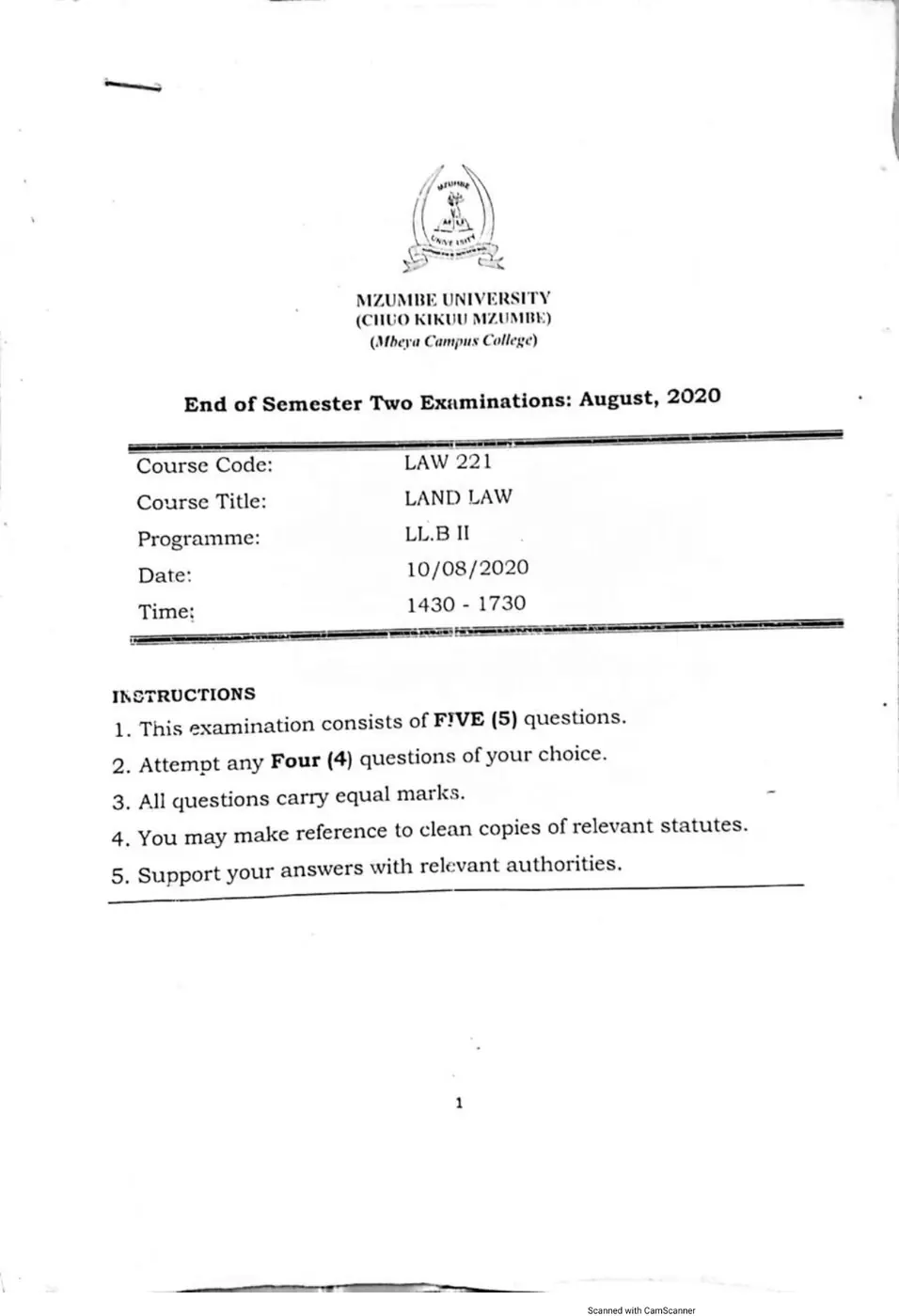 Full size
 Full size
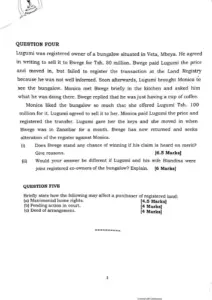
Page 3 of 3
Create a free account to see the whole paper. It takes a minute.
Create a free accountAlready a member? Log inRead the questions as text
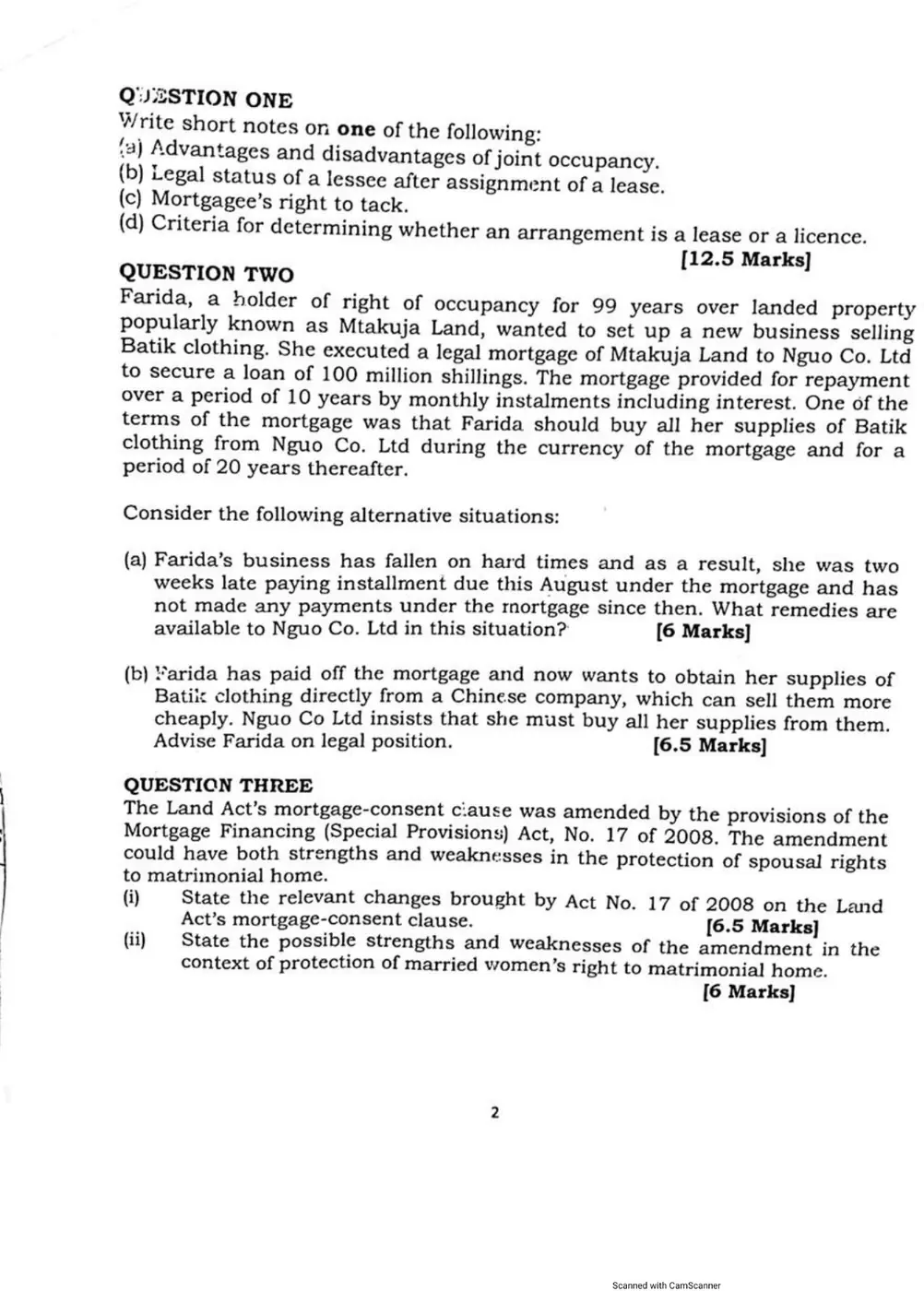
1. Write short notes on one of the following: (a) Advantages and disadvantages of joint occupancy. (b) Legal status of a lessee after assignment of a lease. (c) Mortgagee’s right to tack. (d) Criteria for determining whether an arrangement is a lease or a licence. (12.5 marks)
2. Farida, a holder of right of occupancy for 99 years over landed property popularly known as Mtakuja Land, wanted to set up a new business selling Batik clothing. She executed a legal mortgage of Mtakuja Land to Nguo Co. Ltd to secure a loan of 100 million shillings. The mortgage provided for repayment over a period of 10 years by monthly instalments including interest. One of the terms of the mortgage was that Farida should buy all her supplies of Batik clothing from Nguo Co. Ltd during the currency of the mortgage and for a period of 20 years thereafter. Consider the following alternative situations:
(a) Farida’s business has fallen on hard times and as a result, she was two weeks late paying installment due this August under the mortgage and has not made any payments under the mortgage since then. What remedies are available to Nguo Co. Ltd in this situation? (6 marks)
(b) Farida has paid off the mortgage and now wants to obtain her supplies of Batik clothing directly from a Chinese company, which can sell them more cheaply. Nguo Co Ltd insists that she must buy all her supplies from them. Advise Farida on legal position. (6.5 marks)
3. The Land Act’s mortgage-consent clause was amended by the provisions of the Mortgage Financing (Special Provisions) Act, No. 17 of 2008. The amendment could have both strengths and weaknesses in the protection of spousal rights to matrimonial home. (i) State the relevant changes brought by Act No. 17 of 2008 on the Land Act’s mortgage-consent clause. (6.5 marks) (ii) State the possible strengths and weaknesses of the amendment in the context of protection of married women’s right to matrimonial home. (6 marks)
4. Lugumi was registered owner of a bungalow situated in Veta, Mbeya. He agreed in writing to sell it to Bwege for Tsh. 80 million. Bwege paid Lugumi the price and moved in, but failed to register the transaction at the Land Registry because he was not well informed. Soon afterwards, Lugumi brought Monica to see the bungalow. Monica met Bwege briefly in the kitchen and asked him what he was doing there. Bwege replied that he was just having a cup of coffee. Monica liked the bungalow so much that she offered Lugumi Tsh. 100 million for it. Lugumi agreed to sell it to her. Monica paid Lugumi the price and registered the transfer. Lugumi gave her the keys and she moved in when Bwege was in Zanzibar for a month. Bwege has now returned and seeks alteration of the register against Monica. (i) Does Bwege stand any chance of winning if his claim is heard on merit? Give reasons. (6.5 marks) (ii) Would your answer be different if Lugumi and his wife Blandina were joint registered co-owners of the bungalow? Explain. (6 marks)
5. Briefly state how the following may affect a purchaser of registered land: (a) Matrimonial home rights. (4.5 marks) (b) Pending action in court. (4 marks) (c) Deed of arrangement. (4 marks)
Source: Mzumbe University examination paper, August 2020, shared for revision. Rights holders can ask for removal through our Contact page.
Part 2
Land Law Past Paper Answers: Model Answers to All 5 Questions
Question 2 is answered in full below, free. Tap any other question to see it and a preview of its answer.
Q1Question 1: Short notes: joint occupancy, assignment of a lease, tacking, lease or licence
12.5 marks · short notes Locked
The question
Write short notes on one of the following: (a) Advantages and disadvantages of joint occupancy. (b) Legal status of a lessee after assignment of a lease. (c) Mortgagee’s right to tack. (d) Criteria for determining whether an arrangement is a lease or a licence. (12.5 marks)
Model answer
Unlock the model answer to Question 1
Get all 4 locked answers on this paper for TSh 3,000. Pay once, keep them in Your Library for life.
Get the solved paper · TSh 3,000Or get every solved paper with Elite
Q2Question 2: Farida's mortgage: lender's remedies and the 20-year supply tie
12.5 marks · problem Free answer
The question
Farida, a holder of right of occupancy for 99 years over landed property popularly known as Mtakuja Land, wanted to set up a new business selling Batik clothing. She executed a legal mortgage of Mtakuja Land to Nguo Co. Ltd to secure a loan of 100 million shillings. The mortgage provided for repayment over a period of 10 years by monthly instalments including interest. One of the terms of the mortgage was that Farida should buy all her supplies of Batik clothing from Nguo Co. Ltd during the currency of the mortgage and for a period of 20 years thereafter. Consider the following alternative situations:
(a) Farida’s business has fallen on hard times and as a result, she was two weeks late paying installment due this August under the mortgage and has not made any payments under the mortgage since then. What remedies are available to Nguo Co. Ltd in this situation? (6 marks)
(b) Farida has paid off the mortgage and now wants to obtain her supplies of Batik clothing directly from a Chinese company, which can sell them more cheaply. Nguo Co Ltd insists that she must buy all her supplies from them. Advise Farida on legal position. (6.5 marks)
Model answer
The short answer
(a) Farida is in default, so Nguo Co. Ltd must first serve a notice of default giving her the statutory period to pay (Land Act s.127). If she does not pay, the lender may sue for the money, appoint a receiver, lease the land, take possession, or sell it (ss.126 and 128–133), but cannot foreclose (s.125); a sale must be in good faith and aim at the best price reasonably obtainable. (b) The supply tie ends with the mortgage. A collateral term that continues after redemption is a clog on the equity of redemption and void (Noakes v Rice), and a 20-year exclusive supply obligation is also an unreasonable restraint of trade (Law of Contract Act s.27; Esso v Harper’s Garage). Farida is free to buy from the Chinese supplier.
Section numbers follow the Land Act R.E. 2019, in force when the paper was set. The 2025 consolidation renumbers the mortgage provisions (now ss.118–152).
(a) Remedies of Nguo Co. Ltd
Is Farida in default?
Yes. She paid August’s instalment late and has paid nothing since. Failure to pay instalments when due is a default.
Step 1: notice of default
- Before using any remedy, the mortgagee must serve a written notice on the mortgagor stating the nature of the default, the amount needed to cure it, and the period within which to pay, warning that the remedies may be exercised if she does not comply (s.127). After the Mortgage Financing (Special Provisions) Act 2008, the period is 30 days.
- A sale or other remedy without a valid notice may be set aside.
Step 2: remedies (s.126)
- Sue Farida for the money due under the mortgage covenant.
- Appoint a receiver of the income of the land (s.128).
- Lease the mortgaged land (s.129).
- Take possession of the land (s.130).
- Sell the land (s.132). The mortgagee must take reasonable care to obtain the best price reasonably obtainable at the time of sale (s.133), usually by valuation and public auction or private treaty after advertisement.
- Foreclosure is abolished (s.125): Nguo cannot simply take ownership.
- Until the sale is concluded, Farida may redeem by paying all sums due (right of discharge).
- Proceeds go first to costs of sale, then to the debt and interest; any surplus belongs to Farida.
(b) The supply tie after redemption
Clog on the equity of redemption
- A mortgage is security only; once the debt is repaid the mortgagor must get her property back free of the mortgagee’s rights. Any term that prevents or burdens redemption is void.
- Noakes & Co Ltd v Rice [1902] AC 24: a publican’s covenant to buy beer only from the mortgagee brewery even after repayment was void as a clog; it ended on redemption.
- Kreglinger v New Patagonia Meat & Cold Storage Co Ltd [1914] AC 25: a collateral advantage may survive redemption only if it is a separate, fair bargain that does not clog the equity and is not unconscionable.
- Here, the tie is a term of the mortgage itself and extends 20 years after repayment. It is not a separate commercial bargain, so it is a clog and void after redemption.
Restraint of trade
- An agreement by which anyone is restrained from exercising a lawful trade or business is void to that extent (Law of Contract Act, s.27).
- In Esso Petroleum Co Ltd v Harper’s Garage (Stourport) Ltd [1968] AC 269, a 21-year solus tie in a mortgage was held an unreasonable restraint of trade; a tie of under 5 years was upheld. A 30-year total tie (10 + 20 years) is clearly unreasonable.
Advice
Farida may lawfully buy from the Chinese company. If Nguo sues, she can plead that the term is void as a clog and as a restraint of trade. During the mortgage, a tie of reasonable duration might be valid, but it ended when she repaid.
What the examiner wants
(a) default, the notice requirement and the list of remedies with the duty on sale; (b) clog on redemption and restraint of trade with leading cases, applied to the 20-year tie.
Common mistakes
- Saying the mortgagee may sell immediately without notice.
- Saying foreclosure is available.
- Upholding the tie simply because Farida agreed to it.
Q3Question 3: Spousal consent to mortgages after the Mortgage Financing Act 2008
12.5 marks · essay Locked
The question
The Land Act’s mortgage-consent clause was amended by the provisions of the Mortgage Financing (Special Provisions) Act, No. 17 of 2008. The amendment could have both strengths and weaknesses in the protection of spousal rights to matrimonial home. (i) State the relevant changes brought by Act No. 17 of 2008 on the Land Act’s mortgage-consent clause. (6.5 marks) (ii) State the possible strengths and weaknesses of the amendment in the context of protection of married women’s right to matrimonial home. (6 marks)
Model answer
Unlock the model answer to Question 3
Get all 4 locked answers on this paper for TSh 3,000. Pay once, keep them in Your Library for life.
Get the solved paper · TSh 3,000Or get every solved paper with Elite
Q4Question 4: Bwege, Monica and the bungalow: rectifying the land register
12.5 marks · problem Locked
The question
Lugumi was registered owner of a bungalow situated in Veta, Mbeya. He agreed in writing to sell it to Bwege for Tsh. 80 million. Bwege paid Lugumi the price and moved in, but failed to register the transaction at the Land Registry because he was not well informed. Soon afterwards, Lugumi brought Monica to see the bungalow. Monica met Bwege briefly in the kitchen and asked him what he was doing there. Bwege replied that he was just having a cup of coffee. Monica liked the bungalow so much that she offered Lugumi Tsh. 100 million for it. Lugumi agreed to sell it to her. Monica paid Lugumi the price and registered the transfer. Lugumi gave her the keys and she moved in when Bwege was in Zanzibar for a month. Bwege has now returned and seeks alteration of the register against Monica. (i) Does Bwege stand any chance of winning if his claim is heard on merit? Give reasons. (6.5 marks) (ii) Would your answer be different if Lugumi and his wife Blandina were joint registered co-owners of the bungalow? Explain. (6 marks)
Model answer
Unlock the model answer to Question 4
Get all 4 locked answers on this paper for TSh 3,000. Pay once, keep them in Your Library for life.
Get the solved paper · TSh 3,000Or get every solved paper with Elite
Q5Question 5: How matrimonial home rights, pending actions and deeds of arrangement affect a purchaser
12.5 marks · short notes Locked
The question
Briefly state how the following may affect a purchaser of registered land: (a) Matrimonial home rights. (4.5 marks) (b) Pending action in court. (4 marks) (c) Deed of arrangement. (4 marks)
Model answer
Unlock the model answer to Question 5
Get all 4 locked answers on this paper for TSh 3,000. Pay once, keep them in Your Library for life.
Get the solved paper · TSh 3,000Or get every solved paper with Elite
Get the Full Solved Paper
All 5 questions answered with the statutes and cases that apply, what the examiner wants and the mistakes to avoid. TSh 3,000, yours for life in Your Library.
Pata majibu yote ya mtihani huu kwa TSh 3,000 tu.




Statutes and Cases for This Land Law Past Paper
- Land Act, Cap. 113 R.E. 2019 (numbering in force when the paper was set)s.114 mortgage of matrimonial home, s.118 tacking, s.121 discharge, s.125 foreclosure abolished, s.126 remedies, s.127 notice of default, ss.128–133 receiver, lease, possession and sale, s.159 co-occupancy, s.161 spouses. The 2025 consolidation renumbers the mortgage part (now ss.118–152) and co-occupancy (s.169)
- Mortgage Financing (Special Provisions) Act, No. 17 of 2008Amended the Land Act mortgage provisions
- Land Registration Act, Cap. 334s.33 estate of registered owner paramount, s.41 dispositions effective on registration, s.73 court orders as incumbrances, s.78 caveats, s.99 rectification, s.100 indemnity
- Law of Marriage Act, Cap. 29s.59 matrimonial home
- Law of Contract Act, Cap. 345s.27 agreements in restraint of trade
- Noakes & Co Ltd v Rice [1902] AC 24Tie after redemption is a clog
- Kreglinger v New Patagonia Meat & Cold Storage Co Ltd [1914] AC 25Collateral advantages
- Esso Petroleum Co Ltd v Harper's Garage (Stourport) Ltd [1968] AC 269Solus ties and restraint of trade
- Street v Mountford [1985] AC 809Lease or licence
Mzumbe Land Law Past Paper: Common Questions
Is this the real Mzumbe Land Law exam paper?
Yes. These are scans of the End of Semester Two Examination, August 2020 paper for LAW 221 Land Law at Mzumbe University, sat on 10 August 2020. Nothing has been retyped or changed.
How many questions do you answer in this Land Law paper?
Five questions. Attempt any four. All questions carry equal marks. Support your answers with relevant authorities.
Are there answers to this past paper?
Yes. All 5 questions have full model answers written to Tanzanian law and reviewed by Isack Kimaro, LL.B, PDLP. The Question 1 answer is free; the full solved paper is TSh 3,000 (TSh 2,000 for Pro members) and is included in Elite.
How do I see every page of the paper?
The first pages are open to everyone. Create a free account to read the whole paper.