

About this paper
Solved answers to all 7 questions
Part 1
Mzumbe Administrative Law II Past Paper (LAW 227): The Full Exam as Set
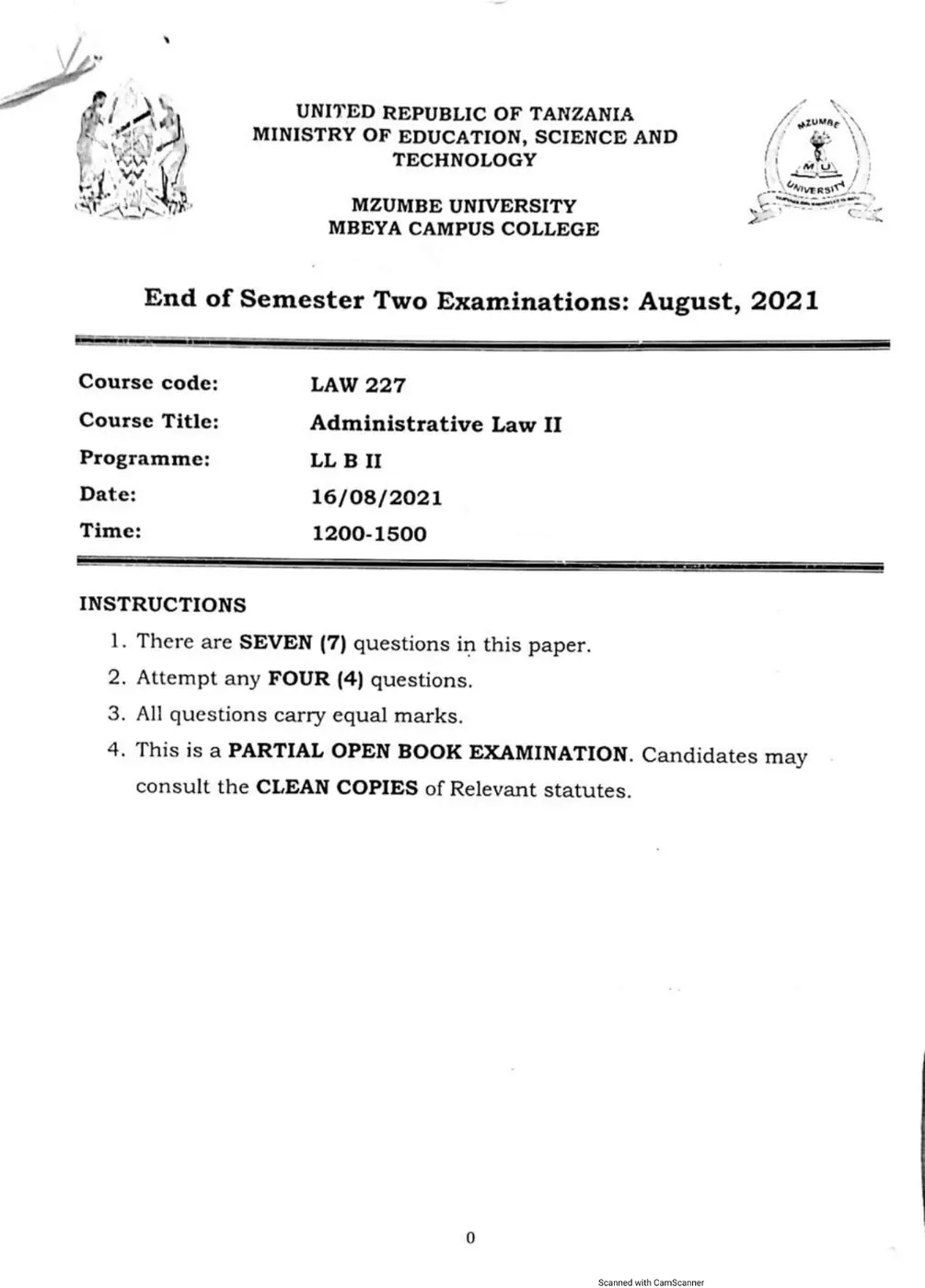
Seven questions. Attempt any four. Partial open book. All questions carry equal marks.
 Full size
 Full size
Page 3 of 4
Create a free account to see the whole paper. It takes a minute.
Create a free accountAlready a member? Log in
Page 4 of 4
Create a free account to see the whole paper. It takes a minute.
Create a free accountAlready a member? Log inRead the questions as text
There are SEVEN (7) questions in this paper. Attempt any FOUR (4) questions. All questions carry equal marks. This is a PARTIAL OPEN BOOK EXAMINATION. Candidates may consult the CLEAN COPIES of relevant statutes.
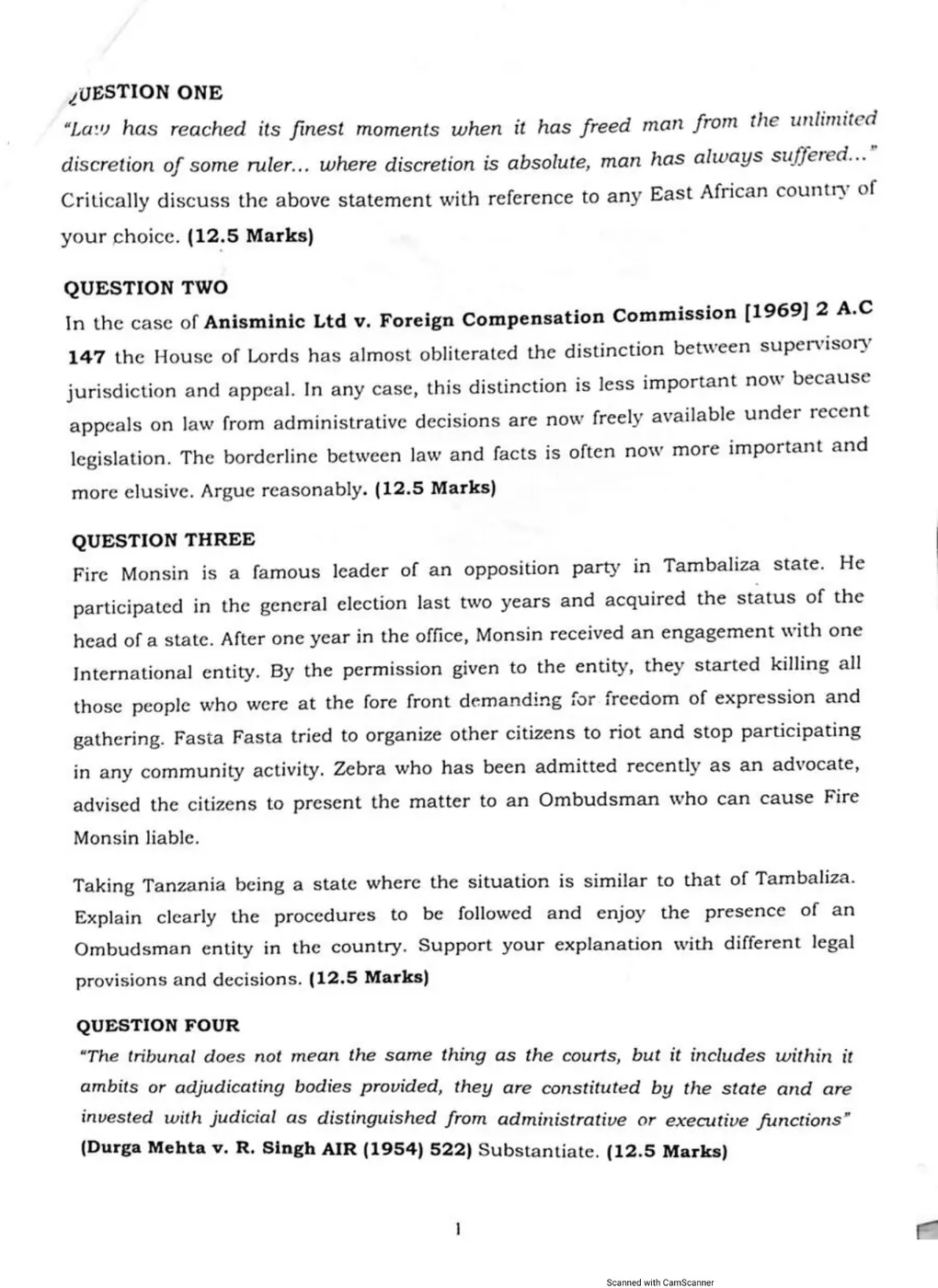
1. “Law has reached its finest moments when it has freed man from the unlimited discretion of some ruler… where discretion is absolute, man has always suffered…” Critically discuss the above statement with reference to any East African country of your choice. (12.5 marks)
2. In the case of Anisminic Ltd v Foreign Compensation Commission [1969] 2 AC 147 the House of Lords almost obliterated the distinction between supervisory jurisdiction and appeal. In any case, this distinction is less important now because appeals on law from administrative decisions are now freely available under recent legislation. The borderline between law and facts is often now more important and more elusive. Argue reasonably. (12.5 marks)
3. Fire Monsin is a famous leader of an opposition party in Tambaliza state. He participated in the general election two years ago and acquired the status of head of state. After one year in office, Monsin received an engagement with an international entity. By the permission given to the entity, they started killing all those people who were at the forefront demanding freedom of expression and gathering. Fasta Fasta tried to organise other citizens to riot and stop participating in any community activity. Zebra, who has recently been admitted as an advocate, advised the citizens to present the matter to an Ombudsman who can cause Fire Monsin to be held liable. Taking Tanzania as a state where the situation is similar to that of Tambaliza, explain clearly the procedures to be followed and the role of an Ombudsman entity in the country. Support your explanation with different legal provisions and decisions. (12.5 marks)
4. “The tribunal does not mean the same thing as the courts, but it includes within its ambit adjudicating bodies, provided they are constituted by the state and are invested with judicial as distinguished from administrative or executive functions.” (Durga Shankar Mehta v Raghuraj Singh AIR 1954 SC 522) Substantiate. (12.5 marks)
5. “The notion, apparently harboured by some people in this country, that the President of the United Republic is above the law is subversive of the Constitution and the laws. All Government leaders, including the President, are, like the humblest citizen, bound to comply with the laws of this country. The maxim the King can do no wrong has no place in our law even if the word ‘President’ is substituted for the word ‘King’. Everyone and every institution or organisation in this country is enjoined to pay respect to the principle of supremacy of the law.” Make a critical assessment of the above observation, identify the challenges encountered in the procedure and suggest recommendations. (12.5 marks)
6. Judicial review is a specialised remedy in public law by which the High Court, in the case of Tanzania, exercises a supervisory jurisdiction over inferior courts, tribunals and other public bodies. The supervisory power of the High Court extends to acts and omissions or decisions of public bodies in the field of public law. Speaking of the supervisory jurisdiction of the superior court, Lord Sumner in R v Nat Bell Liquors Ltd [1922] 2 AC 128 at 156 said: “Its jurisdiction is to see that the inferior court has not exceeded its own and for that very reason it is bound not to interfere in what has been done within that jurisdiction for in so doing it would, in turn, transgress the limits within which its own jurisdiction of supervision, not of review, is confined. That supervision goes to two points: one is the area of the inferior jurisdiction and the qualifications and conditions of its exercise; the other is the observance of the law in the course of its exercise.” The High Court is concerned with evaluating the fairness in the action, omission or decision, as Lord Hailsham LC ably contends in Chief Constable of North Wales Police v Evans: “It is important to remember in every case that the purpose … is to ensure that the individual is given fair treatment by the authority to which he has been subjected and that it is no part of that purpose to substitute the opinion of the judiciary or of individual judges for that of the authority constituted by law to decide the matters in question.” The High Court reviews decisions, actions or omissions by the executive, legislature or subordinate courts only to retain fairness. Fairness is determined by regard to the Constitution; such decisions, actions or omissions are examined as to whether they are consistent with the Constitution. Through judicial review the High Court determines whether or not state executive acts or statutes are valid. Support those arguments with reference to the law and procedure for judicial review in Tanzania. (12.5 marks)
7. Write short but comprehensive notes on the following headings: (a) extra-judicial control of administrative actions in Tanzania (4 marks); (b) prerogative writs (4 marks); (c) substantive grounds of judicial review in Tanzania (4.5 marks).
Source: Mzumbe University examination paper, August 2021, shared for revision. Rights holders can ask for removal through our Contact page.
Part 2
Administrative Law II Past Paper Answers: Model Answers to All 7 Questions
Question 1 is answered in full below, free. Tap any other question to see it and a preview of its answer.
Q1Question 1: Unlimited discretion and the rule of law in Tanzania
12.5 marks · Essay Free answer
The question
“Law has reached its finest moments when it has freed man from the unlimited discretion of some ruler… where discretion is absolute, man has always suffered…” Critically discuss the above statement with reference to any East African country of your choice. (12.5 marks)
Model answer
The short answer
The statement is largely true. Administrative law exists to keep discretion within legal limits, and Tanzanian courts have struck down laws and decisions that gave officials unchecked power. But discretion cannot be abolished, because modern government needs it; the real task is to confine, structure and check it. In Tanzania the checks are real but uneven, especially where statutes grant wide powers or oust the courts.
Why unlimited discretion is dangerous
- Unlimited discretion lets officials decide by personal preference, favouritism or political motive rather than law, so citizens cannot predict how they will be treated. It conflicts with equality before the law and the right to a fair hearing (Article 13 of the Constitution of Tanzania) and with the duty of every authority to obey the Constitution (Article 26).
- English law, which Tanzanian courts follow, rejects the idea of unfettered discretion: a power must be used for the purpose Parliament intended: Padfield v Minister of Agriculture, Fisheries and Food [1968] AC 997, and reasonably: Associated Provincial Picture Houses Ltd v Wednesbury Corporation [1948] 1 KB 223.
How Tanzanian law confines discretion
- Judicial review: the High Court may quash decisions by certiorari, compel duties by mandamus and stop excesses by prohibition (Law Reform (Fatal Accidents and Miscellaneous Provisions) Act, Cap. 310, sections 17 to 19). In Sanai Murumbe v Muhere Chacha [1990] TLR 54 the Court of Appeal set out grounds for certiorari, including acting without jurisdiction, breach of natural justice, taking irrelevant matters into account and acting unreasonably.
- Constitutional review of laws: in DPP v Daudi Pete [1993] TLR 22 the Court of Appeal struck down a law that let the DPP block bail by certificate, because it allowed the executive to decide liberty without judicial control. In Kukutia Ole Pumbun v Attorney General [1993] TLR 159 it struck down the requirement of Government consent before suing it.
- Extra-judicial checks: Parliament’s oversight, the Commission for Human Rights and Good Governance (Articles 129 to 131) and the Controller and Auditor General.
Where the statement needs qualifying
- Discretion is necessary: licensing, planning, immigration and policing require judgment on varying facts. Rigid rules would produce injustice too. The aim is controlled discretion, not none.
- Wide statutory powers remain: some laws give ministers, regional and district commissioners, or registrars very broad powers, for example to detain, ban gatherings or deregister organisations, which courts review only for legality, not merits.
- Ouster and access barriers: provisions that oust courts, require notices before suing the Government, or protect certain decisions (such as the declared presidential election result, Article 41(7)) limit judicial control.
- Practical barriers: cost, delay and fear deter ordinary citizens from challenging officials.
Conclusion
Tanzanian law has had “fine moments” in cases such as Daudi Pete and Kukutia, which freed citizens from unchecked executive discretion. The statement is true as an ideal; in practice, discretion is limited only as far as courts, Parliament and oversight bodies are willing and able to enforce those limits.
What the examiner wants
A critical discussion, not agreement alone: why absolute discretion is dangerous, the legal tools that confine it with Tanzanian cases, and the limits of those tools.
Common mistakes
- Arguing that all discretion should be abolished.
- Writing only theory with no Tanzanian authority.
Q2Question 2: Anisminic, review versus appeal, and the law-fact borderline
12.5 marks · Essay Locked
The question
In the case of Anisminic Ltd v Foreign Compensation Commission [1969] 2 AC 147 the House of Lords almost obliterated the distinction between supervisory jurisdiction and appeal. In any case, this distinction is less important now because appeals on law from administrative decisions are now freely available under recent legislation. The borderline between law and facts is often now more important and more elusive. Argue reasonably. (12.5 marks)
Model answer
Unlock the model answer to Question 2
Get all 6 locked answers on this paper for TSh 3,000. Pay once, keep them in Your Library for life.
Get the solved paper · TSh 3,000Or get every solved paper with Elite
Q3Question 3: Killings ordered by a head of state: what an Ombudsman (CHRAGG) can and cannot do
12.5 marks · Problem Locked
The question
Fire Monsin is a famous leader of an opposition party in Tambaliza state. He participated in the general election two years ago and acquired the status of head of state. After one year in office, Monsin received an engagement with an international entity. By the permission given to the entity, they started killing all those people who were at the forefront demanding freedom of expression and gathering. Fasta Fasta tried to organise other citizens to riot and stop participating in any community activity. Zebra, who has recently been admitted as an advocate, advised the citizens to present the matter to an Ombudsman who can cause Fire Monsin to be held liable. Taking Tanzania as a state where the situation is similar to that of Tambaliza, explain clearly the procedures to be followed and the role of an Ombudsman entity in the country. Support your explanation with different legal provisions and decisions. (12.5 marks)
Model answer
Unlock the model answer to Question 3
Get all 6 locked answers on this paper for TSh 3,000. Pay once, keep them in Your Library for life.
Get the solved paper · TSh 3,000Or get every solved paper with Elite
Q4Question 4: What makes a body a tribunal
12.5 marks · Essay Locked
The question
“The tribunal does not mean the same thing as the courts, but it includes within its ambit adjudicating bodies, provided they are constituted by the state and are invested with judicial as distinguished from administrative or executive functions.” (Durga Shankar Mehta v Raghuraj Singh AIR 1954 SC 522) Substantiate. (12.5 marks)
Model answer
Unlock the model answer to Question 4
Get all 6 locked answers on this paper for TSh 3,000. Pay once, keep them in Your Library for life.
Get the solved paper · TSh 3,000Or get every solved paper with Elite
Q5Question 5: Is the President above the law?
12.5 marks · Essay Locked
The question
“The notion, apparently harboured by some people in this country, that the President of the United Republic is above the law is subversive of the Constitution and the laws. All Government leaders, including the President, are, like the humblest citizen, bound to comply with the laws of this country. The maxim the King can do no wrong has no place in our law even if the word ‘President’ is substituted for the word ‘King’. Everyone and every institution or organisation in this country is enjoined to pay respect to the principle of supremacy of the law.” Make a critical assessment of the above observation, identify the challenges encountered in the procedure and suggest recommendations. (12.5 marks)
Model answer
Unlock the model answer to Question 5
Get all 6 locked answers on this paper for TSh 3,000. Pay once, keep them in Your Library for life.
Get the solved paper · TSh 3,000Or get every solved paper with Elite
Q6Question 6: Law and procedure for judicial review in Tanzania
12.5 marks · Essay Locked
The question
Judicial review is a specialised remedy in public law by which the High Court, in the case of Tanzania, exercises a supervisory jurisdiction over inferior courts, tribunals and other public bodies. The supervisory power of the High Court extends to acts and omissions or decisions of public bodies in the field of public law. Speaking of the supervisory jurisdiction of the superior court, Lord Sumner in R v Nat Bell Liquors Ltd [1922] 2 AC 128 at 156 said: “Its jurisdiction is to see that the inferior court has not exceeded its own and for that very reason it is bound not to interfere in what has been done within that jurisdiction for in so doing it would, in turn, transgress the limits within which its own jurisdiction of supervision, not of review, is confined. That supervision goes to two points: one is the area of the inferior jurisdiction and the qualifications and conditions of its exercise; the other is the observance of the law in the course of its exercise.” The High Court is concerned with evaluating the fairness in the action, omission or decision, as Lord Hailsham LC ably contends in Chief Constable of North Wales Police v Evans: “It is important to remember in every case that the purpose … is to ensure that the individual is given fair treatment by the authority to which he has been subjected and that it is no part of that purpose to substitute the opinion of the judiciary or of individual judges for that of the authority constituted by law to decide the matters in question.” The High Court reviews decisions, actions or omissions by the executive, legislature or subordinate courts only to retain fairness. Fairness is determined by regard to the Constitution; such decisions, actions or omissions are examined as to whether they are consistent with the Constitution. Through judicial review the High Court determines whether or not state executive acts or statutes are valid. Support those arguments with reference to the law and procedure for judicial review in Tanzania. (12.5 marks)
Model answer
Unlock the model answer to Question 6
Get all 6 locked answers on this paper for TSh 3,000. Pay once, keep them in Your Library for life.
Get the solved paper · TSh 3,000Or get every solved paper with Elite
Q7Question 7: Short notes: extra-judicial control, prerogative writs, substantive grounds of review
12.5 marks · Short notes Locked
The question
Write short but comprehensive notes on the following headings: (a) extra-judicial control of administrative actions in Tanzania (4 marks); (b) prerogative writs (4 marks); (c) substantive grounds of judicial review in Tanzania (4.5 marks).
Model answer
Unlock the model answer to Question 7
Get all 6 locked answers on this paper for TSh 3,000. Pay once, keep them in Your Library for life.
Get the solved paper · TSh 3,000Or get every solved paper with Elite
Get the Full Solved Paper
All 7 questions answered with the statutes and cases that apply, what the examiner wants and the mistakes to avoid. TSh 3,000, yours for life in Your Library.
Pata majibu yote ya mtihani huu kwa TSh 3,000 tu.




Statutes and Cases for This Administrative Law II Past Paper
- Constitution of the United Republic of Tanzania, 1977Equality and fair hearing (art. 13), duty to obey the Constitution and right to challenge (art. 26), enforcement of rights (art. 30(3)), presidential immunity and impeachment (arts. 46, 46A), Commission for Human Rights and Good Governance (arts. 129-131)
- Law Reform (Fatal Accidents and Miscellaneous Provisions) Act, Cap. 310Prerogative orders of mandamus, prohibition and certiorari (ss.17-19)
- Law Reform (Fatal Accidents and Miscellaneous Provisions) (Judicial Review Procedure and Fees) Rules, 2014 (GN 324 of 2014)Leave and procedure for judicial review
- Commission for Human Rights and Good Governance Act, Cap. 391Ombudsman functions and complaints
- Basic Rights and Duties Enforcement Act, Cap. 3Constitutional petitions to the High Court
- Government Proceedings Act, Cap. 5Suits against the Government
- Sanai Murumbe v Muhere Chacha [1990] TLR 54 (CA)Grounds for certiorari
- Kukutia Ole Pumbun v Attorney General [1993] TLR 159 (CA)Access to court against the Government
- DPP v Daudi Pete [1993] TLR 22 (CA)Limits on laws restricting rights
- Anisminic Ltd v Foreign Compensation Commission [1969] 2 AC 147 (HL)Errors of law and ouster clauses
- Council of Civil Service Unions v Minister for the Civil Service [1985] AC 374 (HL)Illegality, irrationality, procedural impropriety
- Associated Provincial Picture Houses v Wednesbury Corporation [1948] 1 KB 223; Padfield v Minister of Agriculture [1968] AC 997Unreasonableness; improper purpose
- Chief Constable of North Wales Police v Evans [1982] 1 WLR 1155 (HL); R v Nat Bell Liquors Ltd [1922] 2 AC 128 (PC)Review, not appeal
Mzumbe Administrative Law II Past Paper: Common Questions
Is this the real Mzumbe Administrative Law II exam paper?
Yes. These are scans of the End of Semester Two Examination, August 2021 paper for LAW 227 Administrative Law II at Mzumbe University, sat on 16 August 2021. Nothing has been retyped or changed.
How many questions do you answer in this Administrative Law II paper?
Seven questions. Attempt any four. Partial open book. All questions carry equal marks.
Are there answers to this past paper?
Yes. All 7 questions have full model answers written to Tanzanian law and reviewed by Isack Kimaro, LL.B, PDLP. The Question 1 answer is free; the full solved paper is TSh 3,000 (TSh 2,000 for Pro members) and is included in Elite.
How do I see every page of the paper?
The first pages are open to everyone. Create a free account to read the whole paper.