

About this paper
This is the real OUT OLW 103 Law of Contract paper from the Annual/Supplementary Examination of May 2019, sat by first-year LL.B students at The Open University of Tanzania. It has six questions and you answer two: offer and invitation to treat, privity, an illegal poaching contract, written contracts, frustration and contractual remedies. The model answer to Question 1 is free below.
Part 1
OUT Law of Contract Past Paper (OLW 103): The Full Exam as Set
Four questions. Attempt any two.
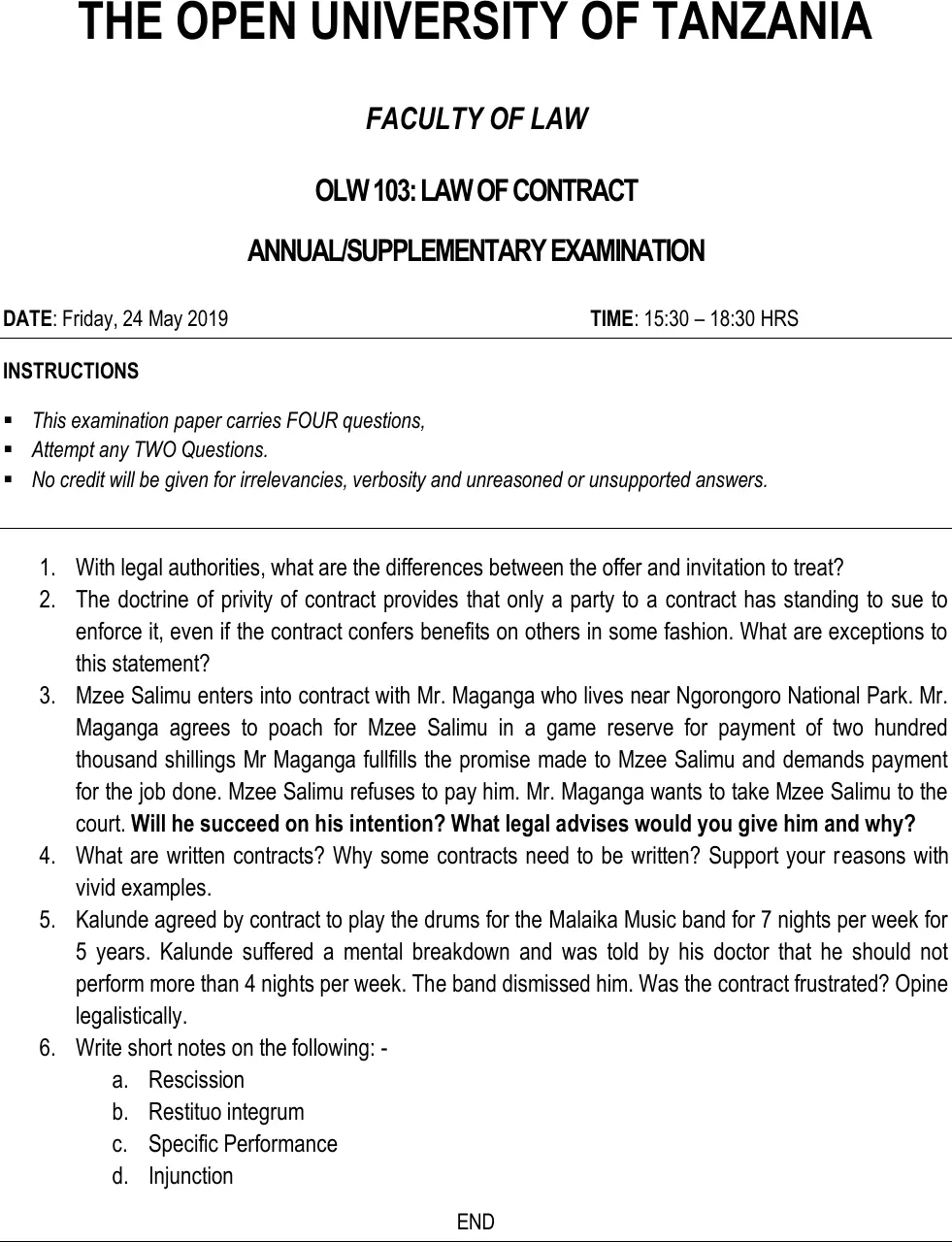
Read the questions as text
Answer any TWO questions. No credit will be given for irrelevancies, verbosity and unreasoned or unsupported answers.
1. With legal authorities, what are the differences between the offer and invitation to treat?
2. The doctrine of privity of contract provides that only a party to a contract has standing to sue to enforce it, even if the contract confers benefits on others in some fashion. What are exceptions to this statement?
3. Mzee Salimu enters into contract with Mr. Maganga who lives near Ngorongoro National Park. Mr. Maganga agrees to poach for Mzee Salimu in a game reserve for payment of two hundred thousand shillings. Mr. Maganga fulfils the promise made to Mzee Salimu and demands payment for the job done. Mzee Salimu refuses to pay him. Mr. Maganga wants to take Mzee Salimu to the court. Will he succeed on his intention? What legal advice would you give him and why?
4. What are written contracts? Why do some contracts need to be written? Support your reasons with vivid examples.
5. Kalunde agreed by contract to play the drums for the Malaika Music band for 7 nights per week for 5 years. Kalunde suffered a mental breakdown and was told by his doctor that he should not perform more than 4 nights per week. The band dismissed him. Was the contract frustrated? Opine legalistically.
6. Write short notes on the following: (a) Rescission; (b) Restitutio in integrum; (c) Specific performance; (d) Injunction.
Source: The Open University of Tanzania examination paper, May 2019, shared for revision. Rights holders can ask for removal through our Contact page.
Part 2
Law of Contract Past Paper Answers: Model Answers to All 6 Questions
Question 1 is answered in full below, free. Tap any other question to see it and a preview of its answer.
Q1Question 1: Offer and invitation to treat
Any two of six · equal marks Free answer
The question
With legal authorities, what are the differences between the offer and invitation to treat?
Model answer
The short answer
An offer is a final, definite promise that becomes a binding contract the moment the other side accepts it. An invitation to treat is only an invitation to start bargaining; when you “accept” it, you are actually the one making the offer, and the other side is still free to say no.
Step 1: Start with the statute
The Law of Contract Act, Cap. 345 R.E. 2023 does not use the word “offer”. It calls it a proposal. Under section 2(1)(a), a person makes a proposal when he signifies to another his willingness to do or to abstain from doing anything, with a view to obtaining that person’s assent. Under section 2(1)(b), once the person to whom the proposal is made signifies his assent, the proposal is accepted and becomes a promise. So the key words are willingness to be bound: an offer shows that the offeror is ready to be bound by a simple “yes”.
The Act has no section on invitations to treat. That concept comes from the common law, which Tanzanian courts apply to fill the gap.
Step 2: The test the courts use
The question is always one of intention, judged objectively: would a reasonable person in the position of the other party understand the statement as a promise to be bound on acceptance, or as an invitation to negotiate? In Gibson v Manchester City Council [1979] 1 WLR 294 (HL), a council letter saying it “may be prepared to sell” a house to a tenant was held not to be an offer, because it did not commit the council to anything.
Compare Harvey v Facey [1893] AC 552 (PC): asked “Will you sell us Bumper Hall Pen? Telegraph lowest cash price”, the defendant replied “Lowest price for Bumper Hall Pen £900”. That reply only supplied information; it was not an offer to sell, so the plaintiffs’ “acceptance” made no contract.
Step 3: The usual examples of invitations to treat
- Goods displayed in a shop. In Pharmaceutical Society of Great Britain v Boots Cash Chemists [1953] 1 QB 401, goods on self-service shelves were an invitation to treat. The customer offers to buy at the till and the cashier accepts. In Fisher v Bell [1961] 1 QB 394, a flick knife in a shop window with a price ticket was not an “offer for sale”.
- Advertisements. In Partridge v Crittenden [1968] 1 WLR 1204, an advertisement of birds for sale was an invitation to treat, because a seller with limited stock cannot be taken to promise to sell to everyone who replies.
- Auctions. The auctioneer’s request for bids is an invitation; each bid is an offer, which the bidder may withdraw before the hammer falls: Payne v Cave (1789) 3 TR 148. An advertisement that an auction will be held is not an offer either: Harris v Nickerson (1873) LR 8 QB 286.
- Tenders. A call for tenders is normally an invitation; each tender is an offer: Spencer v Harding (1870) LR 5 CP 561. In Tanzania, in Thumbsup Company Limited v Board of Trustees of Ifakara Health Institute, Civil Appeal No. 25867 of 2023 [2024] TZHC 5719, the trial court treated a tender advertisement and pre-qualification as an invitation to treat, and the High Court upheld the finding that no contract had been made.
Step 4: When an advertisement is an offer
An advertisement becomes an offer when it is clear, definite and shows an intention to be bound by anyone who performs the stated conditions. The leading case is Carlill v Carbolic Smoke Ball Co [1893] 1 QB 256 (CA): the company promised £100 to anyone who caught influenza after using its smoke ball as directed, and deposited £1,000 with its bank “to show our sincerity”. That was a unilateral offer to the world, accepted by performing the conditions.
Step 5: The differences in one table
| Point | Offer (proposal) | Invitation to treat |
|---|---|---|
| Intention | Ready to be bound on acceptance (s. 2(1)(a)) | Only inviting offers or negotiation |
| Effect of a “yes” | Creates a promise and, if s. 10 is met, a contract | The “yes” is itself only an offer |
| Who is free to refuse | No one, once accepted | The person who made the invitation |
| Typical examples | Reward advertisements (Carlill), a firm quote to a named buyer | Shop displays, price lists, adverts, auctions, calls for tenders |
Conclusion
The difference lies in intention. An offer is a definite promise waiting only for acceptance; an invitation to treat is a step before that. Because the Act defines a proposal by “willingness” to be bound, Tanzanian courts use the common law cases above to decide which side of the line a statement falls on.
What the examiner wants
A clear definition from section 2(1)(a) and (b) of Cap. 345, the objective test of intention, at least four classic categories of invitation to treat each backed by a case, the Carlill exception, and a short conclusion. “With legal authorities” means marks go to cases and sections, not to description.
Common mistakes
- Saying every advertisement is an invitation to treat, without the Carlill exception.
- Calling the shop’s display the offer and the customer’s payment the acceptance. It is the reverse.
- Forgetting that Cap. 345 uses “proposal” and “promise”, not “offer”.
- Listing cases with no facts. One line of facts per case shows the examiner you understand why it was decided that way.
Q2Question 2: Exceptions to privity of contract
Any two of six · equal marks Locked
The question
The doctrine of privity of contract provides that only a party to a contract has standing to sue to enforce it, even if the contract confers benefits on others in some fashion. What are exceptions to this statement?
Model answer
Unlock the model answer to Question 2
Get all 5 locked answers on this paper for TSh 3,000. Pay once, keep them in Your Library for life.
Get the solved paper · TSh 3,000Or get every solved paper with Elite
Q3Question 3: Paying a poacher: illegal contract
Any two of six · equal marks Locked
The question
Mzee Salimu enters into contract with Mr. Maganga who lives near Ngorongoro National Park. Mr. Maganga agrees to poach for Mzee Salimu in a game reserve for payment of two hundred thousand shillings. Mr. Maganga fulfils the promise made to Mzee Salimu and demands payment for the job done. Mzee Salimu refuses to pay him. Mr. Maganga wants to take Mzee Salimu to the court. Will he succeed on his intention? What legal advice would you give him and why?
Model answer
Unlock the model answer to Question 3
Get all 5 locked answers on this paper for TSh 3,000. Pay once, keep them in Your Library for life.
Get the solved paper · TSh 3,000Or get every solved paper with Elite
Q4Question 4: Written contracts and why some must be written
Any two of six · equal marks Locked
The question
What are written contracts? Why do some contracts need to be written? Support your reasons with vivid examples.
Model answer
Unlock the model answer to Question 4
Get all 5 locked answers on this paper for TSh 3,000. Pay once, keep them in Your Library for life.
Get the solved paper · TSh 3,000Or get every solved paper with Elite
Q5Question 5: The drummer who could only play four nights: frustration
Any two of six · equal marks Locked
The question
Kalunde agreed by contract to play the drums for the Malaika Music band for 7 nights per week for 5 years. Kalunde suffered a mental breakdown and was told by his doctor that he should not perform more than 4 nights per week. The band dismissed him. Was the contract frustrated? Opine legalistically.
Model answer
Unlock the model answer to Question 5
Get all 5 locked answers on this paper for TSh 3,000. Pay once, keep them in Your Library for life.
Get the solved paper · TSh 3,000Or get every solved paper with Elite
Q6Question 6: Rescission, restitutio in integrum, specific performance, injunction
Any two of six · equal marks Locked
The question
Write short notes on the following: (a) Rescission; (b) Restitutio in integrum; (c) Specific performance; (d) Injunction.
Model answer
Unlock the model answer to Question 6
Get all 5 locked answers on this paper for TSh 3,000. Pay once, keep them in Your Library for life.
Get the solved paper · TSh 3,000Or get every solved paper with Elite
Get the Full Solved Paper
All 6 questions answered with the statutes and cases that apply, what the examiner wants and the mistakes to avoid. TSh 3,000, yours for life in Your Library.
Pata majibu yote ya mtihani huu kwa TSh 3,000 tu.




Statutes and Cases for This Law of Contract Past Paper
- Law of Contract Act, Cap. 345 R.E. 2023ss. 2(1)(a)–(b), 10, 19, 23, 56(2), 64–66, 75
- Land Act, Cap. 113 R.E. 2023s. 68(1), contracts for land must be written (s. 64 before 2023)
- Employment and Labour Relations Act, Cap. 366 R.E. 2023s. 15(2), written employment contracts
- Arbitration Act, Cap. 15s. 8, arbitration agreements must be written
- Wildlife Conservation Act, Cap. 283unlawful hunting and entry into game reserves
- Zakaria Barie Bura v Theresia Maria John Mubiru [1995] TLR 211 (CA)illegal agreement unenforceable
- Atilio v Mbowe (1969) HCD 284three conditions for a temporary injunction
- Carlill v Carbolic Smoke Ball Co [1893] 1 QB 256advertisement as a unilateral offer
- Condor v The Baron Knights Ltd [1966] 1 WLR 87illness of a drummer frustrates the contract
OUT Law of Contract Past Paper: Common Questions
Is this the real OUT Law of Contract exam paper?
Yes. These are scans of the Annual/Supplementary Examination, May 2019 paper for OLW 103 Law of Contract at The Open University of Tanzania, sat on 24 May 2019. Nothing has been retyped or changed.
How many questions do you answer in this Law of Contract paper?
Four questions. Attempt any two.
Are there answers to this past paper?
Yes. All six questions have full model answers written to Tanzanian law and checked by Isack Kimaro, LL.B, PDLP. The Question 1 answer on offer and invitation to treat is free; the full solved paper is TSh 3,000 (TSh 2,000 for Pro members) and is included in Elite.
How do I see every page of the paper?
The first pages are open to everyone. Create a free account to read the whole paper.