

About this paper
Solved answers to all 6 questions
Part 1
OUT Criminal Law and Procedure Past Paper (OLW 102): The Full Exam as Set
Six questions. Answer four. Closed book.
Read the questions as text
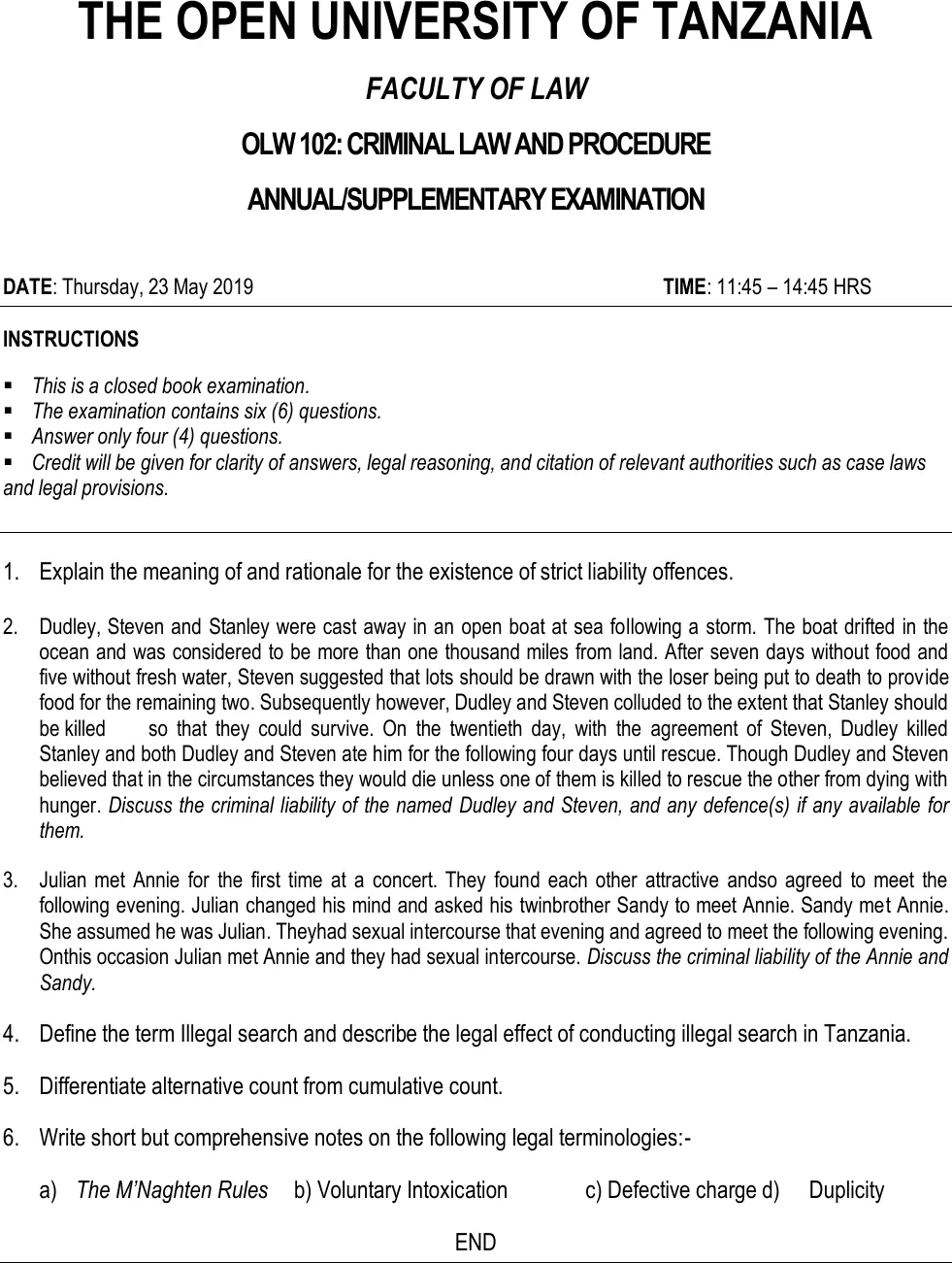
This is a closed book examination. The examination contains six (6) questions. Answer only four (4) questions. Credit will be given for clarity of answers, legal reasoning, and citation of relevant authorities such as case law and legal provisions.
1. Explain the meaning of and rationale for the existence of strict liability offences.
2. Dudley, Steven and Stanley were cast away in an open boat at sea following a storm. The boat drifted in the ocean and was considered to be more than one thousand miles from land. After seven days without food and five without fresh water, Steven suggested that lots should be drawn, with the loser being put to death to provide food for the remaining two. Subsequently, however, Dudley and Steven colluded to the extent that Stanley should be killed so that they could survive. On the twentieth day, with the agreement of Steven, Dudley killed Stanley and both Dudley and Steven ate him for the following four days until rescue. Dudley and Steven believed that in the circumstances they would die unless one of them was killed to rescue the others from dying of hunger. Discuss the criminal liability of the named Dudley and Steven, and any defence(s), if any, available to them.
3. Julian met Annie for the first time at a concert. They found each other attractive and so agreed to meet the following evening. Julian changed his mind and asked his twin brother Sandy to meet Annie. Sandy met Annie. She assumed he was Julian. They had sexual intercourse that evening and agreed to meet the following evening. On this occasion Julian met Annie and they had sexual intercourse. Discuss the criminal liability of Annie and Sandy.
4. Define the term illegal search and describe the legal effect of conducting an illegal search in Tanzania.
5. Differentiate an alternative count from a cumulative count.
6. Write short but comprehensive notes on the following legal terminologies: (a) The M’Naghten Rules; (b) Voluntary intoxication; (c) Defective charge; (d) Duplicity.
Source: The Open University of Tanzania examination paper, May 2019, shared for revision. Rights holders can ask for removal through our Contact page.
Part 2
Criminal Law and Procedure Past Paper Answers: Model Answers to All 6 Questions
Question 2 is answered in full below, free. Tap any other question to see it and a preview of its answer.
Q1Question 1: Strict liability offences: meaning and rationale
Essay Locked
The question
Explain the meaning of and rationale for the existence of strict liability offences.
Model answer
Unlock the model answer to Question 1
Get all 5 locked answers on this paper for TSh 3,000. Pay once, keep them in Your Library for life.
Get the solved paper · TSh 3,000Or get every solved paper with Elite
Q2Question 2: Killing a castaway to survive: murder and the necessity defence
Problem Free answer
The question
Dudley, Steven and Stanley were cast away in an open boat at sea following a storm. The boat drifted in the ocean and was considered to be more than one thousand miles from land. After seven days without food and five without fresh water, Steven suggested that lots should be drawn, with the loser being put to death to provide food for the remaining two. Subsequently, however, Dudley and Steven colluded to the extent that Stanley should be killed so that they could survive. On the twentieth day, with the agreement of Steven, Dudley killed Stanley and both Dudley and Steven ate him for the following four days until rescue. Dudley and Steven believed that in the circumstances they would die unless one of them was killed to rescue the others from dying of hunger. Discuss the criminal liability of the named Dudley and Steven, and any defence(s), if any, available to them.
Model answer
The short answer
Both Dudley and Steven are guilty of murder: Dudley as the person who killed Stanley, and Steven as a principal offender who agreed to and encouraged the killing. Necessity is not a defence to murder, as held in R v Dudley and Stephens (1884), whose facts this question mirrors, and Tanzania’s Penal Code contains no general necessity defence. Their extreme circumstances may only support mercy in sentencing through the prerogative of mercy.
The offence
- Murder (Penal Code ss.196 and 200): causing the death of another by an unlawful act with malice aforethought. Dudley deliberately killed Stanley intending to cause death, so the elements are satisfied.
- Steven’s liability: every person who aids, counsels or procures another to commit an offence is deemed to have taken part in it and may be charged with committing it (s.22). Steven proposed killing one of them, colluded with Dudley in choosing Stanley, and agreed to the killing; he is a principal offender in murder.
- Conspiracy to murder (s.384) also arises from their agreement.
- Eating the body: this is not itself murder; the liability rests on the killing.
Possible defences
- Necessity: in R v Dudley and Stephens (1884) 14 QBD 273, two shipwrecked sailors killed and ate a cabin boy to survive. The court held that necessity is no defence to murder: no one has the right to choose whose life is less valuable, and allowing the defence would be dangerous. Their death sentences were later commuted to six months’ imprisonment. Tanzania’s Penal Code does not provide a general defence of necessity, so this principle applies.
- Compulsion (s.17): applies only where an offender acts because another offender threatens to kill him or cause grievous harm instantly if he refuses. Hunger and the threat of death from starvation are not threats by another person, so s.17 does not apply.
- Self-defence (ss.18 to 18C): Stanley posed no threat to them, so self-defence is not available.
- Insanity or diminished capacity: extreme hunger and thirst might affect mental state, but insanity requires a disease of the mind producing the effects in s.13; there is no evidence of that.
Sentence and mercy
Murder carries the death penalty (s.197). The circumstances may be urged in mitigation and in a petition for the President’s prerogative of mercy (Constitution, art. 45), as happened by commutation in Dudley and Stephens.
What the examiner wants
The elements of murder, Steven’s liability as a party, the necessity defence with Dudley and Stephens, why compulsion and self-defence fail, and the sentencing point.
Common mistakes
- Treating Steven as innocent because he did not strike the blow.
- Accepting necessity as a defence to murder.
Q3Question 3: The twin brother impersonation: rape and consent
Problem Locked
The question
Julian met Annie for the first time at a concert. They found each other attractive and so agreed to meet the following evening. Julian changed his mind and asked his twin brother Sandy to meet Annie. Sandy met Annie. She assumed he was Julian. They had sexual intercourse that evening and agreed to meet the following evening. On this occasion Julian met Annie and they had sexual intercourse. Discuss the criminal liability of Annie and Sandy.
Model answer
Unlock the model answer to Question 3
Get all 5 locked answers on this paper for TSh 3,000. Pay once, keep them in Your Library for life.
Get the solved paper · TSh 3,000Or get every solved paper with Elite
Q4Question 4: Illegal searches and their legal effect in Tanzania
Essay Locked
The question
Define the term illegal search and describe the legal effect of conducting an illegal search in Tanzania.
Model answer
Unlock the model answer to Question 4
Get all 5 locked answers on this paper for TSh 3,000. Pay once, keep them in Your Library for life.
Get the solved paper · TSh 3,000Or get every solved paper with Elite
Q5Question 5: Alternative counts and cumulative counts
Essay Locked
The question
Differentiate an alternative count from a cumulative count.
Model answer
Unlock the model answer to Question 5
Get all 5 locked answers on this paper for TSh 3,000. Pay once, keep them in Your Library for life.
Get the solved paper · TSh 3,000Or get every solved paper with Elite
Q6Question 6: Short notes: M'Naghten Rules, voluntary intoxication, defective charge, duplicity
Short notes Locked
The question
Write short but comprehensive notes on the following legal terminologies: (a) The M’Naghten Rules; (b) Voluntary intoxication; (c) Defective charge; (d) Duplicity.
Model answer
Unlock the model answer to Question 6
Get all 5 locked answers on this paper for TSh 3,000. Pay once, keep them in Your Library for life.
Get the solved paper · TSh 3,000Or get every solved paper with Elite
Get the Full Solved Paper
All 6 questions answered with the statutes and cases that apply, what the examiner wants and the mistakes to avoid. TSh 3,000, yours for life in Your Library.
Pata majibu yote ya mtihani huu kwa TSh 3,000 tu.




Statutes and Cases for This Criminal Law and Procedure Past Paper
- Penal Code, Cap. 16Insanity (ss.12-13), intoxication (s.14), compulsion (s.17), self-defence (ss.18-18C), principal offenders (s.22), rape (s.130, incl. impersonation of a husband in s.130(2)(d)), murder and malice aforethought (ss.196, 200), conspiracy (s.384)
- Criminal Procedure Act, Cap. 20Searches (ss.38-42), charges and joinder (ss.132-135), exclusion of illegally obtained evidence (s.169)
- Constitution of the United Republic of Tanzania, 1977Right to life (art. 14), privacy of the person and home (art. 16), prerogative of mercy (art. 45)
- R v Dudley and Stephens (1884) 14 QBD 273Necessity is no defence to murder
- M'Naghten's Case (1843) 10 Cl & F 200 (HL)Test of insanity
- DPP v Majewski [1977] AC 443 (HL)Voluntary intoxication and specific intent
- DPP v Beard [1920] AC 479 (HL)Intoxication and intent
- Sweet v Parsley [1970] AC 132 (HL)Presumption of mens rea
- Gammon (Hong Kong) Ltd v Attorney General of Hong Kong [1985] AC 1 (PC)When strict liability applies
- R v Elbekkay [1995] Crim LR 163 (CA)Impersonating a partner and consent (English law)
OUT Criminal Law and Procedure Past Paper: Common Questions
Is this the real OUT Criminal Law and Procedure exam paper?
Yes. These are scans of the Annual/Supplementary Examination, May 2019 paper for OLW 102 Criminal Law and Procedure at The Open University of Tanzania, sat on 23 May 2019. Nothing has been retyped or changed.
How many questions do you answer in this Criminal Law and Procedure paper?
Six questions. Answer four. Closed book.
Are there answers to this past paper?
Yes. All 6 questions have full model answers written to Tanzanian law and reviewed by Isack Kimaro, LL.B, PDLP. The Question 1 answer is free; the full solved paper is TSh 3,000 (TSh 2,000 for Pro members) and is included in Elite.
How do I see every page of the paper?
The first pages are open to everyone. Create a free account to read the whole paper.