

About this paper
Solved answers to all 6 questions
Part 1
OUT Constitutions and Legal Systems of East Africa Past Paper (OLW 101): The Full Exam as Set
Six questions. Attempt four; Question 1 is compulsory. Support your answers with relevant authorities.
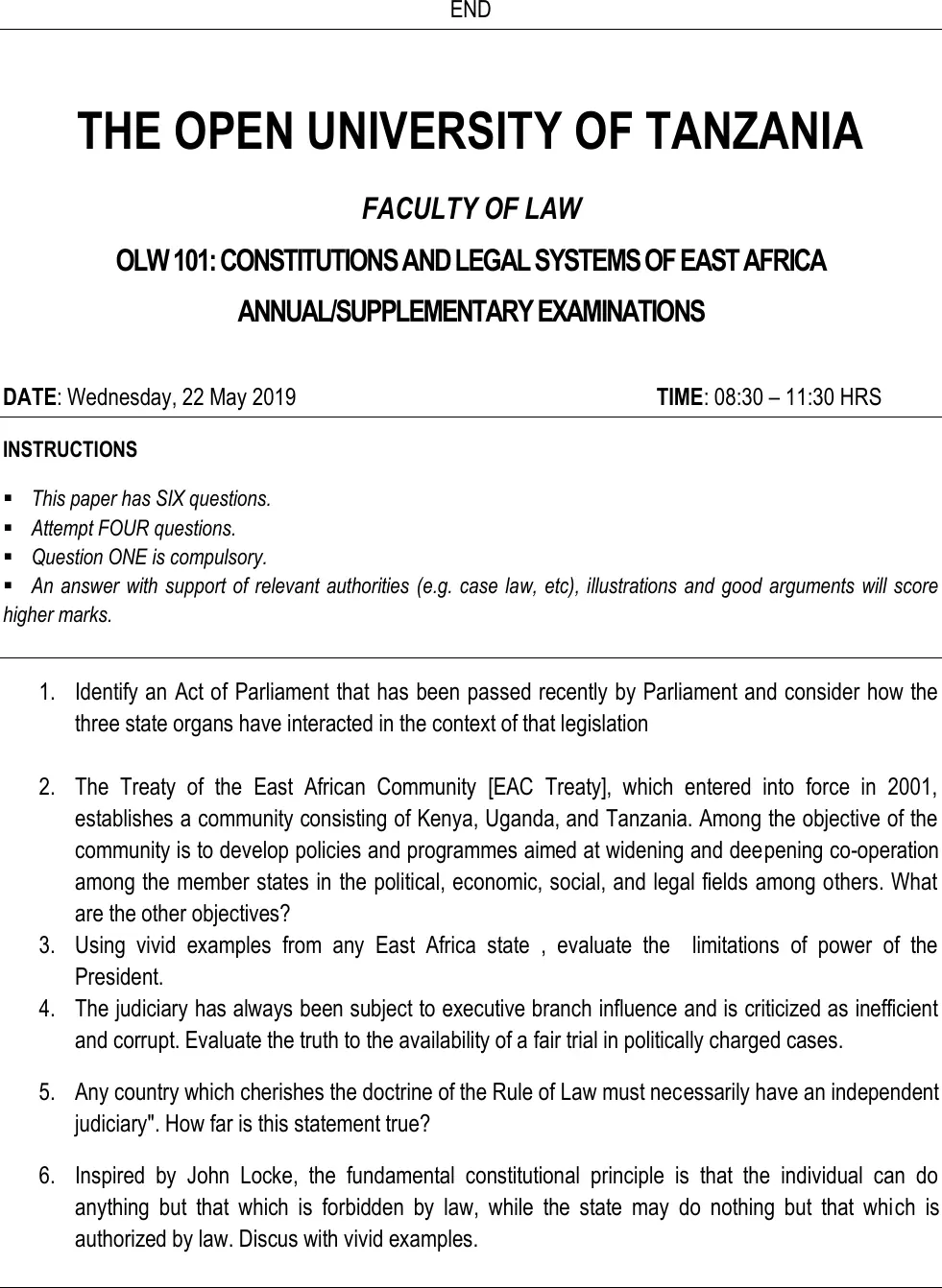
Read the questions as text
This paper has SIX questions. Attempt FOUR questions. Question ONE is compulsory. An answer with support of relevant authorities (e.g. case law), illustrations and good arguments will score higher marks.
1. Identify an Act of Parliament that has been passed recently by Parliament and consider how the three state organs have interacted in the context of that legislation.
2. The Treaty of the East African Community [EAC Treaty], which entered into force in 2001, establishes a community consisting of Kenya, Uganda and Tanzania. Among the objectives of the community is to develop policies and programmes aimed at widening and deepening co-operation among the member states in the political, economic, social and legal fields, among others. What are the other objectives?
3. Using vivid examples from any East African state, evaluate the limitations of power of the President.
4. The judiciary has always been subject to executive branch influence and is criticised as inefficient and corrupt. Evaluate the truth of the availability of a fair trial in politically charged cases.
5. “Any country which cherishes the doctrine of the Rule of Law must necessarily have an independent judiciary.” How far is this statement true?
6. Inspired by John Locke, the fundamental constitutional principle is that the individual can do anything but that which is forbidden by law, while the state may do nothing but that which is authorised by law. Discuss with vivid examples.
Source: The Open University of Tanzania examination paper, May 2019, shared for revision. Rights holders can ask for removal through our Contact page.
Part 2
Constitutions and Legal Systems of East Africa Past Paper Answers: Model Answers to All 6 Questions
Question 1 is answered in full below, free. Tap any other question to see it and a preview of its answer.
Q1Question 1: How Parliament, the President and the courts interacted over the Political Parties (Amendment) Act 2019
Essay · Compulsory Free answer
The question
Identify an Act of Parliament that has been passed recently by Parliament and consider how the three state organs have interacted in the context of that legislation.
Model answer
The short answer
The Political Parties (Amendment) Act, No. 1 of 2019 is a good example. Parliament passed it, the President assented and the executive applied it through the Registrar of Political Parties, and the courts were then asked to check it. The East African Court of Justice held in 2022, and confirmed on appeal in 2023, that several of its provisions violate the EAC Treaty. The episode shows separation of powers working with checks, but also the limits of those checks when a judgment has to be implemented by the same organs it criticises.
Any recent Act can be used if you show all three organs at work. Choose one you can describe accurately.
The framework: three organs, separate but checking one another
Article 4 of the Constitution of the United Republic of Tanzania, 1977 allocates state authority to the executive, the legislature and the judiciary. The legislature makes law (Articles 63 and 64), the President must assent before a Bill becomes law and may withhold assent (Article 97), and the judiciary is the final authority in the dispensation of justice and must be independent (Articles 107A and 107B). Any person may challenge an act or law that contravenes the Constitution (Article 26).
Stage 1: the executive proposes and Parliament legislates
The Bill was a Government Bill, so the executive set the agenda. Parliament passed it on 29 January 2019. The Act regulated political parties’ registration, membership, civic education, coalitions and internal affairs, and gave the Registrar of Political Parties wide powers, including to suspend or deregister parties and their members. Opposition MPs objected that it gave the executive control over its own political competitors, but the Government majority carried it. This shows the usual pattern in a dominant-party system: the legislature checks the executive weakly when the same party controls both.
Stage 2: the President assents and the executive implements
The President assented on 13 February 2019, completing the law-making process under Article 97. The Registrar of Political Parties, an executive office, then began applying the new powers. Here the executive both proposed the law and enforced it.
Stage 3: the courts are asked to check it
- Opposition leaders and the Legal and Human Rights Centre filed References No. 3 and 4 of 2019 in the East African Court of Justice, arguing that the Act violated the Treaty’s principles of democracy, the rule of law and good governance (Articles 6(d) and 7(2)) and Tanzania’s undertaking not to jeopardise the Treaty’s objectives (Article 8(1)(c)).
- On 25 March 2022 the First Instance Division declared that sections 3, 4, 5, 9, 15 and 29 of the Act were unjustified restrictions on freedom of association and political participation, and directed Tanzania to take the necessary measures. In 2023 the Appellate Division dismissed the Attorney General’s appeal (Attorney General of Tanzania v Freeman Mbowe & others, Appeal No. 5 of 2022).
Evaluation
- Checks worked in form: the law went through Parliament and presidential assent, and a court reviewed it on application by citizens.
- Checks were weak in substance: the legislature did not restrain the executive, and the effective judicial check came from a regional court whose judgments depend on the Government and Parliament to implement them. A national court can only enforce the Constitution, and the EACJ cannot strike down a Tanzanian statute; it declares a Treaty violation.
- Dialogue between organs: the judgments put pressure on Parliament and the executive to amend the law, which is how separation of powers is supposed to work: each organ responds to the others rather than one dominating.
Conclusion
The 2019 Act shows all three organs interacting: executive initiative, legislative approval, presidential assent and executive enforcement, followed by judicial review. It also shows that in practice the balance depends on party politics and on each organ’s willingness to respect the others’ role.
What the examiner wants
A real, accurately described Act; the constitutional role of each organ with articles; a stage-by-stage account of how they interacted; and an evaluation of whether the checks worked.
Common mistakes
- Describing separation of powers in theory without a concrete Act.
- Leaving out the judiciary because no domestic case was decided. Explain whichever court reviewed the law, or why none did.
Q2Question 2: The objectives of the East African Community under Article 5 of the Treaty
Essay Locked
The question
The Treaty of the East African Community [EAC Treaty], which entered into force in 2001, establishes a community consisting of Kenya, Uganda and Tanzania. Among the objectives of the community is to develop policies and programmes aimed at widening and deepening co-operation among the member states in the political, economic, social and legal fields, among others. What are the other objectives?
Model answer
Unlock the model answer to Question 2
Get all 5 locked answers on this paper for TSh 3,000. Pay once, keep them in Your Library for life.
Get the solved paper · TSh 3,000Or get every solved paper with Elite
Q3Question 3: Limits on presidential power in East Africa
Essay Locked
The question
Using vivid examples from any East African state, evaluate the limitations of power of the President.
Model answer
Unlock the model answer to Question 3
Get all 5 locked answers on this paper for TSh 3,000. Pay once, keep them in Your Library for life.
Get the solved paper · TSh 3,000Or get every solved paper with Elite
Q4Question 4: Can politically charged cases get a fair trial?
Essay Locked
The question
The judiciary has always been subject to executive branch influence and is criticised as inefficient and corrupt. Evaluate the truth of the availability of a fair trial in politically charged cases.
Model answer
Unlock the model answer to Question 4
Get all 5 locked answers on this paper for TSh 3,000. Pay once, keep them in Your Library for life.
Get the solved paper · TSh 3,000Or get every solved paper with Elite
Q5Question 5: Rule of law and an independent judiciary
Essay Locked
The question
“Any country which cherishes the doctrine of the Rule of Law must necessarily have an independent judiciary.” How far is this statement true?
Model answer
Unlock the model answer to Question 5
Get all 5 locked answers on this paper for TSh 3,000. Pay once, keep them in Your Library for life.
Get the solved paper · TSh 3,000Or get every solved paper with Elite
Q6Question 6: Locke's principle: individuals may do what is not forbidden, the state only what is authorised
Essay Locked
The question
Inspired by John Locke, the fundamental constitutional principle is that the individual can do anything but that which is forbidden by law, while the state may do nothing but that which is authorised by law. Discuss with vivid examples.
Model answer
Unlock the model answer to Question 6
Get all 5 locked answers on this paper for TSh 3,000. Pay once, keep them in Your Library for life.
Get the solved paper · TSh 3,000Or get every solved paper with Elite
Get the Full Solved Paper
All 6 questions answered with the statutes and cases that apply, what the examiner wants and the mistakes to avoid. TSh 3,000, yours for life in Your Library.
Pata majibu yote ya mtihani huu kwa TSh 3,000 tu.




Statutes and Cases for This Constitutions and Legal Systems of East Africa Past Paper
- Constitution of the United Republic of Tanzania, 1977Separation of powers (art. 4), presidency (arts. 33-46A), Parliament and assent to Bills (arts. 63-64, 97), judiciary (arts. 107A-107B), fair hearing and legality (art. 13(6)), right to challenge unconstitutional acts (art. 26), limitation of rights (art. 30)
- Treaty for the Establishment of the East African Community, 1999Objectives (art. 5), fundamental principles (art. 6), operational principles (art. 7), Partner States' undertakings (art. 8)
- Political Parties (Amendment) Act, No. 1 of 2019Restrictions on political parties challenged before the EACJ
- Freeman Mbowe & others v Attorney General of Tanzania, EACJ References No. 3 and 4 of 2019 (25 March 2022) and Appeal No. 5 of 2022Provisions of the 2019 Act found to violate the EAC Treaty
- Attorney General v Rev. Christopher Mtikila, Civil Appeal No. 45 of 2009 (CA)Independent candidates: the Court of Appeal left the matter to Parliament
- Tanganyika Law Society & others v Tanzania, African Court Applications 009 and 011 of 2011 (2013)Ban on independent candidates violated the African Charter
- DPP v Daudi Pete [1993] TLR 22 (CA)Laws limiting rights must be lawful and proportionate
- Kukutia Ole Pumbun v Attorney General [1993] TLR 159 (CA)Access to court against the government
- Raila Odinga & another v IEBC & others, Presidential Petition No. 1 of 2017 (Supreme Court of Kenya)Presidential election annulled
- Attorney General v David Ndii & others [2022] KESC 8Limits on presidential power to initiate constitutional amendments (BBI)
- Entick v Carrington (1765) 19 St Tr 1030; R v Somerset County Council, ex p Fewings [1995] 1 All ER 513State action must have legal authority
OUT Constitutions and Legal Systems of East Africa Past Paper: Common Questions
Is this the real OUT Constitutions and Legal Systems of East Africa exam paper?
Yes. These are scans of the Annual/Supplementary Examination, May 2019 paper for OLW 101 Constitutions and Legal Systems of East Africa at The Open University of Tanzania, sat on 22 May 2019. Nothing has been retyped or changed.
How many questions do you answer in this Constitutions and Legal Systems of East Africa paper?
Six questions. Attempt four; Question 1 is compulsory. Support your answers with relevant authorities.
Are there answers to this past paper?
Yes. All 6 questions have full model answers written to Tanzanian law and reviewed by Isack Kimaro, LL.B, PDLP. The Question 1 answer is free; the full solved paper is TSh 3,000 (TSh 2,000 for Pro members) and is included in Elite.
How do I see every page of the paper?
The first pages are open to everyone. Create a free account to read the whole paper.