

About this paper
Solved answers to all 5 questions
Part 1
SAUT Contract Law II Past Paper (SLW 125): The Full Exam as Set
Five questions. Answer any three; Question 1 is compulsory (40 marks). Partial open book: the Law of Contract Act allowed.
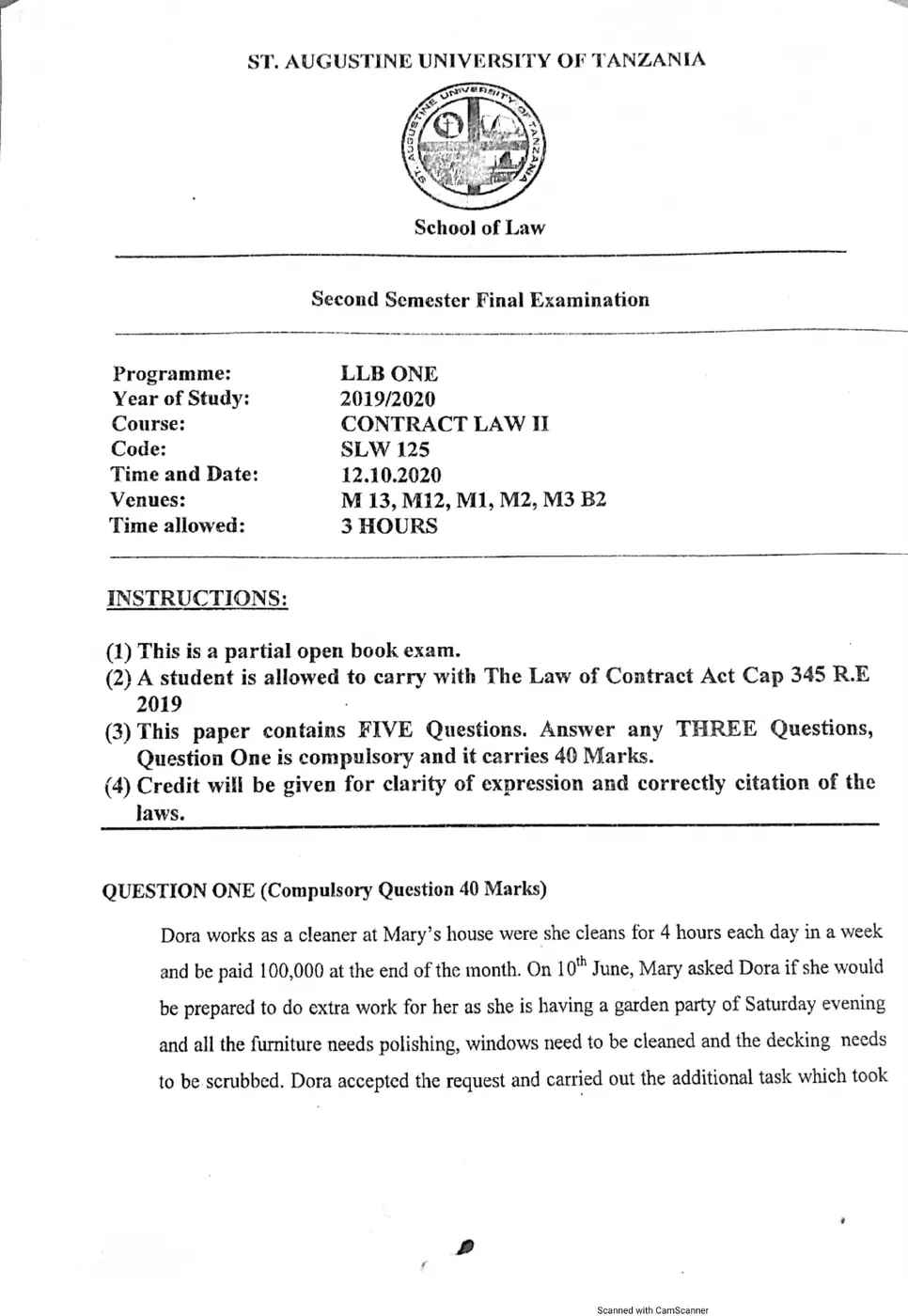
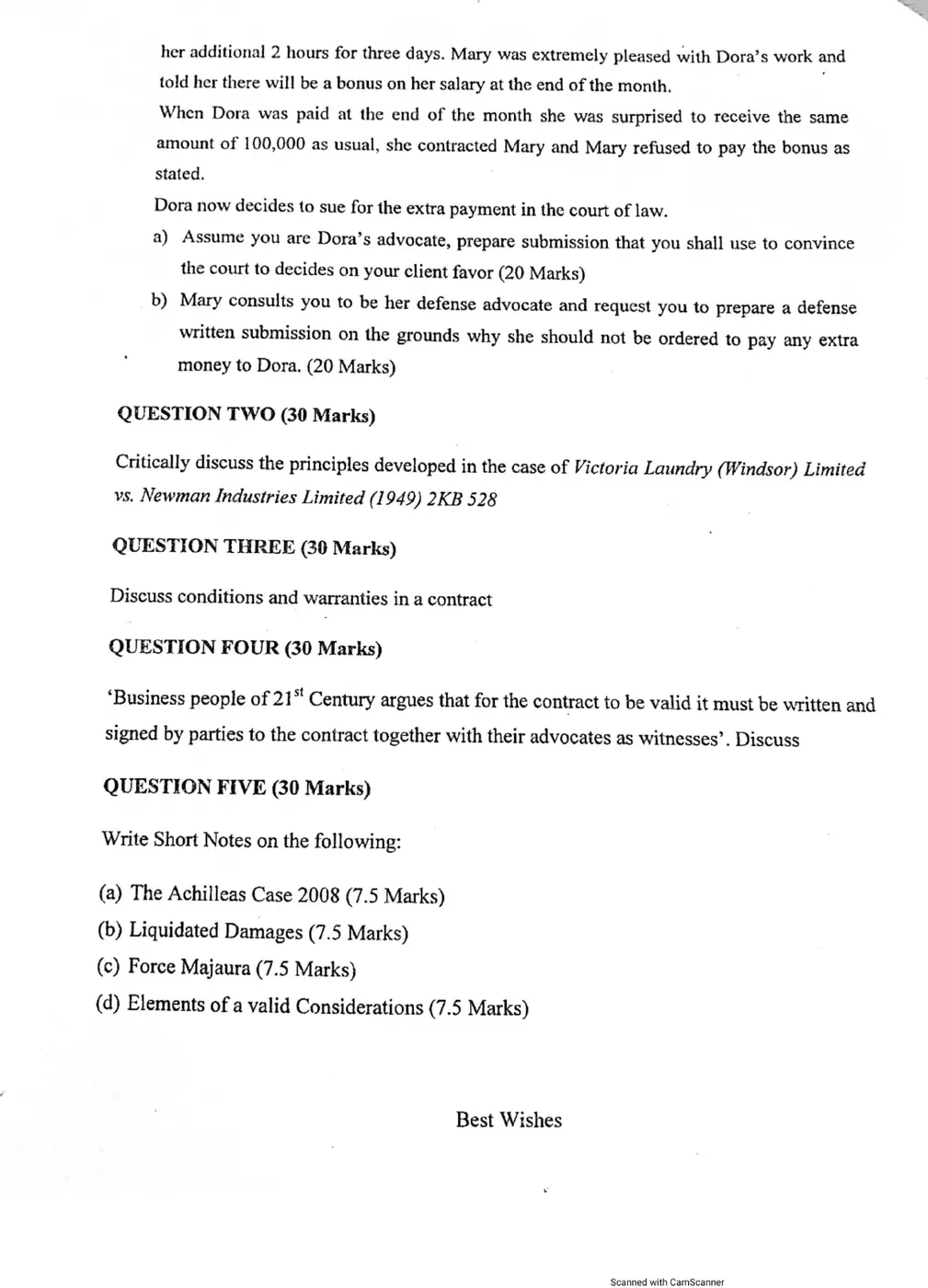
Read the questions as text
This is a partial open book exam. A student is allowed to carry the Law of Contract Act Cap 345 R.E. 2019. This paper contains FIVE questions. Answer any THREE questions; Question One is compulsory and carries 40 marks. Credit will be given for clarity of expression and correct citation of the laws.
1. (Compulsory, 40 marks) Dora works as a cleaner at Mary’s house, where she cleans for 4 hours each day in a week and is paid 100,000 at the end of the month. On 10th June, Mary asked Dora if she would be prepared to do extra work for her as she is having a garden party on Saturday evening and all the furniture needs polishing, windows need to be cleaned and the decking needs to be scrubbed. Dora accepted the request and carried out the additional task, which took her an additional 2 hours for three days. Mary was extremely pleased with Dora’s work and told her there would be a bonus on her salary at the end of the month. When Dora was paid at the end of the month she was surprised to receive the same amount of 100,000 as usual; she contacted Mary and Mary refused to pay the bonus as stated. Dora now decides to sue for the extra payment in a court of law. (a) Assume you are Dora’s advocate; prepare the submission that you shall use to convince the court to decide in your client’s favour. (20 marks) (b) Mary consults you to be her defence advocate and requests you to prepare a defence written submission on the grounds why she should not be ordered to pay any extra money to Dora. (20 marks)
2. (30 marks) Critically discuss the principles developed in the case of Victoria Laundry (Windsor) Ltd v Newman Industries Ltd [1949] 2 KB 528.
3. (30 marks) Discuss conditions and warranties in a contract.
4. (30 marks) “Business people of the 21st century argue that for a contract to be valid it must be written and signed by the parties to the contract together with their advocates as witnesses.” Discuss.
5. (30 marks) Write short notes on the following: (a) The Achilleas case 2008 (7.5 marks); (b) Liquidated damages (7.5 marks); (c) Force majeure (7.5 marks); (d) Elements of valid consideration (7.5 marks).
Source: St. Augustine University of Tanzania examination paper, October 2020, shared for revision. Rights holders can ask for removal through our Contact page.
Part 2
Contract Law II Past Paper Answers: Model Answers to All 5 Questions
Question 1 is answered in full below, free. Tap any other question to see it and a preview of its answer.
Q1Question 1: Dora's unpaid bonus: submissions for both sides on past consideration
40 marks · Problem · Compulsory Free answer
The question
(Compulsory, 40 marks) Dora works as a cleaner at Mary’s house, where she cleans for 4 hours each day in a week and is paid 100,000 at the end of the month. On 10th June, Mary asked Dora if she would be prepared to do extra work for her as she is having a garden party on Saturday evening and all the furniture needs polishing, windows need to be cleaned and the decking needs to be scrubbed. Dora accepted the request and carried out the additional task, which took her an additional 2 hours for three days. Mary was extremely pleased with Dora’s work and told her there would be a bonus on her salary at the end of the month. When Dora was paid at the end of the month she was surprised to receive the same amount of 100,000 as usual; she contacted Mary and Mary refused to pay the bonus as stated. Dora now decides to sue for the extra payment in a court of law. (a) Assume you are Dora’s advocate; prepare the submission that you shall use to convince the court to decide in your client’s favour. (20 marks) (b) Mary consults you to be her defence advocate and requests you to prepare a defence written submission on the grounds why she should not be ordered to pay any extra money to Dora. (20 marks)
Model answer
The short answer
Dora’s best argument is that she did extra work, beyond her existing duties, at Mary’s request; under Tanzanian law consideration may be something already done at the promisor’s desire, so Mary’s later promise of a bonus is enforceable, or at least Dora is entitled to reasonable payment for the extra hours. Mary’s best arguments are that the work was done before any promise of payment (past consideration), that the “bonus” was a gratuitous expression of thanks, and that its amount is too uncertain to enforce. On balance Dora is likely to recover at least a reasonable sum for the six extra hours.
Sections are from the Law of Contract Act, Cap. 345 R.E. 2019 (LCA), the edition the paper allows.
(a) Submission for Dora (the plaintiff)
- A contract to do extra work was formed on 10 June. Mary asked Dora whether she would do extra work: polishing furniture, cleaning windows and scrubbing the decking. Dora accepted and performed. Work requested by an employer in a commercial relationship carries an implied promise to pay for it. Dora’s monthly wage of 100,000 covered four hours a day of cleaning; six additional hours of different tasks were outside her existing duty, so they were fresh consideration (compare Hartley v Ponsonby (1857) 7 E & B 872, where work beyond the original contract supported a promise of extra pay).
- Past consideration is good consideration in Tanzania when given at the promisor’s desire. Section 2(1)(d) LCA defines consideration as an act done “at the desire of the promisor” by the promisee, and expressly includes something the promisee “has done”. Unlike English law, the LCA does not exclude past consideration as long as the act was done at the promisor’s request. Dora worked at Mary’s express request, so Mary’s later promise of a bonus is supported by consideration.
- Even under English principles the promise is enforceable. Where an act is done at the promisor’s request, both parties understand it is to be paid for, and payment would be legally enforceable if promised in advance, a later promise to pay is binding: Lampleigh v Brathwait (1615) Hob 105; Pao On v Lau Yiu Long [1980] AC 614 (PC). All three conditions are met here.
- Section 25(1)(b) LCA: even if there were no consideration, a promise to compensate a person who has already voluntarily done something for the promisor is enforceable.
- Intention to create legal relations: this is an employment relationship, not a domestic or social arrangement, so intention to be legally bound is presumed.
- Certainty: although no figure was named, the court can make the amount certain by reference to Dora’s existing rate. Her pay is 100,000 for about 4 hours a day; the extra six hours can be valued at the same hourly rate. An agreement is void for uncertainty only if its meaning is not certain or capable of being made certain (s.29). If the court finds no agreed amount, Dora claims a reasonable sum (quantum meruit) for work done at Mary’s request.
- Prayers: judgment for the bonus or, alternatively, reasonable remuneration for the six extra hours; general damages for breach; interest and costs. Dora may also rely on the overtime protections for employees under the Employment and Labour Relations Act.
(b) Submission for Mary (the defendant)
- No promise of payment when the work was requested. On 10 June Mary asked Dora to do the extra work; nothing was said about payment. Dora agreed freely, as a helpful employee. The bonus was mentioned only after the work was finished.
- Past consideration. A promise made after the act is complete is not supported by consideration: Roscorla v Thomas (1842) 3 QB 234; Re McArdle [1951] Ch 669. Dora’s work was not done in exchange for the bonus promise, which did not yet exist.
- No mutual understanding that payment would follow. The Pao On exception requires that both parties understood from the start that the work would be paid for. Here, the work was a favour within a continuing employment relationship, and the bonus was a spontaneous expression of thanks.
- Section 25 LCA: an agreement without consideration is void. Section 25(1)(b) does not help Dora, because she was not acting “voluntarily” in the sense of the subsection; she was doing what her employer asked as part of her job, so the promise is, at most, a gratuitous one.
- Uncertainty and discretion. “There will be a bonus” names no amount and no basis of calculation. A bonus is, by nature, discretionary. The promise is too vague to enforce (s.29; Scammell and Nephew Ltd v Ouston [1941] AC 251).
- No intention to create legal relations in the bonus remark, which was a social expression of satisfaction.
- Prayer: the suit be dismissed with costs; alternatively, any award be limited to a modest sum for the hours actually worked.
Assessment
Mary’s past-consideration argument is weaker in Tanzania than in England because section 2(1)(d) LCA counts an act already done at the promisor’s desire. Dora also has the alternative quantum meruit claim for work requested by her employer. Mary’s strongest point is the uncertainty of the bonus amount, which may limit Dora to a reasonable payment rather than any larger bonus.
What the examiner wants
Two persuasive, structured submissions on the same facts, using section 2(1)(d), section 25 and section 29 of the LCA and the past consideration cases, and showing awareness of the Tanzanian departure from English law.
Common mistakes
- Applying the English rule on past consideration without reading section 2(1)(d) LCA.
- Writing one neutral essay instead of two opposing submissions.
Q2Question 2: Victoria Laundry and the remoteness of damage
30 marks · Essay Locked
The question
(30 marks) Critically discuss the principles developed in the case of Victoria Laundry (Windsor) Ltd v Newman Industries Ltd [1949] 2 KB 528.
Model answer
Unlock the model answer to Question 2
Get all 4 locked answers on this paper for TSh 3,000. Pay once, keep them in Your Library for life.
Get the solved paper · TSh 3,000Or get every solved paper with Elite
Q3Question 3: Conditions, warranties and innominate terms
30 marks · Essay Locked
The question
(30 marks) Discuss conditions and warranties in a contract.
Model answer
Unlock the model answer to Question 3
Get all 4 locked answers on this paper for TSh 3,000. Pay once, keep them in Your Library for life.
Get the solved paper · TSh 3,000Or get every solved paper with Elite
Q4Question 4: Must a contract be written and witnessed by advocates?
30 marks · Essay Locked
The question
(30 marks) “Business people of the 21st century argue that for a contract to be valid it must be written and signed by the parties to the contract together with their advocates as witnesses.” Discuss.
Model answer
Unlock the model answer to Question 4
Get all 4 locked answers on this paper for TSh 3,000. Pay once, keep them in Your Library for life.
Get the solved paper · TSh 3,000Or get every solved paper with Elite
Q5Question 5: Short notes: The Achilleas, liquidated damages, force majeure, valid consideration
30 marks · Short notes Locked
The question
(30 marks) Write short notes on the following: (a) The Achilleas case 2008 (7.5 marks); (b) Liquidated damages (7.5 marks); (c) Force majeure (7.5 marks); (d) Elements of valid consideration (7.5 marks).
Model answer
Unlock the model answer to Question 5
Get all 4 locked answers on this paper for TSh 3,000. Pay once, keep them in Your Library for life.
Get the solved paper · TSh 3,000Or get every solved paper with Elite
Get the Full Solved Paper
All 5 questions answered with the statutes and cases that apply, what the examiner wants and the mistakes to avoid. TSh 3,000, yours for life in Your Library.
Pata majibu yote ya mtihani huu kwa TSh 3,000 tu.




Statutes and Cases for This Contract Law II Past Paper
- Law of Contract Act, Cap. 345 R.E. 2019Consideration (s.2(1)(d)), what agreements are contracts and writing laws preserved (s.10), lawful consideration (s.23), agreements without consideration and exceptions (s.25), uncertainty (s.29), frustration (s.56), damages for breach (s.73), sum named or penalty (s.74)
- Sale of Goods Act, Cap. 214Condition treated as warranty (s.13), implied terms (ss.14-17), breach of warranty (s.54)
- Land Act, Cap. 113Contracts for land must be in writing
- Electronic Transactions Act, Cap. 442Validity of electronic contracts and signatures
- Pao On v Lau Yiu Long [1980] AC 614 (PC); Lampleigh v Brathwait (1615) Hob 105Past consideration given at the promisor's request
- Re McArdle [1951] Ch 669 (CA); Roscorla v Thomas (1842) 3 QB 234Past consideration is no consideration
- Hadley v Baxendale (1854) 9 Exch 341; The Heron II [1969] 1 AC 350 (HL)Remoteness of damage
- Transfield Shipping Inc v Mercator Shipping Inc (The Achilleas) [2008] UKHL 48Assumption of responsibility
- Hongkong Fir Shipping Co v Kawasaki Kisen Kaisha [1962] 2 QB 26 (CA)Innominate terms
- Poussard v Spiers (1876) 1 QBD 410; Bettini v Gye (1876) 1 QBD 183Conditions and warranties
- Dunlop Pneumatic Tyre Co v New Garage and Motor Co [1915] AC 79 (HL)Liquidated damages and penalties
SAUT Contract Law II Past Paper: Common Questions
Is this the real SAUT Contract Law II exam paper?
Yes. These are scans of the Second Semester Final Examination 2019/2020 paper for SLW 125 Contract Law II at St. Augustine University of Tanzania, sat on 12 October 2020. Nothing has been retyped or changed.
How many questions do you answer in this Contract Law II paper?
Five questions. Answer any three; Question 1 is compulsory (40 marks). Partial open book: the Law of Contract Act allowed.
Are there answers to this past paper?
Yes. All 5 questions have full model answers written to Tanzanian law and reviewed by Isack Kimaro, LL.B, PDLP. The Question 1 answer is free; the full solved paper is TSh 3,000 (TSh 2,000 for Pro members) and is included in Elite.
How do I see every page of the paper?
The first pages are open to everyone. Create a free account to read the whole paper.