

About this paper
Solved answers to all 5 questions
Part 1
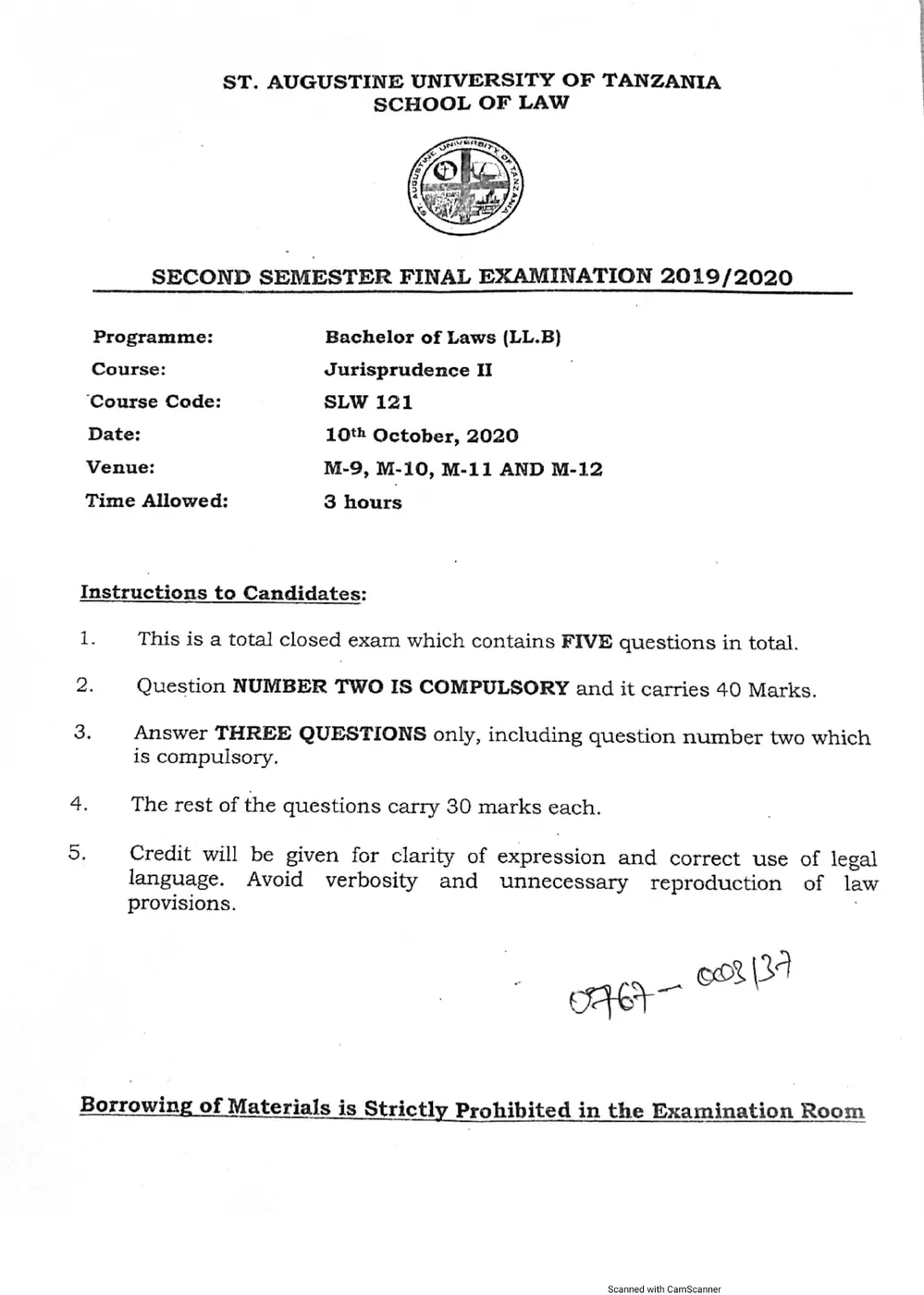
SAUT Jurisprudence II Past Paper (SLW 121): The Full Exam as Set
Five questions. Answer three, including Question 2, which is compulsory (40 marks). Other questions carry 30 marks. Closed book.
Read the questions as text
This is a total closed exam which contains FIVE questions in total. Question NUMBER TWO IS COMPULSORY and carries 40 marks. Answer THREE QUESTIONS only, including question number two, which is compulsory. The rest of the questions carry 30 marks each. Credit will be given for clarity of expression and correct use of legal language. Avoid verbosity and unnecessary reproduction of law provisions.
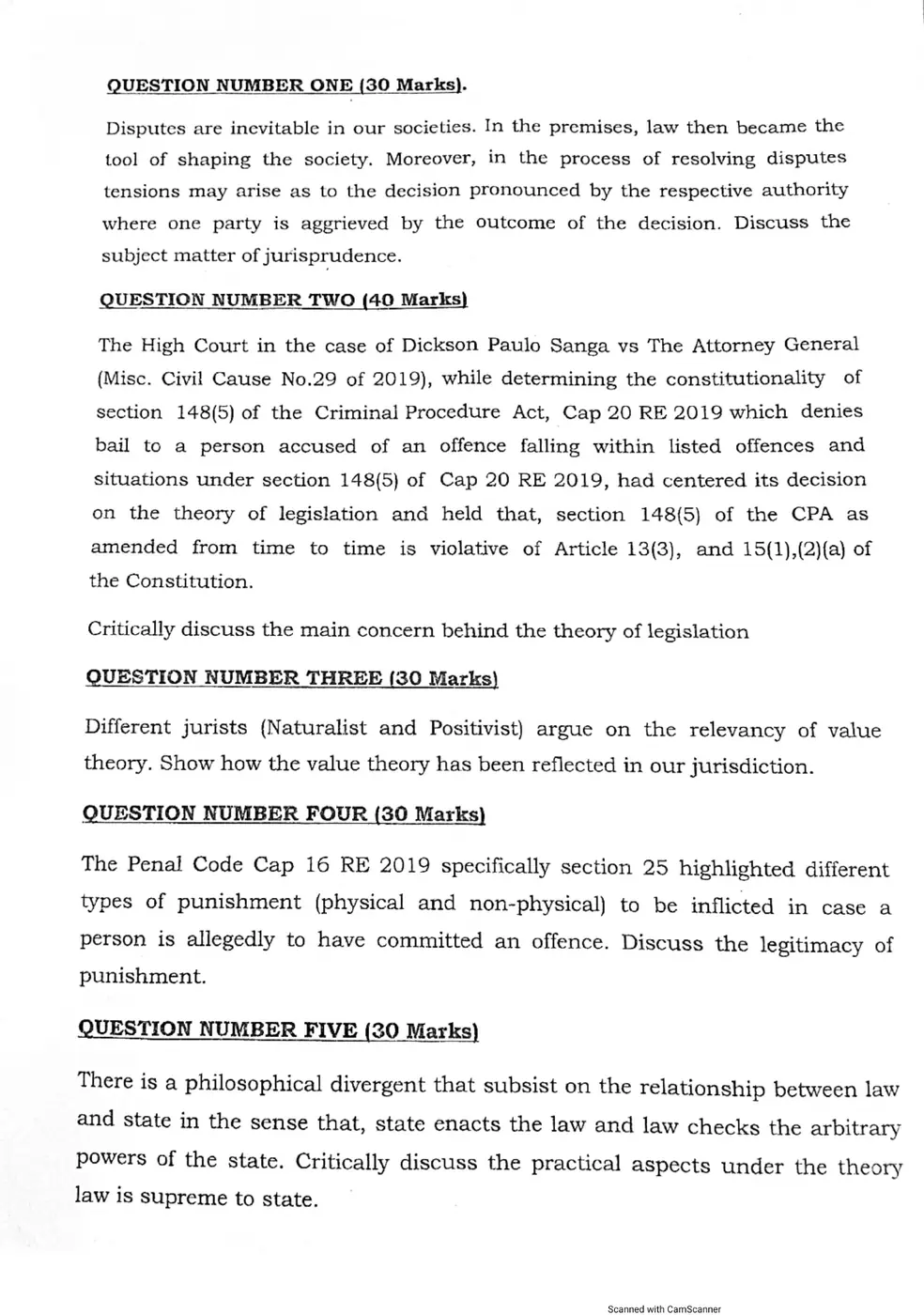
1. (30 marks) Disputes are inevitable in our societies. In the premises, law then became the tool of shaping the society. Moreover, in the process of resolving disputes, tensions may arise as to the decision pronounced by the respective authority where one party is aggrieved by the outcome of the decision. Discuss the subject matter of jurisprudence.
2. (40 marks) The High Court in the case of Dickson Paulo Sanga v The Attorney General (Misc. Civil Cause No. 29 of 2019), while determining the constitutionality of section 148(5) of the Criminal Procedure Act, Cap 20 R.E. 2019, which denies bail to a person accused of an offence falling within the listed offences and situations under section 148(5) of Cap 20 R.E. 2019, centred its decision on the theory of legislation and held that section 148(5) of the CPA as amended from time to time is violative of Article 13(3) and 15(1), (2)(a) of the Constitution. Critically discuss the main concern behind the theory of legislation.
3. (30 marks) Different jurists (naturalist and positivist) argue on the relevancy of value theory. Show how the value theory has been reflected in our jurisdiction.
4. (30 marks) The Penal Code Cap 16 R.E. 2019, specifically section 25, highlights different types of punishment (physical and non-physical) to be inflicted in case a person is alleged to have committed an offence. Discuss the legitimacy of punishment.
5. (30 marks) There is a philosophical divergence that subsists on the relationship between law and state, in the sense that the state enacts the law and law checks the arbitrary powers of the state. Critically discuss the practical aspects under the theory that law is supreme to the state.
Source: St. Augustine University of Tanzania examination paper, October 2020, shared for revision. Rights holders can ask for removal through our Contact page.
Part 2
Jurisprudence II Past Paper Answers: Model Answers to All 5 Questions
Question 2 is answered in full below, free. Tap any other question to see it and a preview of its answer.
Q1Question 1: The subject matter of jurisprudence
30 marks · Essay Locked
The question
(30 marks) Disputes are inevitable in our societies. In the premises, law then became the tool of shaping the society. Moreover, in the process of resolving disputes, tensions may arise as to the decision pronounced by the respective authority where one party is aggrieved by the outcome of the decision. Discuss the subject matter of jurisprudence.
Model answer
Unlock the model answer to Question 1
Get all 4 locked answers on this paper for TSh 3,000. Pay once, keep them in Your Library for life.
Get the solved paper · TSh 3,000Or get every solved paper with Elite
Q2Question 2: The theory of legislation and the Dickson Paulo Sanga bail case
40 marks · Essay · Compulsory Free answer
The question
(40 marks) The High Court in the case of Dickson Paulo Sanga v The Attorney General (Misc. Civil Cause No. 29 of 2019), while determining the constitutionality of section 148(5) of the Criminal Procedure Act, Cap 20 R.E. 2019, which denies bail to a person accused of an offence falling within the listed offences and situations under section 148(5) of Cap 20 R.E. 2019, centred its decision on the theory of legislation and held that section 148(5) of the CPA as amended from time to time is violative of Article 13(3) and 15(1), (2)(a) of the Constitution. Critically discuss the main concern behind the theory of legislation.
Model answer
The short answer
The main concern of the theory of legislation is what makes a law good and legitimate: it should promote the general welfare (Bentham’s utility), respect fundamental rights and the limits the Constitution places on Parliament, and restrict liberty only when necessary and proportionately. The High Court in Dickson Paulo Sanga applied this concern to strike down section 148(5) of the CPA, but the Court of Appeal reversed it in August 2020, holding that the provision met the tests of lawfulness, legitimacy and proportionality. The case shows both the force and the limits of the theory.
The theory of legislation
- Bentham: in his Theory of Legislation, Bentham argued that the legislator’s aim should be the greatest happiness of the greatest number. Every law restricts someone’s liberty and is therefore an evil, justified only if it prevents a greater evil. Laws should be clear, certain, accessible and proportionate to the harm they address.
- Constitutional limits: in a constitutional democracy, Parliament’s power to legislate is limited by the Constitution and the Bill of Rights. A law that restricts a basic right is valid only if it is lawful, pursues a legitimate aim, and is reasonably necessary and proportionate (Article 30(2) of the Constitution of Tanzania).
- Rule of law and legality: laws must be general, prospective, clear and not arbitrary (Fuller’s “inner morality of law”), and must preserve the role of courts in protecting liberty.
The High Court decision
- In Dickson Paulo Sanga v Attorney General, Misc. Civil Cause No. 29 of 2019 [2020] TZHC 653, the petitioner challenged section 148(5) of the CPA, which bars any police officer or court from granting bail for listed offences (such as murder, armed robbery, terrorism, money laundering and drug trafficking).
- The High Court held that the provision violated the presumption of innocence and the right to personal liberty (Articles 13 and 15), because it removed the court’s discretion and provided no procedure to consider whether detention was necessary in an individual case.
- This reflects the legislative-theory concern: a law that automatically deprives liberty, without weighing individual circumstances, is disproportionate and treats the accused as guilty before trial. The High Court followed the reasoning of DPP v Daudi Pete [1993] TLR 22, where the Court of Appeal struck down a provision allowing the DPP to block bail by certificate, and stressed that laws limiting rights must not be arbitrary.
The Court of Appeal decision
In Attorney General v Dickson Paulo Sanga, Civil Appeal No. 175 of 2020, decided on 5 August 2020, a five-judge bench of the Court of Appeal quashed the High Court decision and held that section 148(5) is not unconstitutional. The Court reasoned that the restriction was prescribed by law, pursued legitimate aims (public safety, the seriousness of the listed offences, the risk of absconding and interference with witnesses) and was proportionate, falling within the limitation allowed by Article 30(2). Section 148(5) therefore remains in force.
Critical discussion
- Utility versus rights: the Court of Appeal’s approach is broadly utilitarian: protecting society from serious crime outweighs individual liberty before trial. The High Court’s approach is rights-based: liberty cannot be removed wholesale without individual assessment. The theory of legislation must reconcile the two.
- Role of courts: a law that removes judicial discretion shifts power from courts to Parliament and prosecutors (who choose the charge). Critics argue that charging a person with a non-bailable offence can be used to detain opponents for long periods.
- Proportionality: a narrower law (a presumption against bail that the accused can rebut) would achieve the same aim with less harm, which is the kind of alternative proportionality analysis demands.
- International standards: the ICCPR (art. 9(3)) states that pre-trial detention should not be the general rule, supporting the High Court’s concern.
Conclusion
The main concern of the theory of legislation is to ensure laws serve the public good without arbitrarily sacrificing individual rights. Dickson Paulo Sanga shows the two courts weighing that concern differently. The final position in Tanzanian law is the Court of Appeal’s: section 148(5) is valid. But the debate continues on whether automatic denial of bail is a proportionate legislative choice.
What the examiner wants
An explanation of the theory (Bentham, constitutional limits, rule of law), its application by the High Court, the Court of Appeal’s reversal, and a critical evaluation.
Common mistakes
- Treating the High Court decision as the current law without mentioning the Court of Appeal reversal.
- Describing the case without linking it to legislative theory.
Q3Question 3: Value theory: naturalists, positivists and Tanzanian law
30 marks · Essay Locked
The question
(30 marks) Different jurists (naturalist and positivist) argue on the relevancy of value theory. Show how the value theory has been reflected in our jurisdiction.
Model answer
Unlock the model answer to Question 3
Get all 4 locked answers on this paper for TSh 3,000. Pay once, keep them in Your Library for life.
Get the solved paper · TSh 3,000Or get every solved paper with Elite
Q4Question 4: The legitimacy of punishment
30 marks · Essay Locked
The question
(30 marks) The Penal Code Cap 16 R.E. 2019, specifically section 25, highlights different types of punishment (physical and non-physical) to be inflicted in case a person is alleged to have committed an offence. Discuss the legitimacy of punishment.
Model answer
Unlock the model answer to Question 4
Get all 4 locked answers on this paper for TSh 3,000. Pay once, keep them in Your Library for life.
Get the solved paper · TSh 3,000Or get every solved paper with Elite
Q5Question 5: Is law supreme to the state? Practical aspects
30 marks · Essay Locked
The question
(30 marks) There is a philosophical divergence that subsists on the relationship between law and state, in the sense that the state enacts the law and law checks the arbitrary powers of the state. Critically discuss the practical aspects under the theory that law is supreme to the state.
Model answer
Unlock the model answer to Question 5
Get all 4 locked answers on this paper for TSh 3,000. Pay once, keep them in Your Library for life.
Get the solved paper · TSh 3,000Or get every solved paper with Elite
Get the Full Solved Paper
All 5 questions answered with the statutes and cases that apply, what the examiner wants and the mistakes to avoid. TSh 3,000, yours for life in Your Library.
Pata majibu yote ya mtihani huu kwa TSh 3,000 tu.




Statutes and Cases for This Jurisprudence II Past Paper
- Constitution of the United Republic of Tanzania, 1977Equality and presumption of innocence (art. 13), personal liberty (art. 15), duty to observe the Constitution (art. 26), limitation of rights (art. 30), constitutional supremacy (art. 64(5))
- Criminal Procedure Act, Cap. 20 R.E. 2019Non-bailable offences (s.148(5))
- Penal Code, Cap. 16 R.E. 2019Types of punishment (s.25)
- Dickson Paulo Sanga v Attorney General, Misc. Civil Cause No. 29 of 2019 [2020] TZHC 653High Court held s.148(5) CPA unconstitutional
- Attorney General v Dickson Paulo Sanga, Civil Appeal No. 175 of 2020 (CA, 5 August 2020)Court of Appeal reversed and upheld s.148(5)
- DPP v Daudi Pete [1993] TLR 22 (CA)Laws limiting rights must be lawful and proportionate
- Kukutia Ole Pumbun v Attorney General [1993] TLR 159 (CA)Access to court against the Government
- Attorney General v Lohay Akonaay and Joseph Lohay [1995] TLR 80 (CA)Customary land rights as constitutionally protected property
- Attorney General v Rebeca Z. Gyumi [2019] TZCA 348Child marriage provisions unconstitutional
- Bi Hawa Mohamed v Ally Sefu [1983] TLR 32 (CA)Domestic work as contribution to matrimonial assets
SAUT Jurisprudence II Past Paper: Common Questions
Is this the real SAUT Jurisprudence II exam paper?
Yes. These are scans of the Second Semester Final Examination 2019/2020 paper for SLW 121 Jurisprudence II at St. Augustine University of Tanzania, sat on 10 October 2020. Nothing has been retyped or changed.
How many questions do you answer in this Jurisprudence II paper?
Five questions. Answer three, including Question 2, which is compulsory (40 marks). Other questions carry 30 marks. Closed book.
Are there answers to this past paper?
Yes. All 5 questions have full model answers written to Tanzanian law and reviewed by Isack Kimaro, LL.B, PDLP. The Question 1 answer is free; the full solved paper is TSh 3,000 (TSh 2,000 for Pro members) and is included in Elite.
How do I see every page of the paper?
The first pages are open to everyone. Create a free account to read the whole paper.