

About this paper
Solved answers to all 6 questions
Part 1
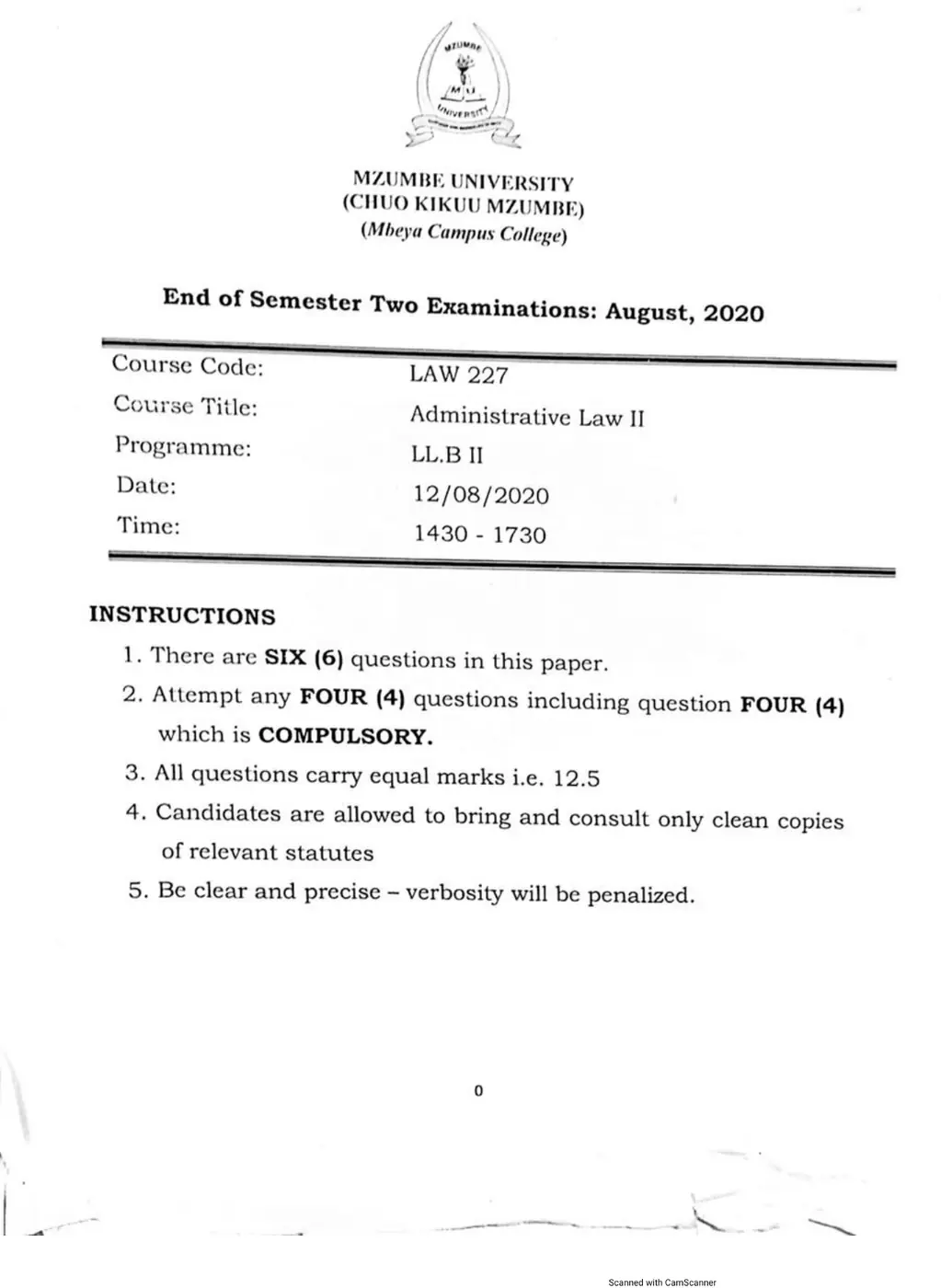
Mzumbe Administrative Law II Past Paper (LAW 227): The Full Exam as Set
Six questions. Attempt four, including Question 4, which is compulsory. Each question carries 12.5 marks.
 Full size
 Full size
Page 3 of 3
Create a free account to see the whole paper. It takes a minute.
Create a free accountAlready a member? Log inRead the questions as text
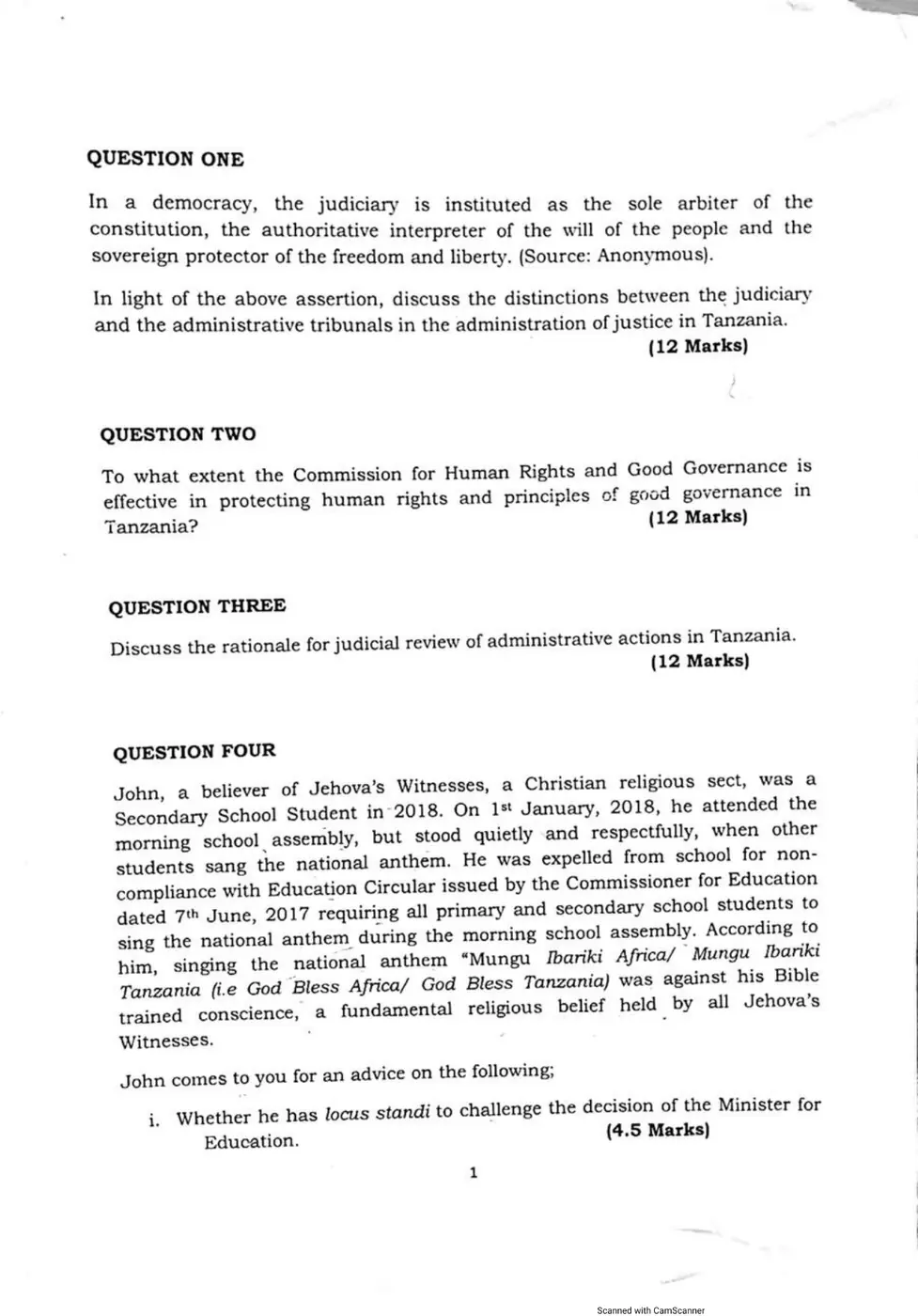
1. In a democracy, the judiciary is instituted as the sole arbiter of the constitution, the authoritative interpreter of the will of the people and the sovereign protector of the freedom and liberty. (Source: Anonymous). In light of the above assertion, discuss the distinctions between the judiciary and the administrative tribunals in the administration of justice in Tanzania. (12 marks)
2. To what extent the Commission for Human Rights and Good Governance is effective in protecting human rights and principles of good governance in Tanzania? (12 marks)
3. Discuss the rationale for judicial review of administrative actions in Tanzania. (12 marks)
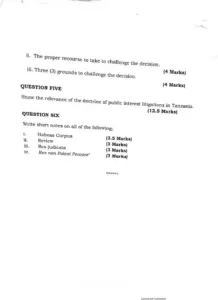
4. John, a believer of Jehova’s Witnesses, a Christian religious sect, was a Secondary School Student in 2018. On 1st January, 2018, he attended the morning school assembly, but stood quietly and respectfully, when other students sang the national anthem. He was expelled from school for non-compliance with Education Circular issued by the Commissioner for Education dated 7th June, 2017 requiring all primary and secondary school students to sing the national anthem during the morning school assembly. According to him, singing the national anthem “Mungu Ibariki Africa/ Mungu Ibariki Tanzania (i.e God Bless Africa/ God Bless Tanzania)” was against his Bible trained conscience, a fundamental religious belief held by all Jehova’s Witnesses. John comes to you for an advice on the following: i. Whether he has locus standi to challenge the decision of the Minister for Education (4.5 marks); ii. The proper recourse to take to challenge the decision (4 marks); iii. Three (3) grounds to challenge the decision (4 marks).
5. Show the relevance of the doctrine of public interest litigations in Tanzania. (12.5 marks)
6. Write short notes on all of the following: i. Habeas Corpus (3.5 marks); ii. Review (3 marks); iii. Res judicata (3 marks); iv. Rex non Potest Peccare (3 marks).
Source: Mzumbe University examination paper, August 2020, shared for revision. Rights holders can ask for removal through our Contact page.
Part 2
Administrative Law II Past Paper Answers: Model Answers to All 6 Questions
Question 4 is answered in full below, free. Tap any other question to see it and a preview of its answer.
Q1Question 1: Courts and administrative tribunals compared
12 marks · essay Locked
The question
In a democracy, the judiciary is instituted as the sole arbiter of the constitution, the authoritative interpreter of the will of the people and the sovereign protector of the freedom and liberty. (Source: Anonymous). In light of the above assertion, discuss the distinctions between the judiciary and the administrative tribunals in the administration of justice in Tanzania. (12 marks)
Model answer
Unlock the model answer to Question 1
Get all 5 locked answers on this paper for TSh 3,000. Pay once, keep them in Your Library for life.
Get the solved paper · TSh 3,000Or get every solved paper with Elite
Q2Question 2: How effective is the Commission for Human Rights and Good Governance?
12 marks · essay Locked
The question
To what extent the Commission for Human Rights and Good Governance is effective in protecting human rights and principles of good governance in Tanzania? (12 marks)
Model answer
Unlock the model answer to Question 2
Get all 5 locked answers on this paper for TSh 3,000. Pay once, keep them in Your Library for life.
Get the solved paper · TSh 3,000Or get every solved paper with Elite
Q3Question 3: Why courts review administrative action
12 marks · essay Locked
The question
Discuss the rationale for judicial review of administrative actions in Tanzania. (12 marks)
Model answer
Unlock the model answer to Question 3
Get all 5 locked answers on this paper for TSh 3,000. Pay once, keep them in Your Library for life.
Get the solved paper · TSh 3,000Or get every solved paper with Elite
Q4Question 4: John, the national anthem and freedom of religion
12.5 marks · problem Free answer
The question
John, a believer of Jehova’s Witnesses, a Christian religious sect, was a Secondary School Student in 2018. On 1st January, 2018, he attended the morning school assembly, but stood quietly and respectfully, when other students sang the national anthem. He was expelled from school for non-compliance with Education Circular issued by the Commissioner for Education dated 7th June, 2017 requiring all primary and secondary school students to sing the national anthem during the morning school assembly. According to him, singing the national anthem “Mungu Ibariki Africa/ Mungu Ibariki Tanzania (i.e God Bless Africa/ God Bless Tanzania)” was against his Bible trained conscience, a fundamental religious belief held by all Jehova’s Witnesses. John comes to you for an advice on the following: i. Whether he has locus standi to challenge the decision of the Minister for Education (4.5 marks); ii. The proper recourse to take to challenge the decision (4 marks); iii. Three (3) grounds to challenge the decision (4 marks).
Model answer
The short answer
(i) John has locus standi: he is directly affected by the expulsion, which interferes with his own right to education and his freedom of conscience and religion (Constitution art. 19), so he has a personal and sufficient interest. (ii) He may challenge the expulsion and the circular by applying for leave for judicial review (certiorari) in the High Court, or by petitioning the High Court under the Basic Rights and Duties Enforcement Act for violation of his basic rights. (iii) Grounds: violation of freedom of conscience and religion (art. 19) and disproportionate limitation; breach of natural justice because he was expelled without a hearing; and illegality or unreasonableness of the circular and the expulsion decision.
(i) Locus standi
- For judicial review, the applicant must have sufficient interest in the matter. John was personally expelled; his interest is direct.
- For a constitutional petition, a person whose basic right has been, is being or is likely to be contravened may apply to the High Court (art. 30(3)). John alleges violation of his own freedom of conscience and religion (art. 19) and his right to be heard (art. 13(6)(a)).
- As a student, he may need a next friend if he is a minor.
(ii) Proper recourse
- Judicial review: apply to the High Court for leave to file for certiorari to quash the expulsion (and the circular as applied to him), and mandamus to compel his readmission (Cap. 310 ss.17–19; GN No. 324 of 2014). The application must be made within the time set by the Rules (six months).
- Constitutional petition: under the Basic Rights and Duties Enforcement Act, Cap. 3, for a declaration that the expulsion violated art. 19 and for readmission.
- First exhaust any available internal appeal (for example to the school board or education authorities), if provided, since courts may refuse review where an adequate alternative remedy exists.
(iii) Grounds
- Violation of freedom of conscience and religion (art. 19): he stood respectfully but did not sing because of his religious belief. Restrictions on rights must be lawful, necessary and proportionate (art. 30(2); DPP v Daudi Pete [1993] TLR 22). Expulsion for silent, respectful non-participation is disproportionate. Comparable reasoning was adopted by the Supreme Court of India in Bijoe Emmanuel v State of Kerala (1986), concerning Jehovah’s Witness students who stood silently during the anthem.
- Breach of natural justice: he was expelled without being heard (art. 13(6)(a)).
- Illegality and unreasonableness: the circular does not prescribe expulsion, and expulsion is a penalty out of proportion to the conduct; a decision no reasonable authority would make.
What the examiner wants
Locus standi under judicial review and art. 30(3), the correct procedures, and well-argued grounds.
Common mistakes
- Suing in an ordinary civil suit for damages only.
- Ignoring the proportionality of restrictions on rights.
Q5Question 5: Public interest litigation in Tanzania
12.5 marks · essay Locked
The question
Show the relevance of the doctrine of public interest litigations in Tanzania. (12.5 marks)
Model answer
Unlock the model answer to Question 5
Get all 5 locked answers on this paper for TSh 3,000. Pay once, keep them in Your Library for life.
Get the solved paper · TSh 3,000Or get every solved paper with Elite
Q6Question 6: Short notes: habeas corpus, review, res judicata, rex non potest peccare
12.5 marks · short notes Locked
The question
Write short notes on all of the following: i. Habeas Corpus (3.5 marks); ii. Review (3 marks); iii. Res judicata (3 marks); iv. Rex non Potest Peccare (3 marks).
Model answer
Unlock the model answer to Question 6
Get all 5 locked answers on this paper for TSh 3,000. Pay once, keep them in Your Library for life.
Get the solved paper · TSh 3,000Or get every solved paper with Elite
Get the Full Solved Paper
All 6 questions answered with the statutes and cases that apply, what the examiner wants and the mistakes to avoid. TSh 3,000, yours for life in Your Library.
Pata majibu yote ya mtihani huu kwa TSh 3,000 tu.




Statutes and Cases for This Administrative Law II Past Paper
- Constitution of the United Republic of Tanzania, 1977Art. 13(6)(a), art. 19 (freedom of conscience and religion), art. 26(2), art. 30(3), art. 107A, arts 129–131 (Commission for Human Rights and Good Governance)
- Basic Rights and Duties Enforcement Act, Cap. 3Enforcement of basic rights; s.4(4)–(5) added in 2020
- Law Reform (Fatal Accidents and Miscellaneous Provisions) Act, Cap. 310ss.17–19 (prerogative orders)
- Law Reform (Fatal Accidents and Miscellaneous Provisions) (Judicial Review Procedure and Fees) Rules, GN No. 324 of 2014Leave and time limits for judicial review
- Commission for Human Rights and Good Governance Act, Cap. 391Functions and powers of the Commission
- Civil Procedure Code, Cap. 33s.9 (res judicata), s.78 and Order XLII (review)
- Criminal Procedure Act, Cap. 20Habeas corpus (directions in the nature of habeas corpus)
- Rev. Christopher Mtikila v Attorney General [1995] TLR 31 (HC)Public interest litigation and art. 26(2)
- Sanai Murumbe v Muhere Chacha [1990] TLR 54 (CA)Grounds for certiorari
- Onesmo Olengurumwa v Attorney General, Civil Appeal No. 134 of 2022 [2025] TZCA 587Challenge to the 2020 BRADEA amendment
Mzumbe Administrative Law II Past Paper: Common Questions
Is this the real Mzumbe Administrative Law II exam paper?
Yes. These are scans of the End of Semester Two Examination, August 2020 paper for LAW 227 Administrative Law II at Mzumbe University, sat on 12 August 2020. Nothing has been retyped or changed.
How many questions do you answer in this Administrative Law II paper?
Six questions. Attempt four, including Question 4, which is compulsory. Each question carries 12.5 marks.
Are there answers to this past paper?
Yes. All 6 questions have full model answers written to Tanzanian law and reviewed by Isack Kimaro, LL.B, PDLP. The Question 1 answer is free; the full solved paper is TSh 3,000 (TSh 2,000 for Pro members) and is included in Elite.
How do I see every page of the paper?
The first pages are open to everyone. Create a free account to read the whole paper.