

About this paper
Solved answers to all 6 questions
Part 1
Mzumbe Civil Procedure II Past Paper (LAW 225): The Full Exam as Set
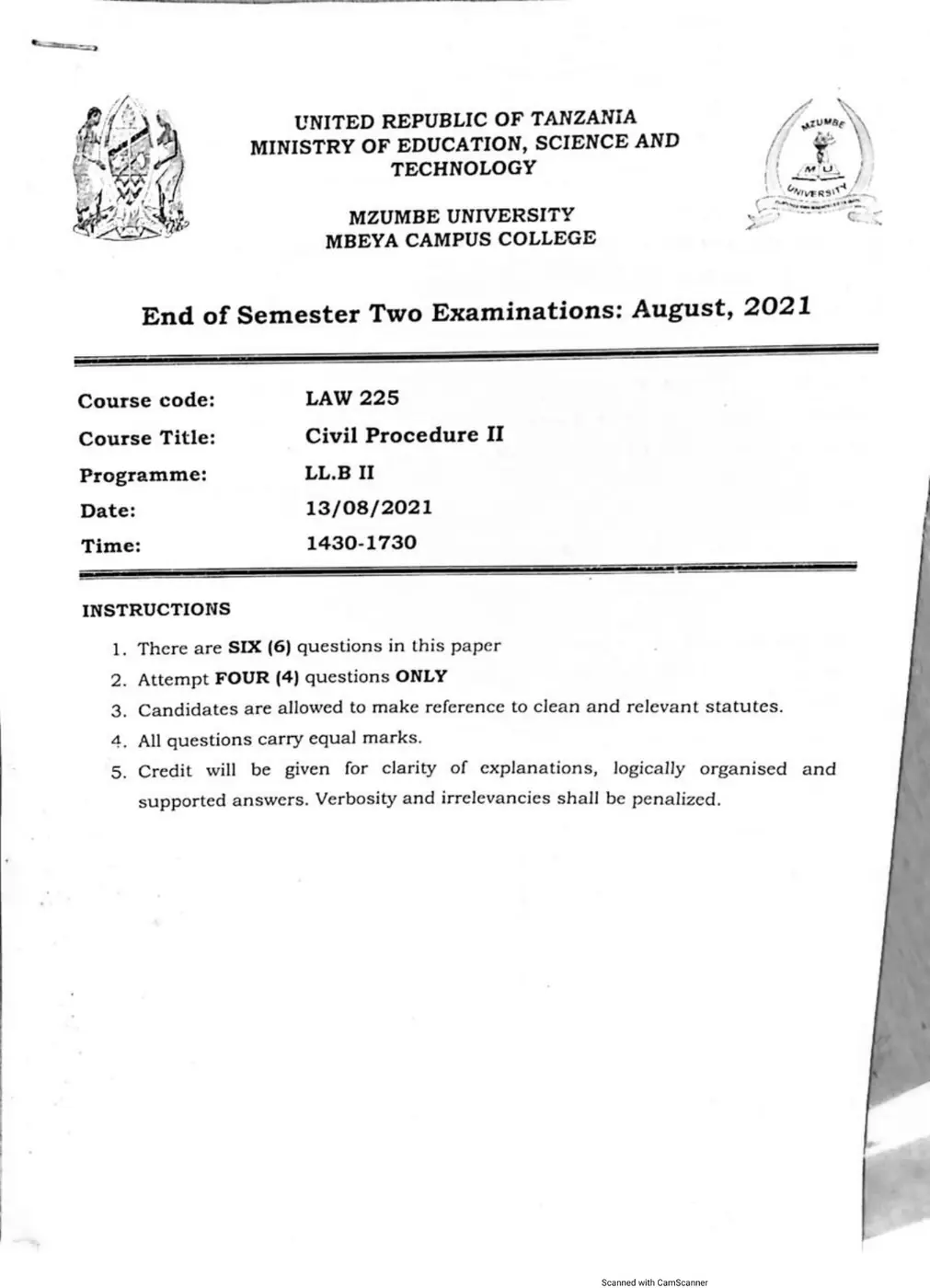
Six questions. Attempt four only. All questions carry equal marks. Clean statutes allowed.
 Full size
 Full size
Page 3 of 4
Create a free account to see the whole paper. It takes a minute.
Create a free accountAlready a member? Log in
Page 4 of 4
Create a free account to see the whole paper. It takes a minute.
Create a free accountAlready a member? Log inRead the questions as text
There are SIX (6) questions in this paper. Attempt FOUR (4) questions ONLY. Candidates are allowed to make reference to clean and relevant statutes. All questions carry equal marks. Credit will be given for clarity of explanations, logically organised and supported answers. Verbosity and irrelevancies shall be penalised.
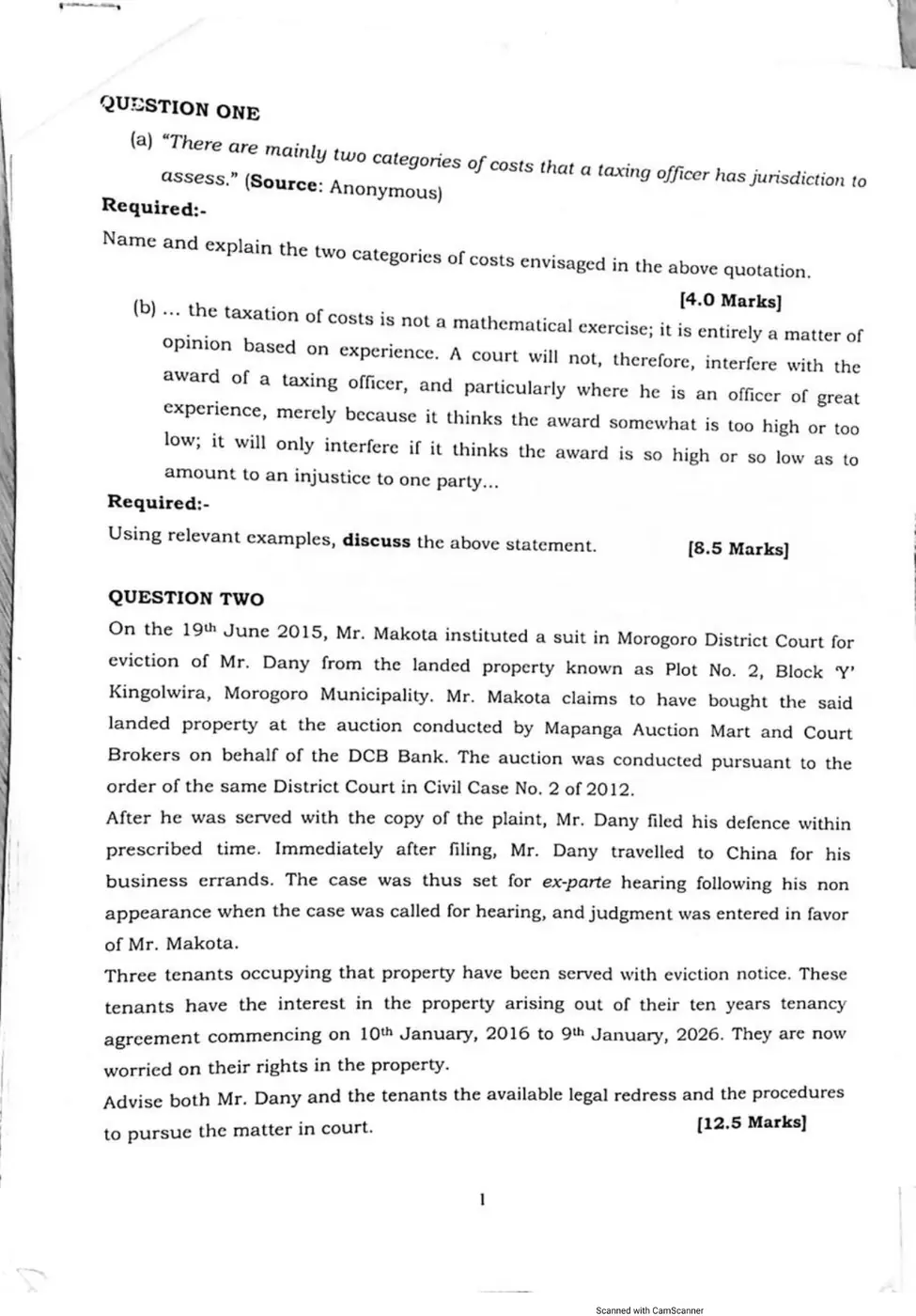
1. (a) “There are mainly two categories of costs that a taxing officer has jurisdiction to assess.” Name and explain the two categories of costs envisaged in the above quotation. [4 marks] (b) “… the taxation of costs is not a mathematical exercise; it is entirely a matter of opinion based on experience. A court will not, therefore, interfere with the award of a taxing officer, and particularly where he is an officer of great experience, merely because it thinks the award somewhat too high or too low; it will only interfere if it thinks the award is so high or so low as to amount to an injustice to one party…” Using relevant examples, discuss the above statement. [8.5 marks]
2. On 19th June 2015, Mr. Makota instituted a suit in Morogoro District Court for eviction of Mr. Dany from the landed property known as Plot No. 2, Block ‘Y’ Kingolwira, Morogoro Municipality. Mr. Makota claims to have bought the said landed property at an auction conducted by Mapanga Auction Mart and Court Brokers on behalf of DCB Bank. The auction was conducted pursuant to the order of the same District Court in Civil Case No. 2 of 2012. After he was served with a copy of the plaint, Mr. Dany filed his defence within the prescribed time. Immediately after filing, Mr. Dany travelled to China on business errands. The case was thus set for ex parte hearing following his non-appearance when the case was called for hearing, and judgment was entered in favour of Mr. Makota. Three tenants occupying the property have been served with an eviction notice. These tenants have an interest in the property arising out of their ten-year tenancy agreement commencing on 10th January 2016 to 9th January 2026. They are now worried about their rights in the property. Advise both Mr. Dany and the tenants on the available legal redress and the procedures to pursue the matter in court. [12.5 marks]
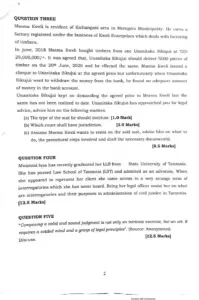
3. Msema Kweli is a resident of Kichangani area in Morogoro Municipality. He owns a factory registered under the business name of Kweli Enterprises which deals with factoring of timber. In June 2018 Msema Kweli bought timber from one Unanitaka Sikujui at TZS 29,000,000/=. It was agreed that Unanitaka Sikujui should deliver 5,000 pieces of timber on 20th June 2020 and he effected the same. Msema Kweli issued a cheque to Unanitaka Sikujui at the agreed price but unfortunately when Unanitaka Sikujui went to withdraw the money from the bank, he found no adequate amount of money in the bank account. Unanitaka Sikujui kept on demanding the agreed price from Msema Kweli but the same has not been realised to date. Unanitaka Sikujui has approached you for legal advice. Advise him on the following matters: (a) the type of suit he should institute [1 mark]; (b) which court shall have jurisdiction [3 marks]; (c) assume Msema Kweli wants to resist the said suit; advise him on what to do, the procedural steps involved, and draft the necessary document(s) [8.5 marks].
4. Mwamini Issa has recently graduated with her LLB from State University of Tanzania. She has passed the Law School of Tanzania (LST) and been admitted as an advocate. When she appeared to represent her client she came across a very strange term, interrogatories, which she has never heard. Being her legal officer, assist her on what interrogatories are and their purposes in the administration of civil justice in Tanzania. [12.5 marks]
5. “Composing a valid and sound judgment is not only an intricate exercise, but an art. It requires a settled mind and a grasp of legal principles.” (Source: Anonymous). Discuss. [12.5 marks]
6. Write short but comprehensive notes on the following: (a) practical grounds the court normally considers before granting an application for extension of time to appeal [4 marks]; (b) objection proceedings [4 marks]; (c) the relevance of the case of Catherine Honorati v CRDB Bank and 2 Others, Civil Application No. 42/2016, CAT at Dar es Salaam (unreported) on stay of execution [4.5 marks].
Source: Mzumbe University examination paper, August 2021, shared for revision. Rights holders can ask for removal through our Contact page.
Part 2
Civil Procedure II Past Paper Answers: Model Answers to All 6 Questions
Question 1 is answered in full below, free. Tap any other question to see it and a preview of its answer.
Q1Question 1: Categories of costs and when a court interferes with a taxing officer's award
12.5 marks · Essay Free answer
The question
(a) “There are mainly two categories of costs that a taxing officer has jurisdiction to assess.” Name and explain the two categories of costs envisaged in the above quotation. [4 marks] (b) “… the taxation of costs is not a mathematical exercise; it is entirely a matter of opinion based on experience. A court will not, therefore, interfere with the award of a taxing officer, and particularly where he is an officer of great experience, merely because it thinks the award somewhat too high or too low; it will only interfere if it thinks the award is so high or so low as to amount to an injustice to one party…” Using relevant examples, discuss the above statement. [8.5 marks]
Model answer
The short answer
(a) the two categories are party-and-party costs (what the losing party pays the winner) and advocate-and-client costs (what a client pays his own advocate). (b) The statement is correct and reflects settled East African law: taxation is a matter of judgment, so on a reference the judge will not substitute his own figure unless the taxing officer erred in principle or the award is so high or low that it causes injustice.
(a) The two categories of costs
- Party-and-party costs: the costs the court orders one party (usually the loser) to pay the other. They cover only what was necessary or proper for the conduct of the case, such as instruction fees, court fees, attendances and disbursements, taxed by the taxing officer on a bill of costs filed by the successful party under the Advocates Remuneration Order, 2015 (GN 264 of 2015).
- Advocate-and-client costs: the fees a client owes his own advocate for the work done. They may be fixed by agreement, or taxed when the client disputes the advocate’s bill. They are usually higher than party-and-party costs, because they include work done for the client’s own benefit that the other side should not have to pay for.
(b) The court’s approach to the taxing officer’s award
- Source and meaning: the statement reflects the East African Court of Appeal in Premchand Raichand Ltd v Quarry Services of East Africa Ltd [1972] EA 162. Taxing costs, especially the instruction fee, involves weighing the value of the subject matter, the complexity of the case, the time and skill involved and the conduct of the parties. There is no formula, so reasonable officers may reach different figures.
- When the judge will interfere on a reference from the taxing officer under the Advocates Remuneration Order:
- where the officer applied a wrong principle, for example ignored the scale, took irrelevant matters into account or failed to consider relevant ones;
- where the award is so manifestly excessive or so low that it amounts to an injustice to one party; and
- where the officer misdirected himself on the facts or the record.
- When the judge will not interfere: merely because he would have awarded a slightly different sum. The taxing officer sees many bills and has experience the judge may lack.
- Underlying policy: costs should fairly reimburse the successful party but must not be so high that access to courts is limited to the wealthy, and awards should be reasonably consistent between cases.
Examples
- A taxing officer awards TSh 10 million as instruction fee in a simple debt claim of TSh 5 million that ended after one hearing. The award is so disproportionate that a judge would interfere.
- A taxing officer awards TSh 3 million where the bill claimed TSh 3.5 million in a moderately complex land case. Even if the judge would have allowed TSh 3.3 million, he would not interfere, because the difference does not cause injustice.
- A taxing officer taxes off all disbursements because receipts were not attached, without asking for them where they were clearly incurred (court fees shown on the record). That may be an error of principle justifying interference.
What the examiner wants
The two categories clearly distinguished, the meaning of the quotation with its source, the grounds for interference, and your own concrete examples.
Common mistakes
- Confusing costs with damages or court fees.
- Saying a judge can freely re-tax a bill on reference.
Q2Question 2: Ex parte eviction judgment: remedies for Mr. Dany and the tenants
12.5 marks · Problem Locked
The question
On 19th June 2015, Mr. Makota instituted a suit in Morogoro District Court for eviction of Mr. Dany from the landed property known as Plot No. 2, Block ‘Y’ Kingolwira, Morogoro Municipality. Mr. Makota claims to have bought the said landed property at an auction conducted by Mapanga Auction Mart and Court Brokers on behalf of DCB Bank. The auction was conducted pursuant to the order of the same District Court in Civil Case No. 2 of 2012. After he was served with a copy of the plaint, Mr. Dany filed his defence within the prescribed time. Immediately after filing, Mr. Dany travelled to China on business errands. The case was thus set for ex parte hearing following his non-appearance when the case was called for hearing, and judgment was entered in favour of Mr. Makota. Three tenants occupying the property have been served with an eviction notice. These tenants have an interest in the property arising out of their ten-year tenancy agreement commencing on 10th January 2016 to 9th January 2026. They are now worried about their rights in the property. Advise both Mr. Dany and the tenants on the available legal redress and the procedures to pursue the matter in court. [12.5 marks]
Model answer
Unlock the model answer to Question 2
Get all 5 locked answers on this paper for TSh 3,000. Pay once, keep them in Your Library for life.
Get the solved paper · TSh 3,000Or get every solved paper with Elite
Q3Question 3: A dishonoured cheque: summary suit, jurisdiction and leave to defend
12.5 marks · Problem and drafting Locked
The question
Msema Kweli is a resident of Kichangani area in Morogoro Municipality. He owns a factory registered under the business name of Kweli Enterprises which deals with factoring of timber. In June 2018 Msema Kweli bought timber from one Unanitaka Sikujui at TZS 29,000,000/=. It was agreed that Unanitaka Sikujui should deliver 5,000 pieces of timber on 20th June 2020 and he effected the same. Msema Kweli issued a cheque to Unanitaka Sikujui at the agreed price but unfortunately when Unanitaka Sikujui went to withdraw the money from the bank, he found no adequate amount of money in the bank account. Unanitaka Sikujui kept on demanding the agreed price from Msema Kweli but the same has not been realised to date. Unanitaka Sikujui has approached you for legal advice. Advise him on the following matters: (a) the type of suit he should institute [1 mark]; (b) which court shall have jurisdiction [3 marks]; (c) assume Msema Kweli wants to resist the said suit; advise him on what to do, the procedural steps involved, and draft the necessary document(s) [8.5 marks].
Model answer
Unlock the model answer to Question 3
Get all 5 locked answers on this paper for TSh 3,000. Pay once, keep them in Your Library for life.
Get the solved paper · TSh 3,000Or get every solved paper with Elite
Q4Question 4: Interrogatories and their purpose
12.5 marks · Essay Locked
The question
Mwamini Issa has recently graduated with her LLB from State University of Tanzania. She has passed the Law School of Tanzania (LST) and been admitted as an advocate. When she appeared to represent her client she came across a very strange term, interrogatories, which she has never heard. Being her legal officer, assist her on what interrogatories are and their purposes in the administration of civil justice in Tanzania. [12.5 marks]
Model answer
Unlock the model answer to Question 4
Get all 5 locked answers on this paper for TSh 3,000. Pay once, keep them in Your Library for life.
Get the solved paper · TSh 3,000Or get every solved paper with Elite
Q5Question 5: Composing a valid judgment
12.5 marks · Essay Locked
The question
“Composing a valid and sound judgment is not only an intricate exercise, but an art. It requires a settled mind and a grasp of legal principles.” (Source: Anonymous). Discuss. [12.5 marks]
Model answer
Unlock the model answer to Question 5
Get all 5 locked answers on this paper for TSh 3,000. Pay once, keep them in Your Library for life.
Get the solved paper · TSh 3,000Or get every solved paper with Elite
Q6Question 6: Short notes: extension of time, objection proceedings, Catherine Honorati on stay of execution
12.5 marks · Short notes Locked
The question
Write short but comprehensive notes on the following: (a) practical grounds the court normally considers before granting an application for extension of time to appeal [4 marks]; (b) objection proceedings [4 marks]; (c) the relevance of the case of Catherine Honorati v CRDB Bank and 2 Others, Civil Application No. 42/2016, CAT at Dar es Salaam (unreported) on stay of execution [4.5 marks].
Model answer
Unlock the model answer to Question 6
Get all 5 locked answers on this paper for TSh 3,000. Pay once, keep them in Your Library for life.
Get the solved paper · TSh 3,000Or get every solved paper with Elite
Get the Full Solved Paper
All 6 questions answered with the statutes and cases that apply, what the examiner wants and the mistakes to avoid. TSh 3,000, yours for life in Your Library.
Pata majibu yote ya mtihani huu kwa TSh 3,000 tu.




Statutes and Cases for This Civil Procedure II Past Paper
- Civil Procedure Code, Cap. 33Jurisdiction (ss.13, 18), judgment (s.3; Order XX rr.4-5), ex parte decrees (Order IX r.13), interrogatories (Order XI), objection proceedings (Order XXI rr.57-62), resistance to possession (Order XXI rr.97-103), summary procedure on bills of exchange (Order XXXV)
- Magistrates' Courts Act, Cap. 11Pecuniary jurisdiction of primary, district and resident magistrates' courts (ss.18, 40, 41)
- Courts (Land Disputes Settlements) Act, Cap. 216Courts with jurisdiction over land disputes (s.3)
- Advocates Remuneration Order, 2015 (GN 264 of 2015)Taxation of costs and references from the taxing officer
- Law of Limitation Act, Cap. 89Time limits and extension of time
- Tanzania Court of Appeal Rules, 2009Stay of execution (r.11)
- Premchand Raichand Ltd v Quarry Services of East Africa Ltd [1972] EA 162Court's approach to a taxing officer's award
- Lyamuya Construction Co Ltd v Board of Registered Trustees of YWCA of Tanzania, Civil Application No. 2 of 2010 (CA)Factors for extension of time
- Principal Secretary, Ministry of Defence and National Service v Devram Valambhia [1992] TLR 185 (CA)Illegality as a ground for extension of time
- Catherine Honorati v CRDB Bank Plc, Civil Application No. 42 of 2016 [2020] TZCA 1851Only an executable decree can be stayed
Mzumbe Civil Procedure II Past Paper: Common Questions
Is this the real Mzumbe Civil Procedure II exam paper?
Yes. These are scans of the End of Semester Two Examination, August 2021 paper for LAW 225 Civil Procedure II at Mzumbe University, sat on 13 August 2021. Nothing has been retyped or changed.
How many questions do you answer in this Civil Procedure II paper?
Six questions. Attempt four only. All questions carry equal marks. Clean statutes allowed.
Are there answers to this past paper?
Yes. All 6 questions have full model answers written to Tanzanian law and reviewed by Isack Kimaro, LL.B, PDLP. The Question 1 answer is free; the full solved paper is TSh 3,000 (TSh 2,000 for Pro members) and is included in Elite.
How do I see every page of the paper?
The first pages are open to everyone. Create a free account to read the whole paper.