

About this paper
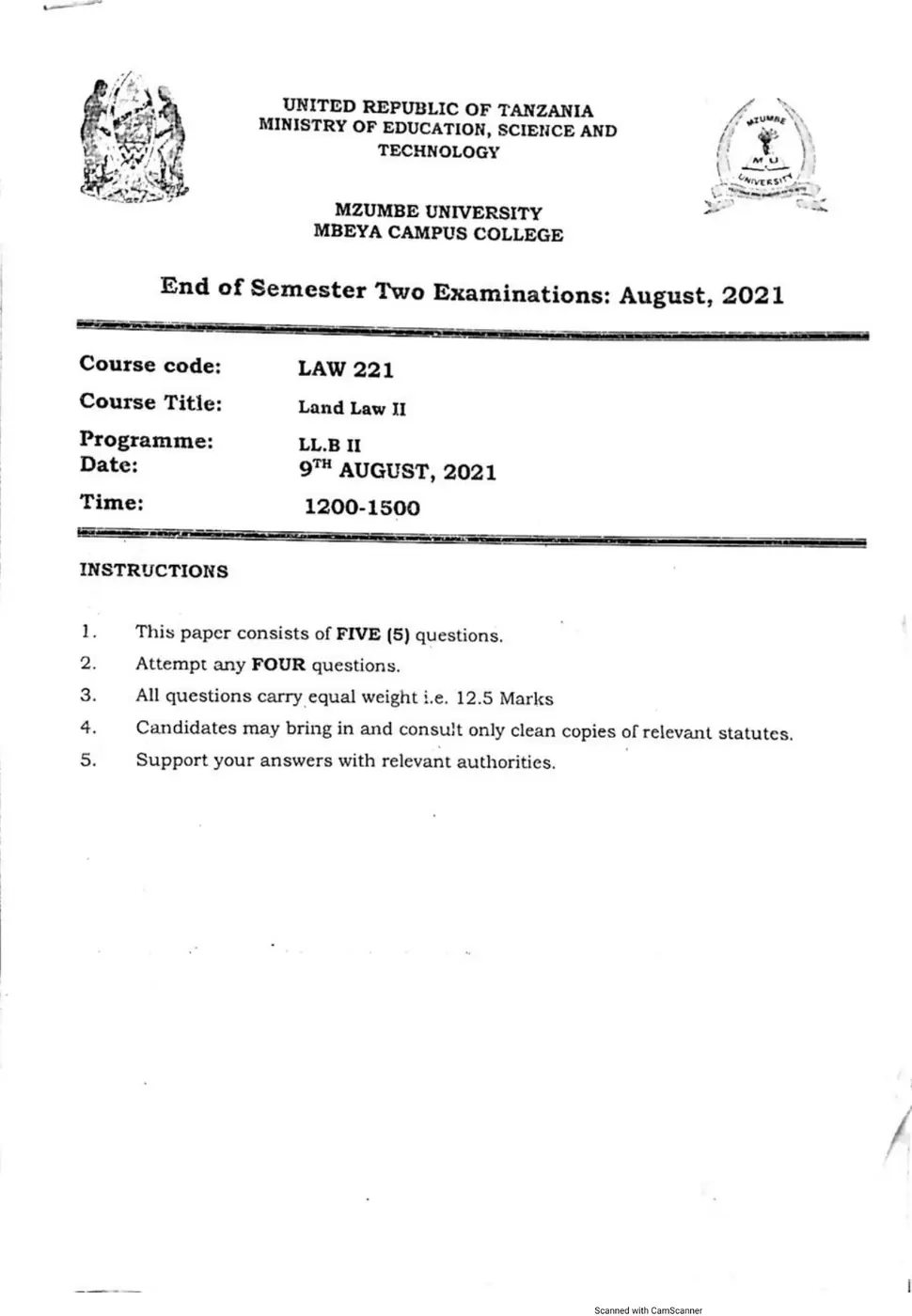
This is the real Mzumbe University LAW 221 Land Law II paper from the End of Semester Two Examination of August 2021, sat by second-year LL.B students. It has five questions and you answer four: the mortgagee's power of sale, the balance in lease law, a double sale of registered land, leasing co-occupied land, and the equity of redemption. The model answer to Question 1 is free below.
Part 1
Mzumbe Land Law II Past Paper (LAW 221): The Full Exam as Set
Five questions. Attempt any four. Each question carries 12.5 marks. Clean copies of relevant statutes allowed.
 Full size
 Full size
Page 3 of 3
Create a free account to see the whole paper. It takes a minute.
Create a free accountAlready a member? Log inRead the questions as text
This paper consists of FIVE questions. Attempt any FOUR. All questions carry equal weight (12.5 marks). Candidates may consult clean copies of relevant statutes. Support your answers with relevant authorities.
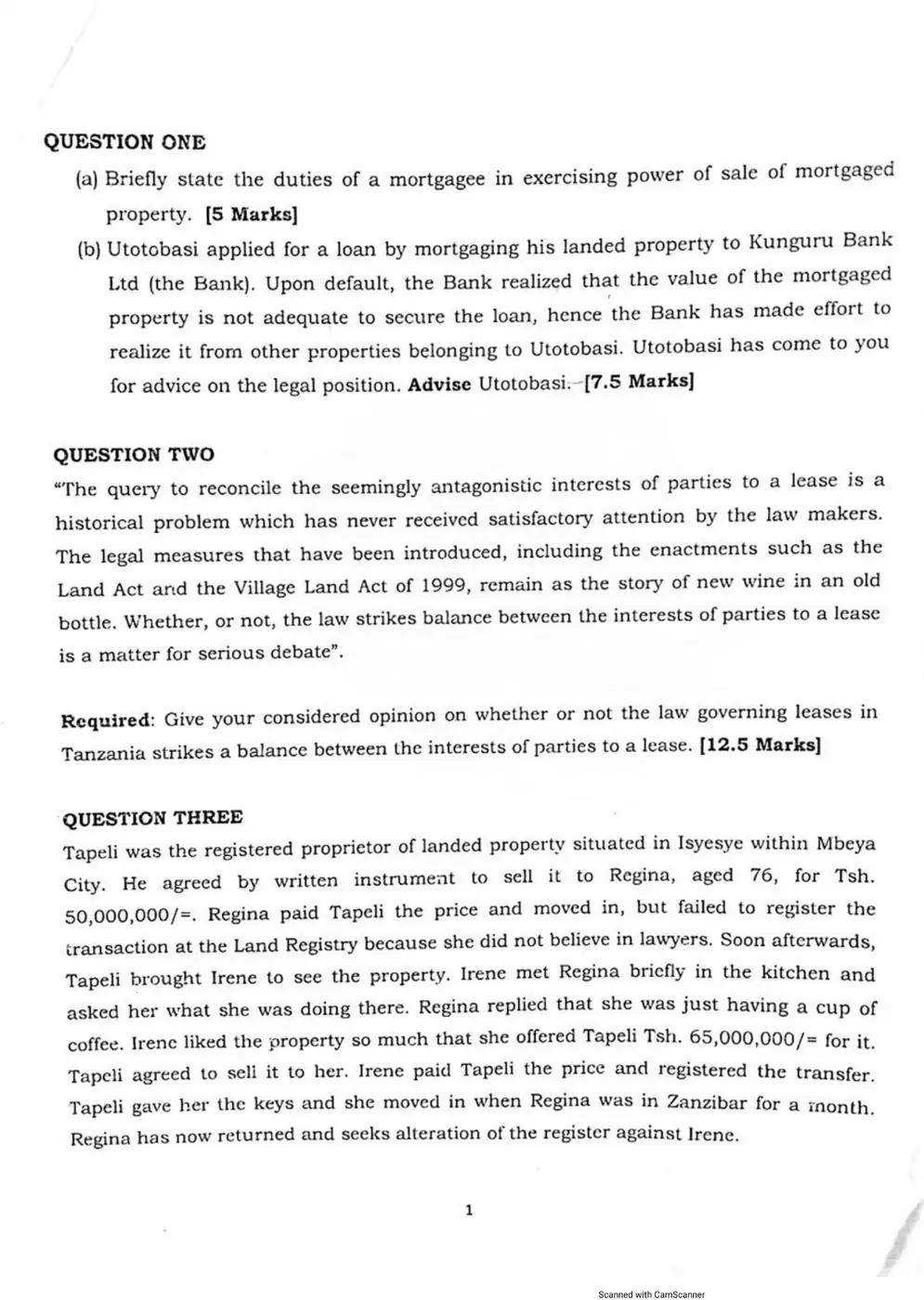
1. (a) Briefly state the duties of a mortgagee in exercising power of sale of mortgaged property. [5 marks] (b) Utotobasi applied for a loan by mortgaging his landed property to Kunguru Bank Ltd (the Bank). Upon default, the Bank realized that the value of the mortgaged property is not adequate to secure the loan, hence the Bank has made effort to realize it from other properties belonging to Utotobasi. Utotobasi has come to you for advice on the legal position. Advise Utotobasi. [7.5 marks]
2. “The query to reconcile the seemingly antagonistic interests of parties to a lease is a historical problem which has never received satisfactory attention by the law makers. The legal measures that have been introduced, including the enactments such as the Land Act and the Village Land Act of 1999, remain as the story of new wine in an old bottle. Whether, or not, the law strikes balance between the interests of parties to a lease is a matter for serious debate.” Required: Give your considered opinion on whether or not the law governing leases in Tanzania strikes a balance between the interests of parties to a lease. [12.5 marks]
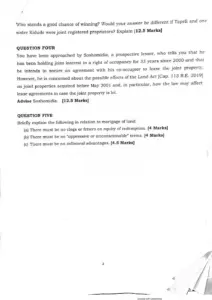
3. Tapeli was the registered proprietor of landed property situated in Isyesye within Mbeya City. He agreed by written instrument to sell it to Regina, aged 76, for Tsh. 50,000,000/=. Regina paid Tapeli the price and moved in, but failed to register the transaction at the Land Registry because she did not believe in lawyers. Soon afterwards, Tapeli brought Irene to see the property. Irene met Regina briefly in the kitchen and asked her what she was doing there. Regina replied that she was just having a cup of coffee. Irene liked the property so much that she offered Tapeli Tsh. 65,000,000/= for it. Tapeli agreed to sell it to her. Irene paid Tapeli the price and registered the transfer. Tapeli gave her the keys and she moved in when Regina was in Zanzibar for a month. Regina has now returned and seeks alteration of the register against Irene. Who stands a good chance of winning? Would your answer be different if Tapeli and one sister Kidude were joint registered proprietors? Explain. [12.5 marks]
4. You have been approached by Soshomidia, a prospective lessor, who tells you that he has been holding joint interest in a right of occupancy for 33 years since 2000 and that he intends to secure an agreement with his co-occupier to lease the joint property. However, he is concerned about the possible effects of the Land Act [Cap. 113 R.E. 2019] on joint properties acquired before May 2001 and, in particular, how the law may affect lease agreements in case the joint property is let. Advise Soshomidia. [12.5 marks]
5. Briefly explain the following in relation to mortgage of land: (a) There must be no clogs or fetters on equity of redemption. [4 marks] (b) There must be no “oppressive or unconscionable” terms. [4 marks] (c) There must be no collateral advantages. [4.5 marks]
Source: Mzumbe University examination paper, August 2021, shared for revision. Rights holders can ask for removal through our Contact page.
Part 2
Land Law II Past Paper Answers: Model Answers to All 5 Questions
Question 1 is answered in full below, free. Tap any other question to see it and a preview of its answer.
Q1Question 1: The mortgagee's power of sale and a shortfall
12.5 marks Free answer
The question
(a) Briefly state the duties of a mortgagee in exercising power of sale of mortgaged property. [5 marks] (b) Utotobasi applied for a loan by mortgaging his landed property to Kunguru Bank Ltd (the Bank). Upon default, the Bank realized that the value of the mortgaged property is not adequate to secure the loan, hence the Bank has made effort to realize it from other properties belonging to Utotobasi. Utotobasi has come to you for advice on the legal position. Advise Utotobasi. [7.5 marks]
Model answer
The short answer
A bank selling mortgaged land must give the statutory default notice, wait the 60 days, advertise and sell properly, and get the best price reasonably obtainable. If the sale does not clear the debt, the bank can still claim the balance from Utotobasi, but only as an ordinary creditor: it must sue him and get a decree before it can touch his other property, unless that property is also mortgaged to it.
(a) Duties of a mortgagee exercising the power of sale
Note first that the Land Act, Cap. 113 was renumbered in the 2023 revised edition. The section numbers below are those of Cap. 113 R.E. 2023, with the R.E. 2019 numbers (the edition named on many exam papers) in brackets.
- Serve a proper notice of default. Before using any remedy, the mortgagee must serve the mortgagor a written notice stating the default, what must be done to cure it, and the 60-day period: section 137 (s. 127).
- Wait for the notice period to expire. The power of sale arises only after 60 days from receipt of the notice: section 142(1) (s. 132).
- Obtain the best price reasonably obtainable. The mortgagee owes the mortgagor a duty of care to obtain the best price reasonably obtainable at the time of sale: section 143(1) (s. 133(1)). Under section 143(2), if the land is sold at 25% or more below its market value, the mortgagee is presumed to have breached that duty. The courts require a proper pre-sale valuation, and the burden of proving compliance lies on the mortgagee. This mirrors the common law rule in Cuckmere Brick Co Ltd v Mutual Finance Ltd [1971] Ch 949.
- Advertise and conduct the sale properly. A sale by public auction must be publicly advertised (section 144(2)), and the auction must comply with the Auctioneers Act, Cap. 227.
- Act in good faith. The mortgagee must not sell to itself or to an associate at an undervalue: Tse Kwong Lam v Wong Chit Sen [1983] 1 WLR 1349 (PC).
- Apply the proceeds in the statutory order and pay over any surplus. Section 147 (s. 137) sets the order: rates and taxes, prior encumbrances, costs of sale, the mortgage debt, later mortgages, and then the balance to the mortgagor.
- Matrimonial home. Where the land is a matrimonial home, the mortgage is valid only if the spouse(s) living there signed or assented to it: section 118 (s. 114). A bank that ignored this cannot validly sell.
(b) Advice to Utotobasi
Issue. Can Kunguru Bank recover the unpaid balance of the loan from Utotobasi’s other properties, which were not mortgaged?
Rule. A mortgage secures a debt; it does not replace it. Utotobasi’s personal promise to repay the loan survives a sale of the mortgaged land. The Court of Appeal confirmed this in CRDB Bank PLC v True Colour Limited and James Vicent Mgaya, Civil Appeal No. 29 of 2019 (judgment of 21 December 2021): a mortgagee whose valid sale does not realise the full debt is not barred from claiming the outstanding balance from the mortgagor. But the remedies in section 136 (s. 126) (appointing a receiver, leasing, taking possession, selling) apply only to the mortgaged land. For any other property, the bank has no security and stands as an ordinary unsecured creditor.
Application. The bank cannot simply seize or sell Utotobasi’s other properties. To reach them it must:
- first realise the security lawfully, following the notice, best-price and accounting duties in part (a);
- then sue Utotobasi for the shortfall on the loan agreement;
- obtain a decree, and only then execute it against his other property through the court’s execution process under the Civil Procedure Code, Cap. 33.
Any attempt by the bank to take or sell his other properties without a decree is unlawful, and Utotobasi can resist it, including by applying for an injunction. He should also check whether the bank complied with part (a). If it sold at an undervalue (25% or more below market value, section 143(2)), the shortfall it claims is inflated, and he can counterclaim for damages or ask to have the sale set aside. If any of his “other properties” are in fact covered by a further mortgage or a guarantee he signed, the bank can enforce that separate security on its own terms.
Conclusion. Utotobasi remains liable for any genuine shortfall, but the bank must prove it in court and cannot self-help against unmortgaged property. My advice is to demand a full account of the sale, check the valuation and the price obtained, and resist any seizure made without a court decree.
What the examiner wants
In (a), a list of the statutory duties with correct sections, including the 60-day notice, the best-price duty and the 25% presumption. In (b), the distinction between the secured remedies (against the mortgaged land) and the personal covenant (against the borrower), with the conclusion that other property is reached only by suit and execution.
Common mistakes
- Telling Utotobasi he owes nothing more once the land is sold. The personal debt survives.
- Saying the bank can attach his other land directly under the Land Act. Without a decree, it cannot.
- Citing R.E. 2019 section numbers as if they were current, without noting the 2023 renumbering.
Q2Question 2: Does the law on leases balance lessor and lessee?
12.5 marks Locked
The question
“The query to reconcile the seemingly antagonistic interests of parties to a lease is a historical problem which has never received satisfactory attention by the law makers. The legal measures that have been introduced, including the enactments such as the Land Act and the Village Land Act of 1999, remain as the story of new wine in an old bottle. Whether, or not, the law strikes balance between the interests of parties to a lease is a matter for serious debate.” Required: Give your considered opinion on whether or not the law governing leases in Tanzania strikes a balance between the interests of parties to a lease. [12.5 marks]
Model answer
Unlock the model answer to Question 2
Get all 4 locked answers on this paper for TSh 3,000. Pay once, keep them in Your Library for life.
Get the solved paper · TSh 3,000Or get every solved paper with Elite
Q3Question 3: Regina, Irene and the register
12.5 marks Locked
The question
Tapeli was the registered proprietor of landed property situated in Isyesye within Mbeya City. He agreed by written instrument to sell it to Regina, aged 76, for Tsh. 50,000,000/=. Regina paid Tapeli the price and moved in, but failed to register the transaction at the Land Registry because she did not believe in lawyers. Soon afterwards, Tapeli brought Irene to see the property. Irene met Regina briefly in the kitchen and asked her what she was doing there. Regina replied that she was just having a cup of coffee. Irene liked the property so much that she offered Tapeli Tsh. 65,000,000/= for it. Tapeli agreed to sell it to her. Irene paid Tapeli the price and registered the transfer. Tapeli gave her the keys and she moved in when Regina was in Zanzibar for a month. Regina has now returned and seeks alteration of the register against Irene. Who stands a good chance of winning? Would your answer be different if Tapeli and one sister Kidude were joint registered proprietors? Explain. [12.5 marks]
Model answer
Unlock the model answer to Question 3
Get all 4 locked answers on this paper for TSh 3,000. Pay once, keep them in Your Library for life.
Get the solved paper · TSh 3,000Or get every solved paper with Elite
Q4Question 4: Advising Soshomidia on leasing co-occupied land
12.5 marks Locked
The question
You have been approached by Soshomidia, a prospective lessor, who tells you that he has been holding joint interest in a right of occupancy for 33 years since 2000 and that he intends to secure an agreement with his co-occupier to lease the joint property. However, he is concerned about the possible effects of the Land Act [Cap. 113 R.E. 2019] on joint properties acquired before May 2001 and, in particular, how the law may affect lease agreements in case the joint property is let. Advise Soshomidia. [12.5 marks]
Model answer
Unlock the model answer to Question 4
Get all 4 locked answers on this paper for TSh 3,000. Pay once, keep them in Your Library for life.
Get the solved paper · TSh 3,000Or get every solved paper with Elite
Q5Question 5: Clogs, unconscionable terms and collateral advantages
12.5 marks Locked
The question
Briefly explain the following in relation to mortgage of land: (a) There must be no clogs or fetters on equity of redemption. [4 marks] (b) There must be no “oppressive or unconscionable” terms. [4 marks] (c) There must be no collateral advantages. [4.5 marks]
Model answer
Unlock the model answer to Question 5
Get all 4 locked answers on this paper for TSh 3,000. Pay once, keep them in Your Library for life.
Get the solved paper · TSh 3,000Or get every solved paper with Elite
Get the Full Solved Paper
All 5 questions answered with the statutes and cases that apply, what the examiner wants and the mistakes to avoid. TSh 3,000, yours for life in Your Library.
Pata majibu yote ya mtihani huu kwa TSh 3,000 tu.




Statutes and Cases for This Land Law II Past Paper
- Land Act, Cap. 113 R.E. 2023ss. 68, 82–114 (leases), 118, 131, 136–147 (mortgages), 151–152, 169, 193
- Land Registration Act, Cap. 334ss. 33, 41, 91, 99, 100
- CRDB Bank PLC v True Colour Ltd and James Vicent Mgaya, Civil Appeal No. 29 of 2019 (CA, 2021)shortfall after sale recoverable from the mortgagor
- Cuckmere Brick Co Ltd v Mutual Finance Ltd [1971] Ch 949duty to obtain the true market value
- Samuel v Jarrah Timber [1904] AC 323option to purchase is a clog
- Kreglinger v New Patagonia Meat [1914] AC 25fair collateral advantage upheld
Mzumbe Land Law II Past Paper: Common Questions
Is this the real Mzumbe Land Law II exam paper?
Yes. These are scans of the End of Semester Two Examination, August 2021 paper for LAW 221 Land Law II at Mzumbe University, sat on 9 August 2021. Nothing has been retyped or changed.
How many questions do you answer in this Land Law II paper?
Five questions. Attempt any four. Each question carries 12.5 marks. Clean copies of relevant statutes allowed.
Are there answers to this past paper?
Yes. All 5 questions have full model answers written to Tanzanian law and reviewed by Isack Kimaro, LL.B, PDLP. The Question 1 answer is free; the full solved paper is TSh 3,000 (TSh 2,000 for Pro members) and is included in Elite.
How do I see every page of the paper?
The first pages are open to everyone. Create a free account to read the whole paper.