

About this paper
Solved answers to all 6 questions
Part 1
Mzumbe Administrative Law II Past Paper (LAW 227): The Full Exam as Set
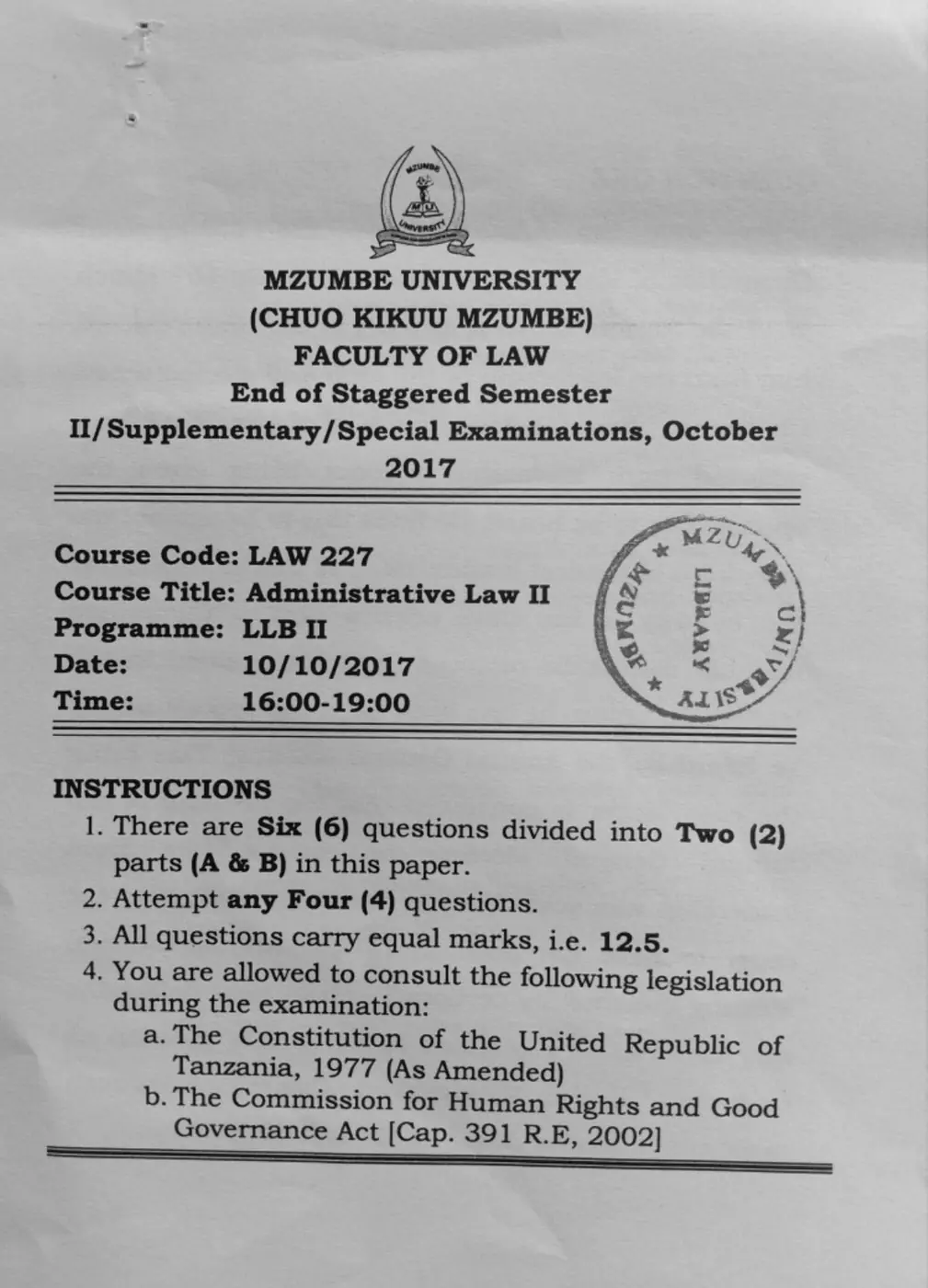
Six questions in two parts. Attempt any four. Each question carries 12.5 marks. The Constitution and the Commission for Human Rights and Good Governance Act allowed.
 Full size
 Full size
Page 3 of 4
Create a free account to see the whole paper. It takes a minute.
Create a free accountAlready a member? Log in
Page 4 of 4
Create a free account to see the whole paper. It takes a minute.
Create a free accountAlready a member? Log inRead the questions as text
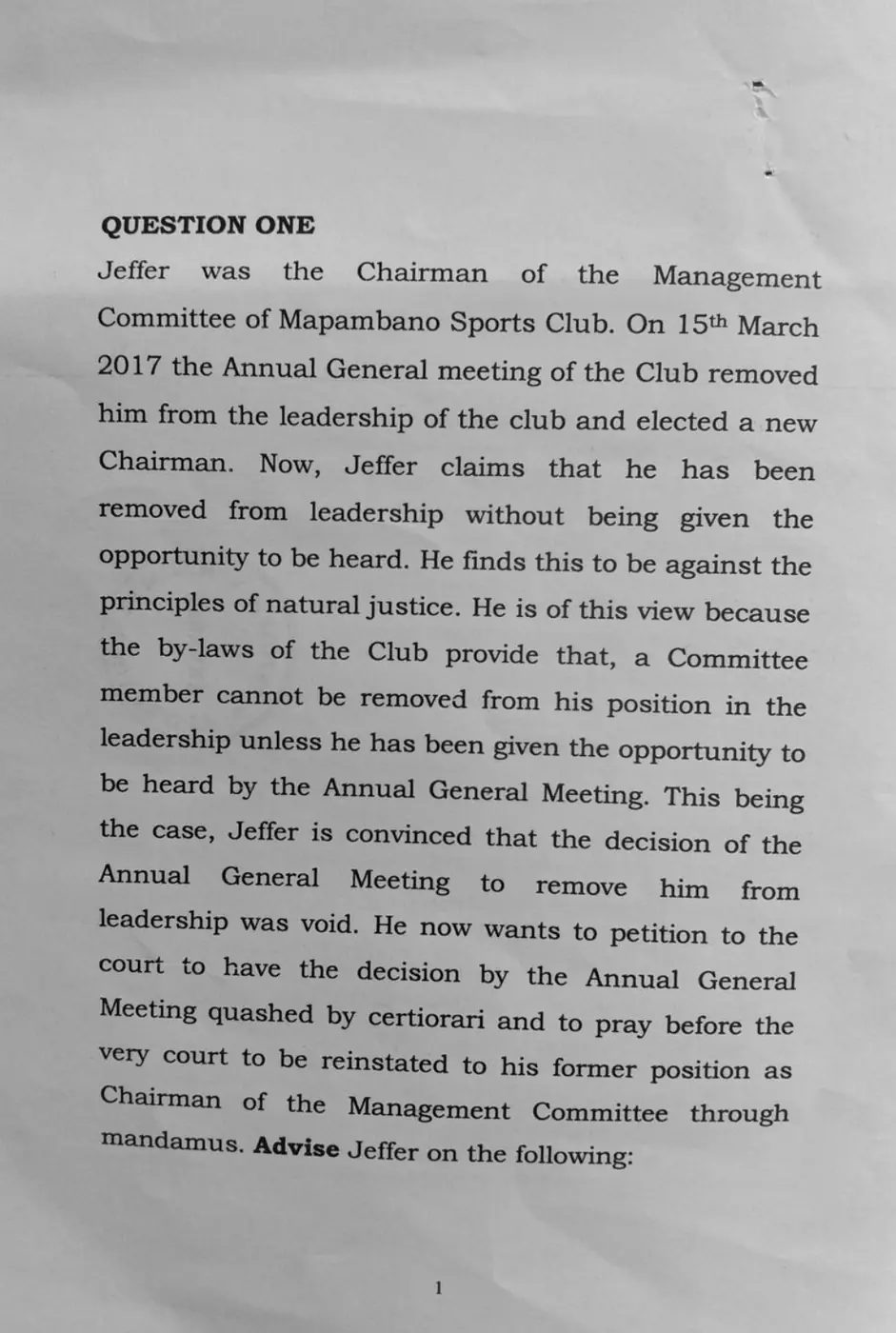
1. Jeffer was the Chairman of the Management Committee of Mapambano Sports Club. On 15th March 2017 the Annual General meeting of the Club removed him from the leadership of the club and elected a new Chairman. Now, Jeffer claims that he has been removed from leadership without being given the opportunity to be heard. He finds this to be against the principles of natural justice. He is of this view because the by-laws of the Club provide that, a Committee member cannot be removed from his position in the leadership unless he has been given the opportunity to be heard by the Annual General Meeting. This being the case, Jeffer is convinced that the decision of the Annual General Meeting to remove him from leadership was void. He now wants to petition to the court to have the decision by the Annual General Meeting quashed by certiorari and to pray before the very court to be reinstated to his former position as Chairman of the Management Committee through mandamus. Advise Jeffer on the following: (a) Whether he can succeed under the order of certiorari. Explain to him the circumstances under which certiorari apply. (b) Assuming that the order of certiorari succeeds; can Jeffer be reinstated to his former post through mandamus? Give reasons to your answer.
2. Judicial review is not free from restrictions. List down any five restrictions on judicial review and explain them.
3. (a) How would you distinguish between ‘duty’ and ‘discretion’? (b) Discuss how a decision-maker may fail to exercise discretion in the following situations: i. Acting under dictation; ii. Self-created rules of policy.
4. Discuss how control of administration may be exercised through the following and their weaknesses: (a) The Press. (b) Public Opinion.
5. When the Parliament enacts a law, it can do so in a way that the discretionary power which is vested in the executive by such law is effectively controlled by the same law. Identify any five ways through which the Parliament can achieve this and give brief explanation on each of them.
6. Write short notes on the following: (a) Features common to all Tribunal procedures. (b) The role, jurisdiction and powers of the Commission for Human Rights and Good Governance of Tanzania.
Source: Mzumbe University examination paper, October 2017, shared for revision. Rights holders can ask for removal through our Contact page.
Part 2
Administrative Law II Past Paper Answers: Model Answers to All 6 Questions
Question 1 is answered in full below, free. Tap any other question to see it and a preview of its answer.
Q1Question 1: Jeffer and the sports club: certiorari and mandamus against a private body
12.5 marks · problem Free answer
The question
Jeffer was the Chairman of the Management Committee of Mapambano Sports Club. On 15th March 2017 the Annual General meeting of the Club removed him from the leadership of the club and elected a new Chairman. Now, Jeffer claims that he has been removed from leadership without being given the opportunity to be heard. He finds this to be against the principles of natural justice. He is of this view because the by-laws of the Club provide that, a Committee member cannot be removed from his position in the leadership unless he has been given the opportunity to be heard by the Annual General Meeting. This being the case, Jeffer is convinced that the decision of the Annual General Meeting to remove him from leadership was void. He now wants to petition to the court to have the decision by the Annual General Meeting quashed by certiorari and to pray before the very court to be reinstated to his former position as Chairman of the Management Committee through mandamus. Advise Jeffer on the following: (a) Whether he can succeed under the order of certiorari. Explain to him the circumstances under which certiorari apply. (b) Assuming that the order of certiorari succeeds; can Jeffer be reinstated to his former post through mandamus? Give reasons to your answer.
Model answer
The short answer
(a) Jeffer is unlikely to succeed with certiorari. Certiorari is a public law remedy that quashes decisions of public bodies or bodies exercising public functions; a private sports club whose power comes from its members’ agreement (its by-laws) is not amenable to judicial review. His proper remedy is an ordinary civil suit for a declaration that his removal was void for breach of the by-laws and natural justice, with an injunction. (b) Mandamus is also unavailable: it compels performance of a public duty, and there is no public duty to reinstate a club chairman. Even in a civil suit, courts are reluctant to force a private association to restore an officer, preferring a declaration or ordering a fresh, fair process.
(a) Certiorari
When certiorari applies
- Certiorari quashes a decision of a public authority or inferior tribunal made without or in excess of jurisdiction, in breach of natural justice, with an error on the face of the record, or that is unreasonable or based on irrelevant considerations (Sanai Murumbe v Muhere Chacha [1990] TLR 54; Cap. 310 ss.17–19).
- It is available only against bodies exercising public law powers. The applicant must obtain leave of the High Court and apply within the time limit (GN No. 324 of 2014).
Application
- Mapambano Sports Club is a private association; its AGM’s power to remove a chairman comes from the club’s by-laws, a contract among members, not from statute or government.
- Courts have refused judicial review of decisions of private bodies whose authority is consensual: R v Disciplinary Committee of the Jockey Club, ex p Aga Khan [1993] 1 WLR 909.
- So certiorari will fail. However, Jeffer has a strong private law claim: the by-laws require that he be heard before removal, and he was not. A decision made in breach of the association’s own rules and natural justice may be declared void in an ordinary civil suit.
(b) Mandamus
- Mandamus compels a public body to perform a public duty owed to the applicant, where the duty is clear and the applicant has demanded performance and been refused.
- The club has no public duty, and the decision to choose a chairman is for the members. So mandamus is not available.
- Even in a civil suit, the court would probably declare the removal void and leave the members to act lawfully (for example, by calling an AGM at which Jeffer is heard), rather than force a private body to accept him as leader.
What the examiner wants
The scope of certiorari and mandamus (public law only), application to a private club, and the correct alternative remedy.
Common mistakes
- Applying prerogative orders to private bodies.
- Ignoring the strong breach-of-rules argument in private law.
Q2Question 2: Five restrictions on judicial review
12.5 marks · essay Locked
The question
Judicial review is not free from restrictions. List down any five restrictions on judicial review and explain them.
Model answer
Unlock the model answer to Question 2
Get all 5 locked answers on this paper for TSh 3,000. Pay once, keep them in Your Library for life.
Get the solved paper · TSh 3,000Or get every solved paper with Elite
Q3Question 3: Duty and discretion; dictation and rigid policies
12.5 marks · essay Locked
The question
(a) How would you distinguish between ‘duty’ and ‘discretion’? (b) Discuss how a decision-maker may fail to exercise discretion in the following situations: i. Acting under dictation; ii. Self-created rules of policy.
Model answer
Unlock the model answer to Question 3
Get all 5 locked answers on this paper for TSh 3,000. Pay once, keep them in Your Library for life.
Get the solved paper · TSh 3,000Or get every solved paper with Elite
Q4Question 4: Control of administration by the press and public opinion
12.5 marks · essay Locked
The question
Discuss how control of administration may be exercised through the following and their weaknesses: (a) The Press. (b) Public Opinion.
Model answer
Unlock the model answer to Question 4
Get all 5 locked answers on this paper for TSh 3,000. Pay once, keep them in Your Library for life.
Get the solved paper · TSh 3,000Or get every solved paper with Elite
Q5Question 5: How Parliament can structure executive discretion
12.5 marks · essay Locked
The question
When the Parliament enacts a law, it can do so in a way that the discretionary power which is vested in the executive by such law is effectively controlled by the same law. Identify any five ways through which the Parliament can achieve this and give brief explanation on each of them.
Model answer
Unlock the model answer to Question 5
Get all 5 locked answers on this paper for TSh 3,000. Pay once, keep them in Your Library for life.
Get the solved paper · TSh 3,000Or get every solved paper with Elite
Q6Question 6: Short notes: tribunal procedure; the Commission for Human Rights and Good Governance
12.5 marks · short notes Locked
The question
Write short notes on the following: (a) Features common to all Tribunal procedures. (b) The role, jurisdiction and powers of the Commission for Human Rights and Good Governance of Tanzania.
Model answer
Unlock the model answer to Question 6
Get all 5 locked answers on this paper for TSh 3,000. Pay once, keep them in Your Library for life.
Get the solved paper · TSh 3,000Or get every solved paper with Elite
Get the Full Solved Paper
All 6 questions answered with the statutes and cases that apply, what the examiner wants and the mistakes to avoid. TSh 3,000, yours for life in Your Library.
Pata majibu yote ya mtihani huu kwa TSh 3,000 tu.




Statutes and Cases for This Administrative Law II Past Paper
- Constitution of the United Republic of Tanzania, 1977Art. 13(6)(a), art. 18 (freedom of expression), arts 129–131 (the Commission)
- Commission for Human Rights and Good Governance Act, Cap. 391 R.E. 2002Functions and powers of the Commission
- Law Reform (Fatal Accidents and Miscellaneous Provisions) Act, Cap. 310ss.17–19 (prerogative orders)
- Law Reform (Fatal Accidents and Miscellaneous Provisions) (Judicial Review Procedure and Fees) Rules, GN No. 324 of 2014Leave and time limits
- Sanai Murumbe v Muhere Chacha [1990] TLR 54 (CA)Grounds for certiorari
- R v Disciplinary Committee of the Jockey Club, ex p Aga Khan [1993] 1 WLR 909Private bodies not amenable to judicial review
- Lavender & Son Ltd v Minister of Housing and Local Government [1970] 1 WLR 1231Acting under dictation
- British Oxygen Co Ltd v Board of Trade [1971] AC 610Fettering discretion by policy
Mzumbe Administrative Law II Past Paper: Common Questions
Is this the real Mzumbe Administrative Law II exam paper?
Yes. These are scans of the Supplementary/Special Examination, October 2017 paper for LAW 227 Administrative Law II at Mzumbe University, sat on 10 October 2017. Nothing has been retyped or changed.
How many questions do you answer in this Administrative Law II paper?
Six questions in two parts. Attempt any four. Each question carries 12.5 marks. The Constitution and the Commission for Human Rights and Good Governance Act allowed.
Are there answers to this past paper?
Yes. All 6 questions have full model answers written to Tanzanian law and reviewed by Isack Kimaro, LL.B, PDLP. The Question 1 answer is free; the full solved paper is TSh 3,000 (TSh 2,000 for Pro members) and is included in Elite.
How do I see every page of the paper?
The first pages are open to everyone. Create a free account to read the whole paper.