

About this paper
Solved answers to all 6 questions
Part 1
Mzumbe Land Law II Past Paper (LAW 221): The Full Exam as Set
Two parts, A and B. Attempt four questions: two from each part. Each question carries 12.5 marks.
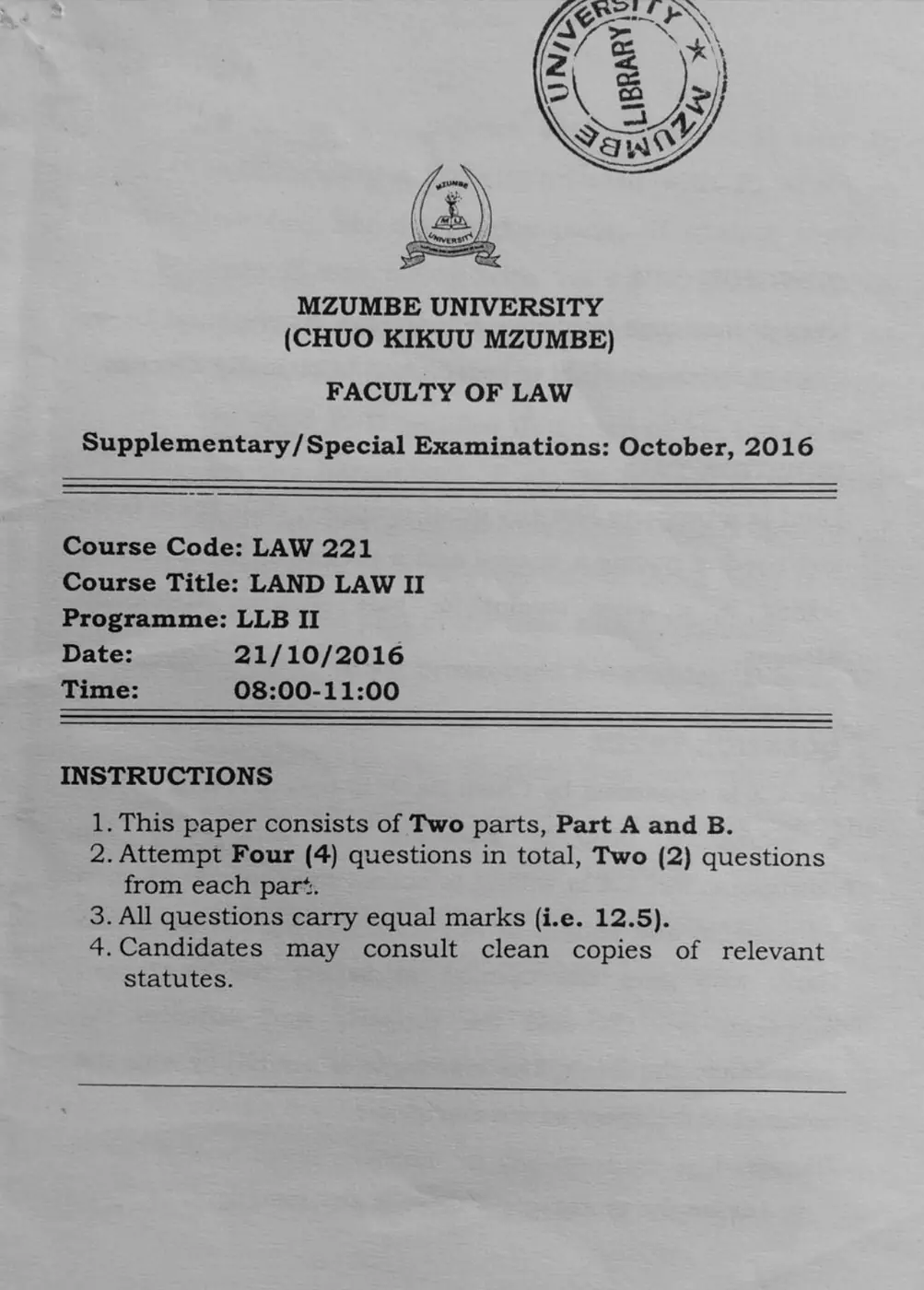 Full size
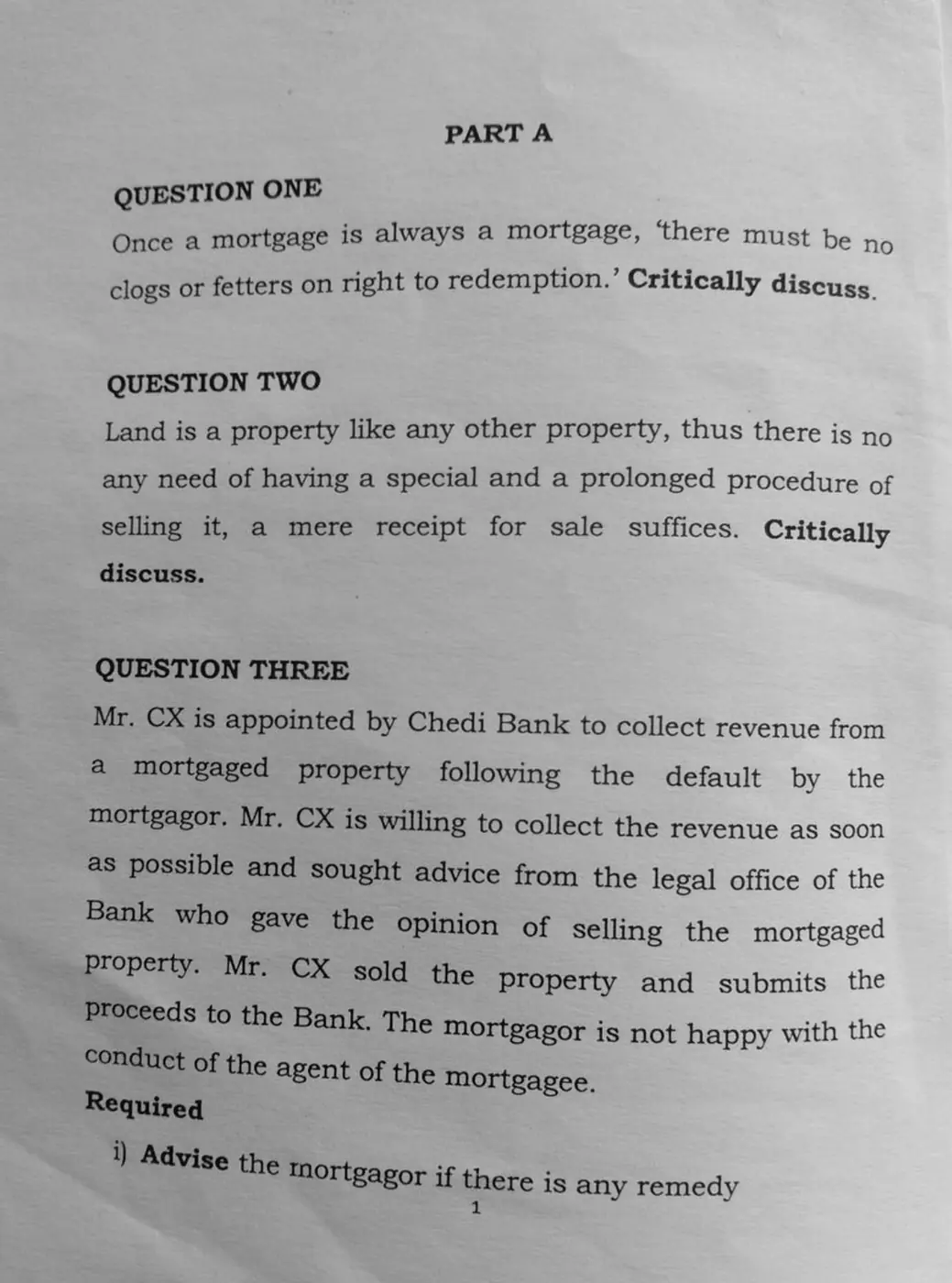 Full size
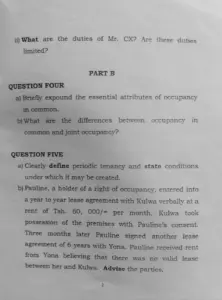
Page 3 of 4
Create a free account to see the whole paper. It takes a minute.
Create a free accountAlready a member? Log in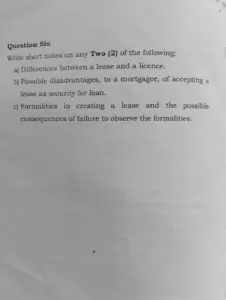
Page 4 of 4
Create a free account to see the whole paper. It takes a minute.
Create a free accountAlready a member? Log inRead the questions as text
Part A
1. Once a mortgage is always a mortgage, ‘there must be no clogs or fetters on right to redemption.’ Critically discuss.
2. Land is a property like any other property, thus there is no any need of having a special and a prolonged procedure of selling it, a mere receipt for sale suffices. Critically discuss.
3. Mr. CX is appointed by Chedi Bank to collect revenue from a mortgaged property following the default by the mortgagor. Mr. CX is willing to collect the revenue as soon as possible and sought advice from the legal office of the Bank who gave the opinion of selling the mortgaged property. Mr. CX sold the property and submits the proceeds to the Bank. The mortgagor is not happy with the conduct of the agent of the mortgagee. Required: i) Advise the mortgagor if there is any remedy. ii) What are the duties of Mr. CX? Are these duties limited?
Part B
4. (a) Briefly expound the essential attributes of occupancy in common. (b) What are the differences between occupancy in common and joint occupancy?
5. (a) Clearly define periodic tenancy and state conditions under which it may be created. (b) Pauline, a holder of a right of occupancy, entered into a year to year lease agreement with Kulwa verbally at a rent of Tsh. 60,000/= per month. Kulwa took possession of the premises with Pauline’s consent. Three months later Pauline signed another lease agreement of 6 years with Yona. Pauline received rent from Yona believing that there was no valid lease between her and Kulwa. Advise the parties.
6. Write short notes on any Two (2) of the following: (a) Differences between a lease and a licence. (b) Possible disadvantages, to a mortgagee, of accepting a lease as security for loan. (c) Formalities in creating a lease and the possible consequences of failure to observe the formalities.
Source: Mzumbe University examination paper, October 2016, shared for revision. Rights holders can ask for removal through our Contact page.
Part 2
Land Law II Past Paper Answers: Model Answers to All 6 Questions
Question 1 is answered in full below, free. Tap any other question to see it and a preview of its answer.
Q1Question 1: Once a mortgage, always a mortgage: clogs on redemption
12.5 marks · essay Free answer
The question
Once a mortgage is always a mortgage, ‘there must be no clogs or fetters on right to redemption.’ Critically discuss.
Model answer
The short answer
The maxim means a mortgage is only security: once the debt is paid, the mortgagor must get the property back free of the mortgagee’s rights, and any term that prevents, postpones unreasonably or burdens redemption (a “clog”) is void. The Land Act reflects this: a mortgage takes effect as security only (s.116), foreclosure is abolished (s.125), and the mortgagor may discharge at any time before sale by paying what is due (s.138). Courts have softened the rule for commercial bargains: collateral advantages that are fair and do not burden redemption may stand (Kreglinger).
The principle
- Equity of redemption: the mortgagor’s right to redeem on payment cannot be taken away by the contract.
- Options to purchase: a term giving the mortgagee an option to buy the property is void as a clog: Samuel v Jarrah Timber and Wood Paving Corp Ltd [1904] AC 323.
- Collateral advantages after redemption: void if they continue after repayment: Noakes & Co Ltd v Rice [1902] AC 24 (a tie to buy beer from the mortgagee after redemption).
- Postponement of redemption: permitted only if reasonable and not making the right illusory.
Tanzanian statutory position
- Mortgage as security only (s.116); foreclosure abolished (s.125); right to discharge before sale (s.138).
- Remedies only after default and notice (ss.126–127), and duties on sale (s.133), protect the mortgagor.
Critique
- Kreglinger v New Patagonia Meat & Cold Storage Co Ltd [1914] AC 25: a collateral advantage (a right of first refusal on sheepskins) that was a separate, fair commercial bargain survived redemption. Modern courts focus on unconscionability rather than rigid rules.
- Between commercial parties of equal bargaining power, a strict rule may defeat legitimate bargains; but for ordinary borrowers it remains important protection.
What the examiner wants
Meaning of the maxim, types of clogs with cases, statutory provisions, and critical evaluation.
Common mistakes
- Saying all collateral advantages are void.
Q2Question 2: Is a receipt enough to sell land?
12.5 marks · essay Locked
The question
Land is a property like any other property, thus there is no any need of having a special and a prolonged procedure of selling it, a mere receipt for sale suffices. Critically discuss.
Model answer
Unlock the model answer to Question 2
Get all 5 locked answers on this paper for TSh 3,000. Pay once, keep them in Your Library for life.
Get the solved paper · TSh 3,000Or get every solved paper with Elite
Q3Question 3: Mr CX, the receiver who sold the mortgaged property
12.5 marks · problem Locked
The question
Mr. CX is appointed by Chedi Bank to collect revenue from a mortgaged property following the default by the mortgagor. Mr. CX is willing to collect the revenue as soon as possible and sought advice from the legal office of the Bank who gave the opinion of selling the mortgaged property. Mr. CX sold the property and submits the proceeds to the Bank. The mortgagor is not happy with the conduct of the agent of the mortgagee. Required: i) Advise the mortgagor if there is any remedy. ii) What are the duties of Mr. CX? Are these duties limited?
Part B
Model answer
Unlock the model answer to Question 3
Get all 5 locked answers on this paper for TSh 3,000. Pay once, keep them in Your Library for life.
Get the solved paper · TSh 3,000Or get every solved paper with Elite
Q4Question 4: Occupancy in common and joint occupancy
12.5 marks · essay Locked
The question
(a) Briefly expound the essential attributes of occupancy in common. (b) What are the differences between occupancy in common and joint occupancy?
Model answer
Unlock the model answer to Question 4
Get all 5 locked answers on this paper for TSh 3,000. Pay once, keep them in Your Library for life.
Get the solved paper · TSh 3,000Or get every solved paper with Elite
Q5Question 5: Periodic tenancy; Pauline's two leases
12.5 marks · problem Locked
The question
(a) Clearly define periodic tenancy and state conditions under which it may be created. (b) Pauline, a holder of a right of occupancy, entered into a year to year lease agreement with Kulwa verbally at a rent of Tsh. 60,000/= per month. Kulwa took possession of the premises with Pauline’s consent. Three months later Pauline signed another lease agreement of 6 years with Yona. Pauline received rent from Yona believing that there was no valid lease between her and Kulwa. Advise the parties.
Model answer
Unlock the model answer to Question 5
Get all 5 locked answers on this paper for TSh 3,000. Pay once, keep them in Your Library for life.
Get the solved paper · TSh 3,000Or get every solved paper with Elite
Q6Question 6: Short notes: lease or licence, leases as security, formalities of leases
12.5 marks · short notes Locked
The question
Write short notes on any Two (2) of the following: (a) Differences between a lease and a licence. (b) Possible disadvantages, to a mortgagee, of accepting a lease as security for loan. (c) Formalities in creating a lease and the possible consequences of failure to observe the formalities.
Model answer
Unlock the model answer to Question 6
Get all 5 locked answers on this paper for TSh 3,000. Pay once, keep them in Your Library for life.
Get the solved paper · TSh 3,000Or get every solved paper with Elite
Get the Full Solved Paper
All 6 questions answered with the statutes and cases that apply, what the examiner wants and the mistakes to avoid. TSh 3,000, yours for life in Your Library.
Pata majibu yote ya mtihani huu kwa TSh 3,000 tu.




Statutes and Cases for This Land Law II Past Paper
- Land Act, Cap. 113 R.E. 2002/2019 (numbering in force in 2016)ss.36–37 (dispositions and approval), s.64 (writing), s.79 (periodic leases), s.80 (short-term leases), s.84, s.88 (lessor's covenants incl. quiet enjoyment), s.116, s.125, s.126, s.127, s.128 (receiver), s.132 (sale), s.133 (duty on sale), s.135 (protection of purchaser), s.138, s.159 (co-occupancy). The 2025 consolidation renumbers these
- Land Registration Act, Cap. 334s.33, s.41
- Noakes & Co Ltd v Rice [1902] AC 24Clog after redemption
- Samuel v Jarrah Timber and Wood Paving Corp Ltd [1904] AC 323Option to purchase in a mortgage void
- Kreglinger v New Patagonia Meat & Cold Storage Co Ltd [1914] AC 25Collateral advantages
- Street v Mountford [1985] AC 809Lease or licence
Mzumbe Land Law II Past Paper: Common Questions
Is this the real Mzumbe Land Law II exam paper?
Yes. These are scans of the Supplementary/Special Examination, October 2016 paper for LAW 221 Land Law II at Mzumbe University, sat on 21 October 2016. Nothing has been retyped or changed.
How many questions do you answer in this Land Law II paper?
Two parts, A and B. Attempt four questions: two from each part. Each question carries 12.5 marks.
Are there answers to this past paper?
Yes. All 6 questions have full model answers written to Tanzanian law and reviewed by Isack Kimaro, LL.B, PDLP. The Question 1 answer is free; the full solved paper is TSh 3,000 (TSh 2,000 for Pro members) and is included in Elite.
How do I see every page of the paper?
The first pages are open to everyone. Create a free account to read the whole paper.