

About this paper
Solved answers to all 6 questions
Part 1
Mzumbe Land Law II Past Paper (LAW 221): The Full Exam as Set
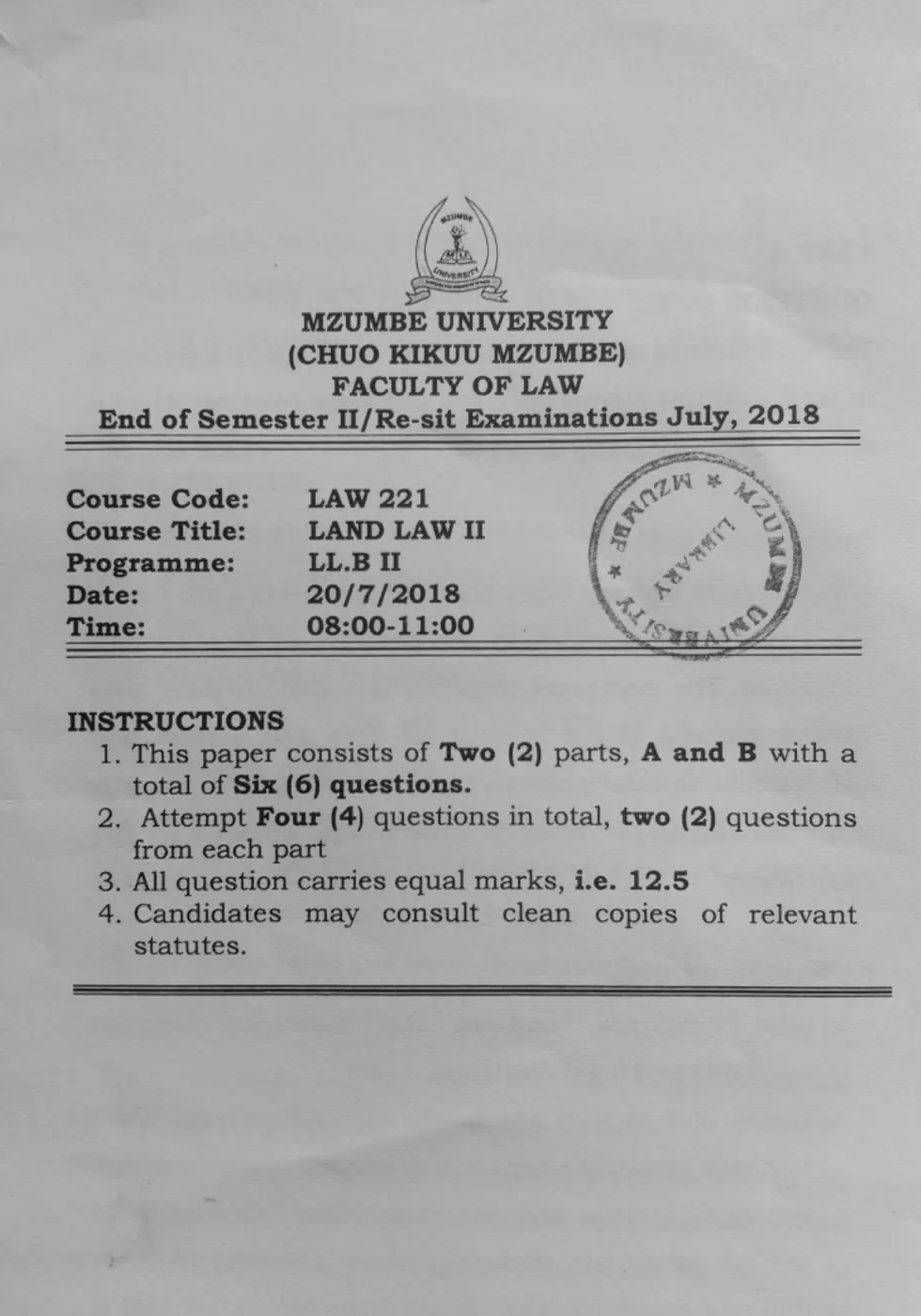
Two parts, A and B, six questions in total. Attempt four: two from each part. Each question carries 12.5 marks.
 Full size
 Full size
Page 3 of 5
Create a free account to see the whole paper. It takes a minute.
Create a free accountAlready a member? Log in
Page 4 of 5
Create a free account to see the whole paper. It takes a minute.
Create a free accountAlready a member? Log in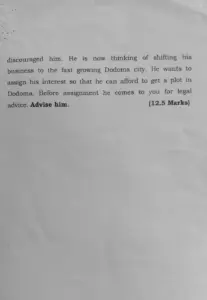
Page 5 of 5
Create a free account to see the whole paper. It takes a minute.
Create a free accountAlready a member? Log inRead the questions as text
Part A
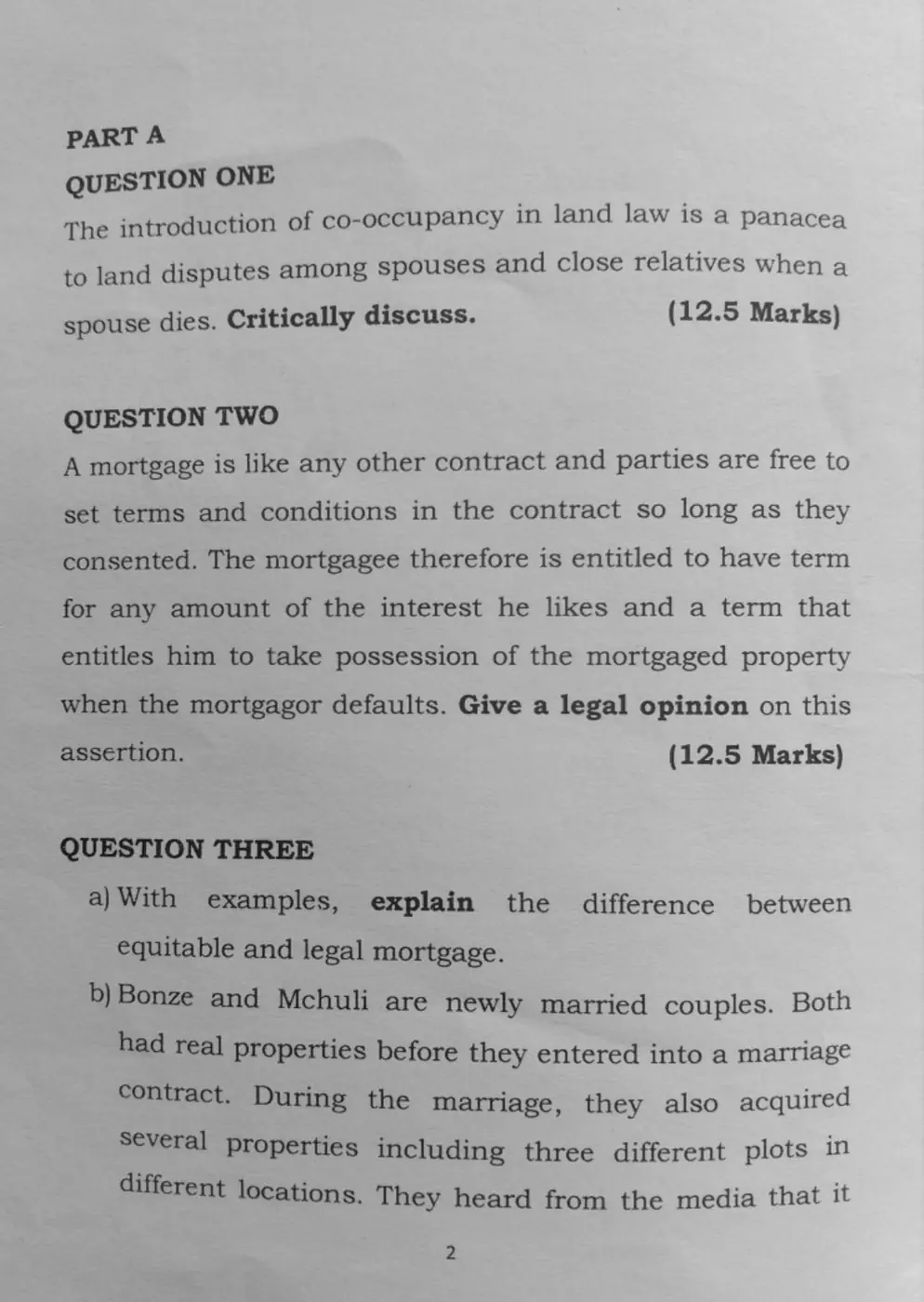
1. The introduction of co-occupancy in land law is a panacea to land disputes among spouses and close relatives when a spouse dies. Critically discuss. (12.5 marks)
2. A mortgage is like any other contract and parties are free to set terms and conditions in the contract so long as they consented. The mortgagee therefore is entitled to have term for any amount of the interest he likes and a term that entitles him to take possession of the mortgaged property when the mortgagor defaults. Give a legal opinion on this assertion. (12.5 marks)
3. (a) With examples, explain the difference between equitable and legal mortgage. (b) Bonze and Mchuli are newly married couples. Both had real properties before they entered into a marriage contract. During the marriage, they also acquired several properties including three different plots in different locations. They heard from the media that it is possible to have a joint title deed in relation to their real property and they wish to implement it. Advise them accordingly. (12.5 marks)
Part B
4. What would be your advice in the following situations? i) A tenant rents a room for three months and sublets the same for three months without seeking permission of the landlord. ii) A lease to take effect in 2050 is created today between a local company and a foreign company without permission of the commissioner for lands. iii) A seller has opted not to disclose a patent defect on the landed property to the buyer. iv) A vendor sold his land three months ago and now wants to repossess his land from the vendee. (12.5 marks)
5. Nowadays it is normal for landlords to insert a close in the lease contracts demanding the tenants to deposit an agreed sum of money apart from rent as caution money. In one of the lease agreement deeds, there was the covenant between the original tenant and original landlord that tenant apart from rent to pay TSH 1,500,000/= as caution money for repair in case the house would be damaged by the tenant. This amount would be spent for purpose targeted and any balance would be reserved for future year. The interest was assigned to a third party who defaulted on payment of caution money. The question before the court was as to whether the obligation was one which bound the assignee as one touching and concerning the land or whether it was merely a collateral covenant binding only as between the original parties? Advise accordingly. (12.5 marks)
6. In 2016 Mr Chepe bought a piece of land around Nanenane ground in Morogoro Municipality. He desperately wanted land around that area because he was impressed by the 2015 Nanenane exhibitions. He thought owning a business place at or near Nanenane grounds could make a big deal. He hurriedly bought a plot and constructed a business complex. However, he was not impressed by the 2017 Nanenane exhibitions as the turn up of people into such exhibitions was very poor something which greatly discouraged him. He is now thinking of shifting his business to the fast growing Dodoma city. He wants to assign his interest so that he can afford to get a plot in Dodoma. Before assignment he comes to you for legal advice. Advise him. (12.5 marks)
Source: Mzumbe University examination paper, July 2018, shared for revision. Rights holders can ask for removal through our Contact page.
Part 2
Land Law II Past Paper Answers: Model Answers to All 6 Questions
Question 2 is answered in full below, free. Tap any other question to see it and a preview of its answer.
Q1Question 1: Is co-occupancy a cure for land disputes when a spouse dies?
12.5 marks · essay Locked
The question
The introduction of co-occupancy in land law is a panacea to land disputes among spouses and close relatives when a spouse dies. Critically discuss. (12.5 marks)
Model answer
Unlock the model answer to Question 1
Get all 5 locked answers on this paper for TSh 3,000. Pay once, keep them in Your Library for life.
Get the solved paper · TSh 3,000Or get every solved paper with Elite
Q2Question 2: Is a mortgage just a contract? Interest and possession
12.5 marks · essay Free answer
The question
A mortgage is like any other contract and parties are free to set terms and conditions in the contract so long as they consented. The mortgagee therefore is entitled to have term for any amount of the interest he likes and a term that entitles him to take possession of the mortgaged property when the mortgagor defaults. Give a legal opinion on this assertion. (12.5 marks)
Model answer
The short answer
The assertion is wrong. A mortgage is a contract, but the Land Act treats it as security only (s.116) and imposes protections that the parties cannot contract out of: the equity of redemption cannot be clogged, foreclosure is abolished (s.125), and the mortgagee can take possession or sell only after default and a statutory notice (ss.126–127, 130, 132). Interest is not unlimited: courts can relieve against unconscionable or extortionate terms, and spousal consent is required for mortgages of a matrimonial home (s.114).
Freedom of contract and its limits
- Parties may agree the amount, interest, repayment and covenants.
- But the law protects the mortgagor, who is usually in a weaker bargaining position.
Interest
- Interest must be agreed and lawful. Courts can reopen mortgages with unconscionable or extortionate terms, and penalty interest on default may be struck down as a penalty (Law of Contract Act s.74).
- Banking regulation (Bank of Tanzania) and consumer protection rules also affect lending terms.
Possession on default
- A mortgage takes effect as security only; it does not transfer ownership (s.116).
- On default, the mortgagee must serve a notice of default giving the mortgagor time to remedy (s.127). Only then may it exercise remedies: sue, appoint a receiver, lease, take possession, or sell (ss.126, 128–132).
- Possession of a dwelling house or agricultural land is subject to further court controls (s.139), and the court has powers over possession (s.140).
- Foreclosure is abolished (s.125); the mortgagor may redeem by paying all sums due before sale (s.138).
Clogs on redemption
“Once a mortgage, always a mortgage”: terms preventing redemption or giving the mortgagee collateral advantages after redemption are void (Noakes & Co Ltd v Rice [1902] AC 24).
Conclusion
Parties have freedom to agree terms, but within statutory and equitable limits that protect the mortgagor. A term allowing unlimited interest or immediate possession without notice would not be enforceable as stated.
What the examiner wants
The security nature of mortgages, statutory limits on remedies and interest, and the doctrine of clogs.
Common mistakes
- Accepting the assertion that freedom of contract is absolute.
Q3Question 3: Legal and equitable mortgages; spouses' joint title
12.5 marks · problem Locked
The question
(a) With examples, explain the difference between equitable and legal mortgage. (b) Bonze and Mchuli are newly married couples. Both had real properties before they entered into a marriage contract. During the marriage, they also acquired several properties including three different plots in different locations. They heard from the media that it is possible to have a joint title deed in relation to their real property and they wish to implement it. Advise them accordingly. (12.5 marks)
Part B
Model answer
Unlock the model answer to Question 3
Get all 5 locked answers on this paper for TSh 3,000. Pay once, keep them in Your Library for life.
Get the solved paper · TSh 3,000Or get every solved paper with Elite
Q4Question 4: Subletting, a future lease to a foreign company, defects and repossession
12.5 marks · problem Locked
The question
What would be your advice in the following situations? i) A tenant rents a room for three months and sublets the same for three months without seeking permission of the landlord. ii) A lease to take effect in 2050 is created today between a local company and a foreign company without permission of the commissioner for lands. iii) A seller has opted not to disclose a patent defect on the landed property to the buyer. iv) A vendor sold his land three months ago and now wants to repossess his land from the vendee. (12.5 marks)
Model answer
Unlock the model answer to Question 4
Get all 5 locked answers on this paper for TSh 3,000. Pay once, keep them in Your Library for life.
Get the solved paper · TSh 3,000Or get every solved paper with Elite
Q5Question 5: Does a caution-money covenant bind an assignee?
12.5 marks · problem Locked
The question
Nowadays it is normal for landlords to insert a close in the lease contracts demanding the tenants to deposit an agreed sum of money apart from rent as caution money. In one of the lease agreement deeds, there was the covenant between the original tenant and original landlord that tenant apart from rent to pay TSH 1,500,000/= as caution money for repair in case the house would be damaged by the tenant. This amount would be spent for purpose targeted and any balance would be reserved for future year. The interest was assigned to a third party who defaulted on payment of caution money. The question before the court was as to whether the obligation was one which bound the assignee as one touching and concerning the land or whether it was merely a collateral covenant binding only as between the original parties? Advise accordingly. (12.5 marks)
Model answer
Unlock the model answer to Question 5
Get all 5 locked answers on this paper for TSh 3,000. Pay once, keep them in Your Library for life.
Get the solved paper · TSh 3,000Or get every solved paper with Elite
Q6Question 6: Mr Chepe's assignment of his Morogoro plot
12.5 marks · problem Locked
The question
In 2016 Mr Chepe bought a piece of land around Nanenane ground in Morogoro Municipality. He desperately wanted land around that area because he was impressed by the 2015 Nanenane exhibitions. He thought owning a business place at or near Nanenane grounds could make a big deal. He hurriedly bought a plot and constructed a business complex. However, he was not impressed by the 2017 Nanenane exhibitions as the turn up of people into such exhibitions was very poor something which greatly discouraged him. He is now thinking of shifting his business to the fast growing Dodoma city. He wants to assign his interest so that he can afford to get a plot in Dodoma. Before assignment he comes to you for legal advice. Advise him. (12.5 marks)
Model answer
Unlock the model answer to Question 6
Get all 5 locked answers on this paper for TSh 3,000. Pay once, keep them in Your Library for life.
Get the solved paper · TSh 3,000Or get every solved paper with Elite
Get the Full Solved Paper
All 6 questions answered with the statutes and cases that apply, what the examiner wants and the mistakes to avoid. TSh 3,000, yours for life in Your Library.
Pata majibu yote ya mtihani huu kwa TSh 3,000 tu.




Statutes and Cases for This Land Law II Past Paper
- Land Act, Cap. 113 R.E. 2019 (numbering in force in 2018)s.20 (non-citizens), ss.36–37 (dispositions and approval), s.64 (writing), s.79 (periodic leases), s.84 (lessor's consent to dealings), ss.88–89 (implied covenants), ss.97–98 (assignor released; assignee bound), s.114 (matrimonial home mortgage), s.116 (mortgage as security only), s.125 (foreclosure abolished), ss.126–132 (remedies), s.159 (co-occupancy), s.161 (spouses). The 2025 consolidation renumbers these
- Land Registration Act, Cap. 334s.41 (registration of dispositions)
- Law of Marriage Act, Cap. 29s.59 (matrimonial home)
- Noakes & Co Ltd v Rice [1902] AC 24Clogs on redemption
- Moss' Empires Ltd v Olympia (Liverpool) Ltd [1939] AC 544Covenant to pay for repairs touches and concerns the land
- Hua Chiao Commercial Bank Ltd v Chiaphua Industries Ltd [1987] AC 99 (PC)Covenant to repay a security deposit is collateral
Mzumbe Land Law II Past Paper: Common Questions
Is this the real Mzumbe Land Law II exam paper?
Yes. These are scans of the End of Semester II/Re-sit Examination, July 2018 paper for LAW 221 Land Law II at Mzumbe University, sat on 20 July 2018. Nothing has been retyped or changed.
How many questions do you answer in this Land Law II paper?
Two parts, A and B, six questions in total. Attempt four: two from each part. Each question carries 12.5 marks.
Are there answers to this past paper?
Yes. All 6 questions have full model answers written to Tanzanian law and reviewed by Isack Kimaro, LL.B, PDLP. The Question 1 answer is free; the full solved paper is TSh 3,000 (TSh 2,000 for Pro members) and is included in Elite.
How do I see every page of the paper?
The first pages are open to everyone. Create a free account to read the whole paper.