

About this paper
Solved answers to all 6 questions
Part 1
Mzumbe Law of Evidence II Past Paper (LAW 228): The Full Exam as Set
Six questions. Attempt any four. Clean copies of the course outline and the Evidence Act allowed. All questions carry equal marks.
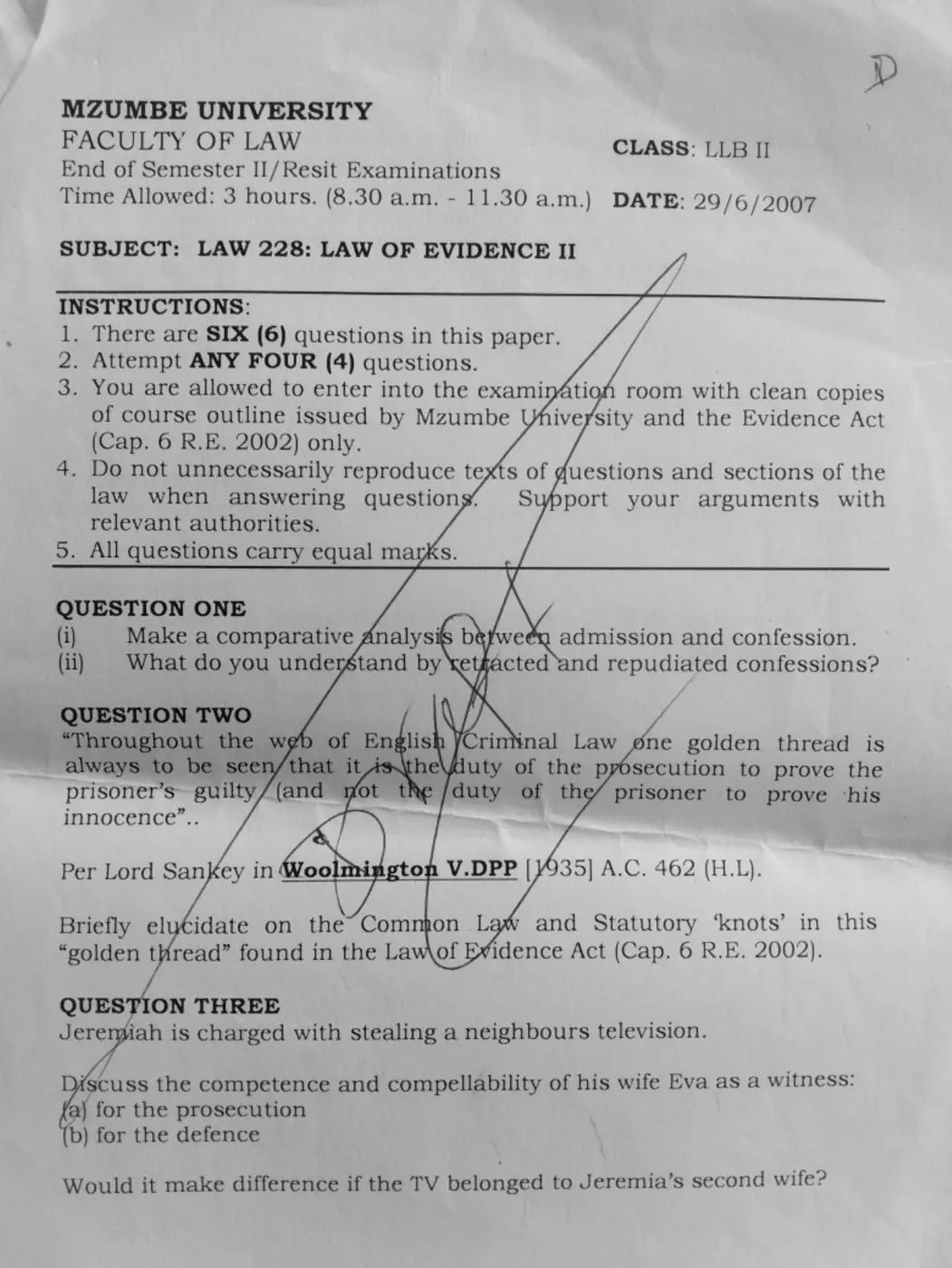
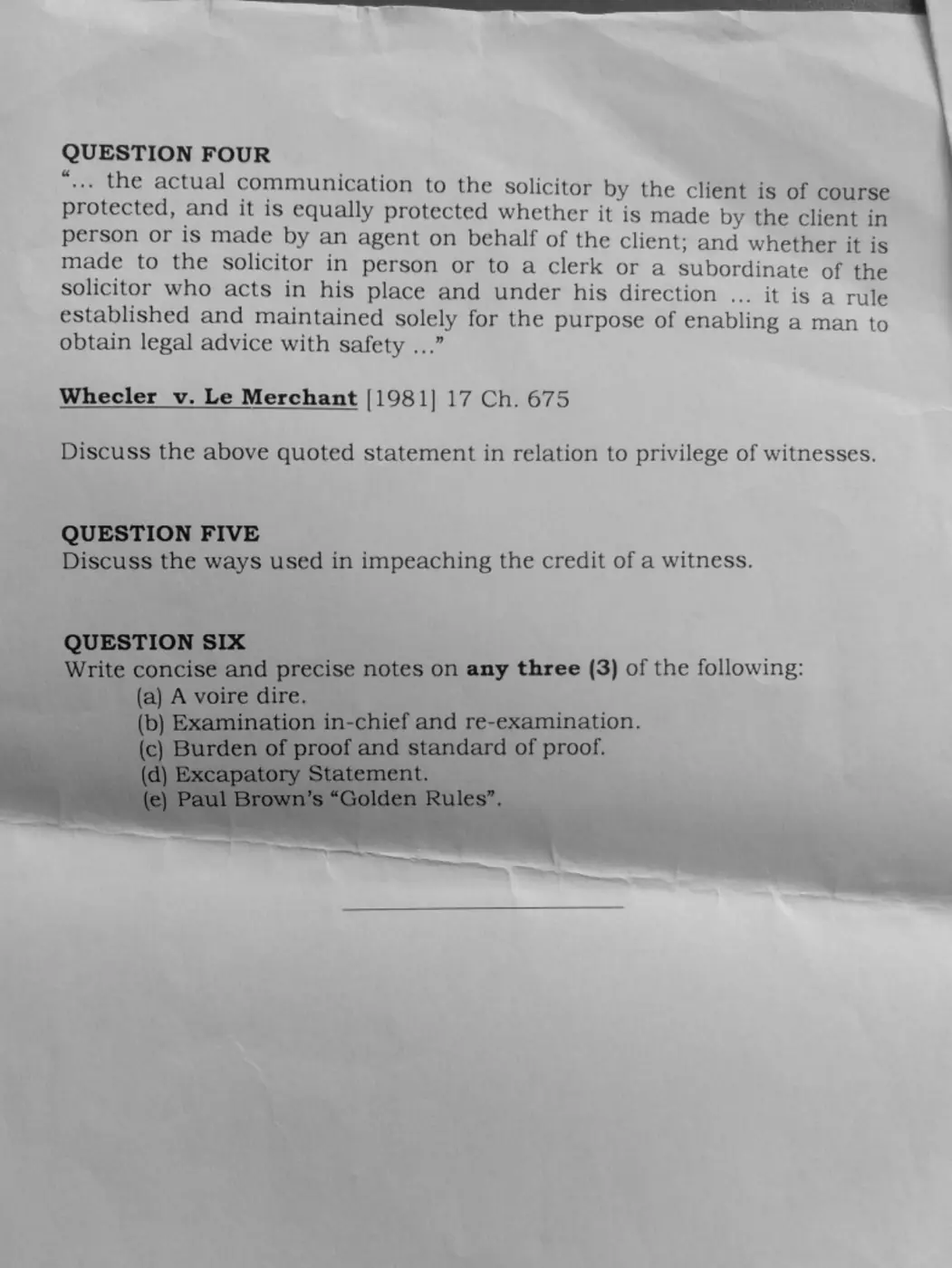
Read the questions as text
1. (i) Make a comparative analysis between admission and confession. (ii) What do you understand by retracted and repudiated confessions?
2. “Throughout the web of English Criminal Law one golden thread is always to be seen, that it is the duty of the prosecution to prove the prisoner’s guilt (and not the duty of the prisoner to prove his innocence).” Per Lord Sankey in Woolmington v DPP [1935] A.C. 462 (H.L). Briefly elucidate on the Common Law and Statutory ‘knots’ in this “golden thread” found in the Law of Evidence Act (Cap. 6 R.E. 2002).
3. Jeremiah is charged with stealing a neighbours television. Discuss the competence and compellability of his wife Eva as a witness: (a) for the prosecution; (b) for the defence. Would it make difference if the TV belonged to Jeremia’s second wife?
4. “… the actual communication to the solicitor by the client is of course protected, and it is equally protected whether it is made by the client in person or is made by an agent on behalf of the client; and whether it is made to the solicitor in person or to a clerk or a subordinate of the solicitor who acts in his place and under his direction … it is a rule established and maintained solely for the purpose of enabling a man to obtain legal advice with safety …” Wheeler v. Le Merchant [1981] 17 Ch. 675. Discuss the above quoted statement in relation to privilege of witnesses.
5. Discuss the ways used in impeaching the credit of a witness.
6. Write concise and precise notes on any three (3) of the following: (a) A voire dire. (b) Examination in-chief and re-examination. (c) Burden of proof and standard of proof. (d) Excapatory Statement. (e) Paul Brown’s “Golden Rules”.
Source: Mzumbe University examination paper, June 2007, shared for revision. Rights holders can ask for removal through our Contact page.
Part 2
Law of Evidence II Past Paper Answers: Model Answers to All 6 Questions
Question 1 is answered in full below, free. Tap any other question to see it and a preview of its answer.
Q1Question 1: Admission and confession; retracted and repudiated confessions
essay Free answer
The question
(i) Make a comparative analysis between admission and confession. (ii) What do you understand by retracted and repudiated confessions?
Model answer
The short answer
An admission is any statement suggesting an inference about a fact in issue or relevant fact (Evidence Act s.19); it applies in civil and criminal cases. A confession is a special kind of admission made by an accused that he committed an offence (s.3(1)); it applies only in criminal cases and must be voluntary (ss.27–29). A retracted confession is one the accused admits making but later withdraws, usually saying it was forced; a repudiated confession is one the accused denies ever making. Either may found a conviction only if the court, after warning itself, is satisfied it is true, usually looking for corroboration (Tuwamoi v Uganda).
Section numbers follow Cap. 6 R.E. 2002, the edition the paper sets (unchanged in R.E. 2019). R.E. 2023 keeps confessions at ss.27–33.
(i) Admission and confession compared
| Admission | Confession | |
|---|---|---|
| Definition | Oral, written or electronic statement suggesting an inference about a fact in issue or relevant fact (s.19) | Words or conduct from which it may be inferred that the maker committed an offence, or a statement admitting the offence or its elements (s.3(1)) |
| Proceedings | Civil and criminal | Criminal only |
| Maker | A party, his agent or persons interested (ss.20–22) | The accused |
| Voluntariness | No general voluntariness test (but see s.25 on without-prejudice statements) | Must be voluntary; prosecution must prove it (s.27(2)); inducement likely to produce a false admission excludes it (s.29) |
| Use against others | Generally only against the maker | May be taken into account against a co-accused in a joint trial, but cannot alone convict him (s.33) |
| Effect | Not conclusive proof; may be explained | May alone found a conviction if true and voluntary |
Every confession is an admission, but not every admission is a confession.
(ii) Retracted and repudiated confessions
- Retracted confession: the accused accepts he made the statement but withdraws it, usually claiming it was obtained by force, threat or promise. Because admissibility is challenged, the court holds a trial within a trial to decide voluntariness before admitting it.
- Repudiated confession: the accused denies making the statement at all (for example, saying he signed a blank paper). This is a question of fact decided with the rest of the evidence; no trial within a trial is needed on voluntariness.
- Weight: in Tuwamoi v Uganda [1967] EA 84, the East African Court of Appeal held that a trial court should accept a retracted or repudiated confession with caution and, as a rule of practice, look for corroboration; but it may convict on it alone if, having considered all the circumstances, it is fully satisfied the confession is true.
What the examiner wants
Clear definitions with the statutory basis, a structured comparison, the distinction between retraction and repudiation, and the rule of practice on corroboration.
Common mistakes
- Treating retracted and repudiated as the same thing.
- Saying a retracted confession can never ground a conviction.
Q2Question 2: Knots in the golden thread: when the accused bears a burden
essay Locked
The question
“Throughout the web of English Criminal Law one golden thread is always to be seen, that it is the duty of the prosecution to prove the prisoner’s guilt (and not the duty of the prisoner to prove his innocence).” Per Lord Sankey in Woolmington v DPP [1935] A.C. 462 (H.L). Briefly elucidate on the Common Law and Statutory ‘knots’ in this “golden thread” found in the Law of Evidence Act (Cap. 6 R.E. 2002).
Model answer
Unlock the model answer to Question 2
Get all 5 locked answers on this paper for TSh 3,000. Pay once, keep them in Your Library for life.
Get the solved paper · TSh 3,000Or get every solved paper with Elite
Q3Question 3: Jeremiah's wife Eva: competent and compellable?
problem Locked
The question
Jeremiah is charged with stealing a neighbours television. Discuss the competence and compellability of his wife Eva as a witness: (a) for the prosecution; (b) for the defence. Would it make difference if the TV belonged to Jeremia’s second wife?
Model answer
Unlock the model answer to Question 3
Get all 5 locked answers on this paper for TSh 3,000. Pay once, keep them in Your Library for life.
Get the solved paper · TSh 3,000Or get every solved paper with Elite
Q4Question 4: Legal professional privilege (Wheeler v Le Merchant)
essay Locked
The question
“… the actual communication to the solicitor by the client is of course protected, and it is equally protected whether it is made by the client in person or is made by an agent on behalf of the client; and whether it is made to the solicitor in person or to a clerk or a subordinate of the solicitor who acts in his place and under his direction … it is a rule established and maintained solely for the purpose of enabling a man to obtain legal advice with safety …” Wheeler v. Le Merchant [1981] 17 Ch. 675. Discuss the above quoted statement in relation to privilege of witnesses.
Model answer
Unlock the model answer to Question 4
Get all 5 locked answers on this paper for TSh 3,000. Pay once, keep them in Your Library for life.
Get the solved paper · TSh 3,000Or get every solved paper with Elite
Q5Question 5: Ways of impeaching a witness's credit
essay Locked
The question
Discuss the ways used in impeaching the credit of a witness.
Model answer
Unlock the model answer to Question 5
Get all 5 locked answers on this paper for TSh 3,000. Pay once, keep them in Your Library for life.
Get the solved paper · TSh 3,000Or get every solved paper with Elite
Q6Question 6: Short notes: voire dire, examination-in-chief and re-examination, burden and standard of proof, exculpatory statements
short notes Locked
The question
Write concise and precise notes on any three (3) of the following: (a) A voire dire. (b) Examination in-chief and re-examination. (c) Burden of proof and standard of proof. (d) Excapatory Statement. (e) Paul Brown’s “Golden Rules”.
Model answer
Unlock the model answer to Question 6
Get all 5 locked answers on this paper for TSh 3,000. Pay once, keep them in Your Library for life.
Get the solved paper · TSh 3,000Or get every solved paper with Elite
Get the Full Solved Paper
All 6 questions answered with the statutes and cases that apply, what the examiner wants and the mistakes to avoid. TSh 3,000, yours for life in Your Library.
Pata majibu yote ya mtihani huu kwa TSh 3,000 tu.




Statutes and Cases for This Law of Evidence II Past Paper
- Evidence Act, Cap. 6 R.E. 2002 (the edition the paper sets; same numbering in R.E. 2019)s.3 (confession; when a fact is proved), s.19 (admission), ss.27–33 (confessions), ss.110–114 (burden), s.122, s.127, s.130 (spouses), ss.134–137 (professional communications), ss.146–147, ss.150–152, s.154, s.163, s.164. R.E. 2023 renumbers some of these (e.g. s.127 is now s.135; burden ss.117–122)
- Penal Code, Cap. 16s.12 (presumption of sanity)
- Woolmington v DPP [1935] AC 462Prosecution bears the burden of proof
- Tuwamoi v Uganda [1967] EA 84Retracted and repudiated confessions
- Wheeler v Le Merchant (1881) 17 Ch D 675Scope of legal professional privilege
Mzumbe Law of Evidence II Past Paper: Common Questions
Is this the real Mzumbe Law of Evidence II exam paper?
Yes. These are scans of the End of Semester II/Re-sit Examination, June 2007 paper for LAW 228 Law of Evidence II at Mzumbe University, sat on 29 June 2007. Nothing has been retyped or changed.
How many questions do you answer in this Law of Evidence II paper?
Six questions. Attempt any four. Clean copies of the course outline and the Evidence Act allowed. All questions carry equal marks.
Are there answers to this past paper?
Yes. All 6 questions have full model answers written to Tanzanian law and reviewed by Isack Kimaro, LL.B, PDLP. The Question 1 answer is free; the full solved paper is TSh 3,000 (TSh 2,000 for Pro members) and is included in Elite.
How do I see every page of the paper?
The first pages are open to everyone. Create a free account to read the whole paper.