

About this paper
Solved answers to all 6 questions
Part 1
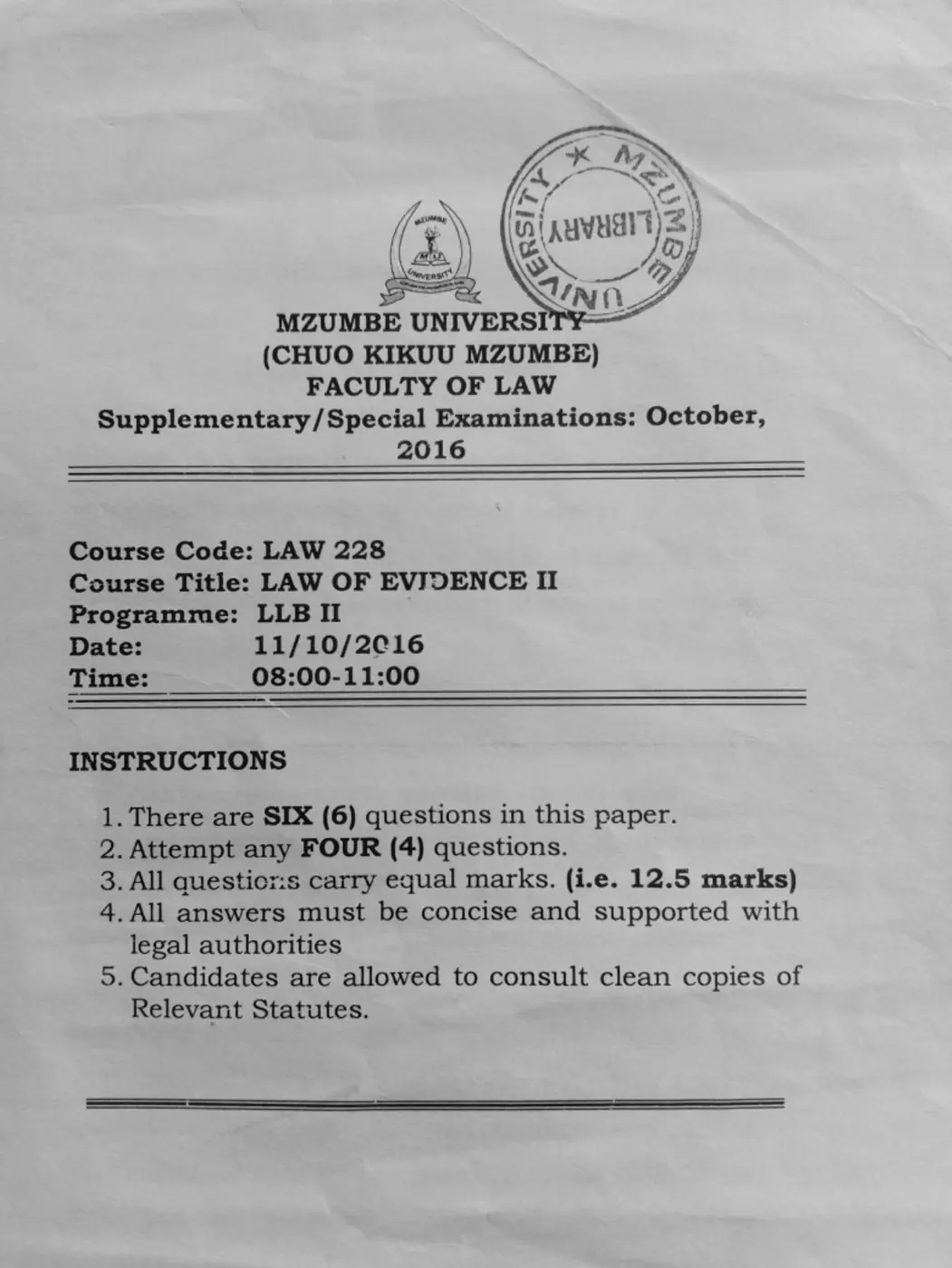
Mzumbe Law of Evidence II Past Paper (LAW 228): The Full Exam as Set
Six questions. Attempt any four. Each question carries 12.5 marks. Clean copies of relevant statutes allowed.
 Full size
 Full size
Page 3 of 4
Create a free account to see the whole paper. It takes a minute.
Create a free accountAlready a member? Log in
Page 4 of 4
Create a free account to see the whole paper. It takes a minute.
Create a free accountAlready a member? Log inRead the questions as text
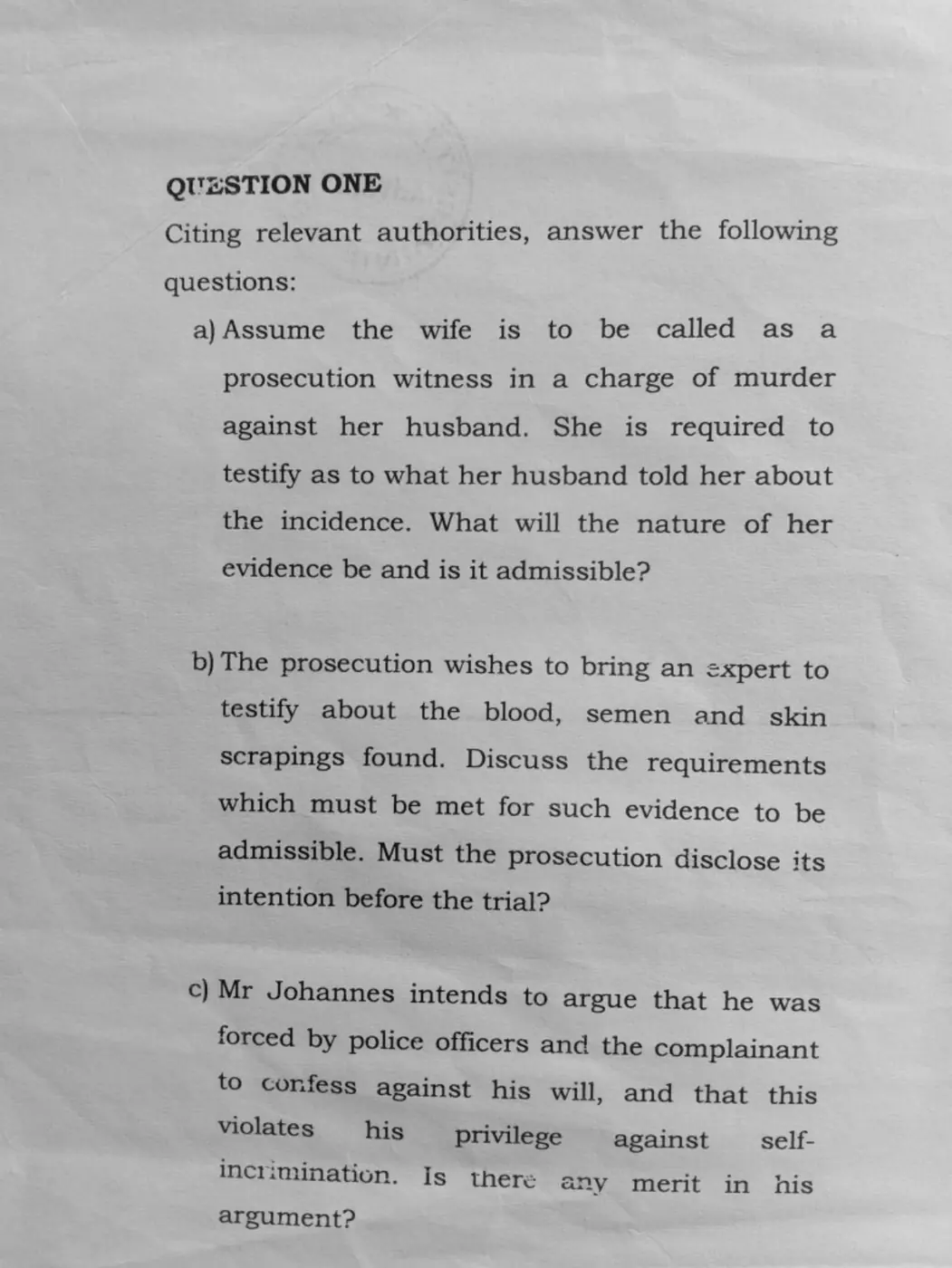
1. Citing relevant authorities, answer the following questions: (a) Assume the wife is to be called as a prosecution witness in a charge of murder against her husband. She is required to testify as to what her husband told her about the incidence. What will the nature of her evidence be and is it admissible? (b) The prosecution wishes to bring an expert to testify about the blood, semen and skin scrapings found. Discuss the requirements which must be met for such evidence to be admissible. Must the prosecution disclose its intention before the trial? (c) Mr Johannes intends to argue that he was forced by police officers and the complainant to confess against his will, and that this violates his privilege against self-incrimination. Is there any merit in his argument?
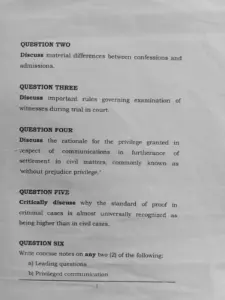
2. Discuss material differences between confessions and admissions.
3. Discuss important rules governing examination of witnesses during trial in court.
4. Discuss the rationale for the privilege granted in respect of communications in furtherance of settlement in civil matters, commonly known as ‘without prejudice privilege.’
5. Critically discuss why the standard of proof in criminal cases is almost universally recognized as being higher than in civil cases.
6. Write concise notes on any two (2) of the following: (a) Leading questions; (b) Privileged communication; (c) Hostile witness; (d) Extra judicial statement and cautioned statement.
Source: Mzumbe University examination paper, October 2016, shared for revision. Rights holders can ask for removal through our Contact page.
Part 2
Law of Evidence II Past Paper Answers: Model Answers to All 6 Questions
Question 1 is answered in full below, free. Tap any other question to see it and a preview of its answer.
Q1Question 1: The wife's evidence, expert DNA evidence and a forced confession
12.5 marks · problem Free answer
The question
Citing relevant authorities, answer the following questions: (a) Assume the wife is to be called as a prosecution witness in a charge of murder against her husband. She is required to testify as to what her husband told her about the incidence. What will the nature of her evidence be and is it admissible? (b) The prosecution wishes to bring an expert to testify about the blood, semen and skin scrapings found. Discuss the requirements which must be met for such evidence to be admissible. Must the prosecution disclose its intention before the trial? (c) Mr Johannes intends to argue that he was forced by police officers and the complainant to confess against his will, and that this violates his privilege against self-incrimination. Is there any merit in his argument?
Model answer
The short answer
(a) What the husband told the wife about the killing is an admission, and if it admits the offence, a confession, made to a private person; it is not hearsay against him. It is admissible if voluntary, but the wife is only a competent, not compellable, prosecution witness in a murder case, and the court must tell her so (Evidence Act s.130(1), (3)). (b) Expert evidence on blood, semen and skin scrapings is admissible if the witness is shown to be an expert in the science (s.47), the samples’ chain of custody is proved, and the basis of the opinion is explained; the prosecution must disclose it before trial through committal or preliminary hearing documents, and if it relies on a written report the accused may require the expert to attend (CPA s.240(3)). (c) Johannes’s argument has merit: a confession obtained by force from police or a person in authority is involuntary and inadmissible (s.27), and the prosecution must prove voluntariness.
(a) The wife’s evidence of what her husband told her
- Nature: a statement by the accused suggesting an inference about a fact in issue is an admission (s.19); if it admits the offence or facts from which guilt may be inferred, it is a confession (s.3(1)). Statements of a party offered against him are not excluded as hearsay.
- Admissibility: a confession to a private person is admissible if voluntary; it is rejected if caused by an inducement likely to produce a false admission (s.29).
- The wife as witness: murder is not within the exceptions in s.130(2), so she is competent but not compellable for the prosecution (s.130(1)). The court must inform her of her right not to testify; otherwise her evidence is inadmissible (s.130(3)). If she chooses to testify, her account of his words is admissible.
- Weight: the court should consider whether she reports him accurately and whether she has a motive to lie, and look for supporting evidence.
(b) Expert evidence on blood, semen and skin scrapings
- Relevance: opinions of persons specially skilled in science are relevant when the court must form an opinion on a scientific matter (s.47), as are facts supporting or contradicting them (s.48).
- Qualification: the witness’s training, experience and laboratory must be established.
- Chain of custody: the prosecution must show who collected, sealed, stored and transported the samples, so the court is sure the samples tested are those found.
- Basis: the expert must explain the methods and reasoning; the court is not bound by the opinion.
- Disclosure: yes. In High Court trials, the statement of the substance of the evidence (including the expert) is given at committal (CPA ss.243–248), and matters in dispute are identified at the preliminary hearing. Where the prosecution relies on a written report, the accused must be informed of his right to require the maker to be called for cross-examination (CPA s.240(3)). Surprise evidence may be excluded or the trial adjourned to prevent prejudice.
(c) Johannes’s claim that he was forced to confess
- Merit: yes. A confession to a police officer is admissible only if voluntary, and the prosecution must prove voluntariness (s.27(1)–(2)). A confession induced by threat, promise or other prejudice from the officer or another person in authority is involuntary (s.27(3)). The complainant may be a person in authority if she has power over the prosecution.
- Force or threats likely to produce a false admission make a confession inadmissible (s.29). The court holds a trial within a trial to decide.
- Self-incrimination: the accused cannot be compelled to give evidence against himself; the Constitution guarantees a fair trial and presumption of innocence (art. 13(6)). The rule in s.141 that a witness may not refuse to answer incriminating questions applies to witnesses, with protection against later prosecution; it does not allow police to force a suspect to confess.
- Evidence obtained in breach of the CPA may also be excluded under CPA s.169.
What the examiner wants
Correct classification of the husband’s statement, s.130 on spouses, the requirements for expert evidence and disclosure, and the voluntariness rule with burden of proof.
Common mistakes
- Calling the husband’s statement inadmissible hearsay.
- Putting the burden of proving involuntariness on the accused.
Q2Question 2: Confessions and admissions: material differences
12.5 marks · essay Locked
The question
Discuss material differences between confessions and admissions.
Model answer
Unlock the model answer to Question 2
Get all 5 locked answers on this paper for TSh 3,000. Pay once, keep them in Your Library for life.
Get the solved paper · TSh 3,000Or get every solved paper with Elite
Q3Question 3: Rules governing the examination of witnesses
12.5 marks · essay Locked
The question
Discuss important rules governing examination of witnesses during trial in court.
Model answer
Unlock the model answer to Question 3
Get all 5 locked answers on this paper for TSh 3,000. Pay once, keep them in Your Library for life.
Get the solved paper · TSh 3,000Or get every solved paper with Elite
Q4Question 4: Why without prejudice privilege exists
12.5 marks · essay Locked
The question
Discuss the rationale for the privilege granted in respect of communications in furtherance of settlement in civil matters, commonly known as ‘without prejudice privilege.’
Model answer
Unlock the model answer to Question 4
Get all 5 locked answers on this paper for TSh 3,000. Pay once, keep them in Your Library for life.
Get the solved paper · TSh 3,000Or get every solved paper with Elite
Q5Question 5: Why the criminal standard of proof is higher
12.5 marks · essay Locked
The question
Critically discuss why the standard of proof in criminal cases is almost universally recognized as being higher than in civil cases.
Model answer
Unlock the model answer to Question 5
Get all 5 locked answers on this paper for TSh 3,000. Pay once, keep them in Your Library for life.
Get the solved paper · TSh 3,000Or get every solved paper with Elite
Q6Question 6: Short notes: leading questions, privileged communication, hostile witness, extra-judicial and cautioned statements
12.5 marks · short notes Locked
The question
Write concise notes on any two (2) of the following: (a) Leading questions; (b) Privileged communication; (c) Hostile witness; (d) Extra judicial statement and cautioned statement.
Model answer
Unlock the model answer to Question 6
Get all 5 locked answers on this paper for TSh 3,000. Pay once, keep them in Your Library for life.
Get the solved paper · TSh 3,000Or get every solved paper with Elite
Get the Full Solved Paper
All 6 questions answered with the statutes and cases that apply, what the examiner wants and the mistakes to avoid. TSh 3,000, yours for life in Your Library.
Pata majibu yote ya mtihani huu kwa TSh 3,000 tu.




Statutes and Cases for This Law of Evidence II Past Paper
- Evidence Act, Cap. 6 R.E. 2002/2019s.3 (confession; when a fact is proved), s.19 (admission), s.25, ss.27–33, ss.47–48, s.130, ss.134–137, s.141, ss.144–172 (examination of witnesses). R.E. 2023 renumbers some (e.g. experts s.52)
- Criminal Procedure Act, Cap. 20 R.E. 2002/2019ss.50–58, s.169, s.240 (expert and medical reports), ss.243–248 (committal: statement of evidence)
- Constitution of the United Republic of Tanzania, 1977Art. 13(6) (fair hearing, presumption of innocence)
- Woolmington v DPP [1935] AC 462Prosecution bears the burden
- Miller v Minister of Pensions [1947] 2 All ER 372Standards of proof
- Tuwamoi v Uganda [1967] EA 84Retracted confessions
Mzumbe Law of Evidence II Past Paper: Common Questions
Is this the real Mzumbe Law of Evidence II exam paper?
Yes. These are scans of the Supplementary/Special Examination, October 2016 paper for LAW 228 Law of Evidence II at Mzumbe University, sat on 11 October 2016. Nothing has been retyped or changed.
How many questions do you answer in this Law of Evidence II paper?
Six questions. Attempt any four. Each question carries 12.5 marks. Clean copies of relevant statutes allowed.
Are there answers to this past paper?
Yes. All 6 questions have full model answers written to Tanzanian law and reviewed by Isack Kimaro, LL.B, PDLP. The Question 1 answer is free; the full solved paper is TSh 3,000 (TSh 2,000 for Pro members) and is included in Elite.
How do I see every page of the paper?
The first pages are open to everyone. Create a free account to read the whole paper.