

About this paper
Solved answers to all 6 questions
Part 1
Mzumbe Law of Evidence II Past Paper (LAW 228): The Full Exam as Set
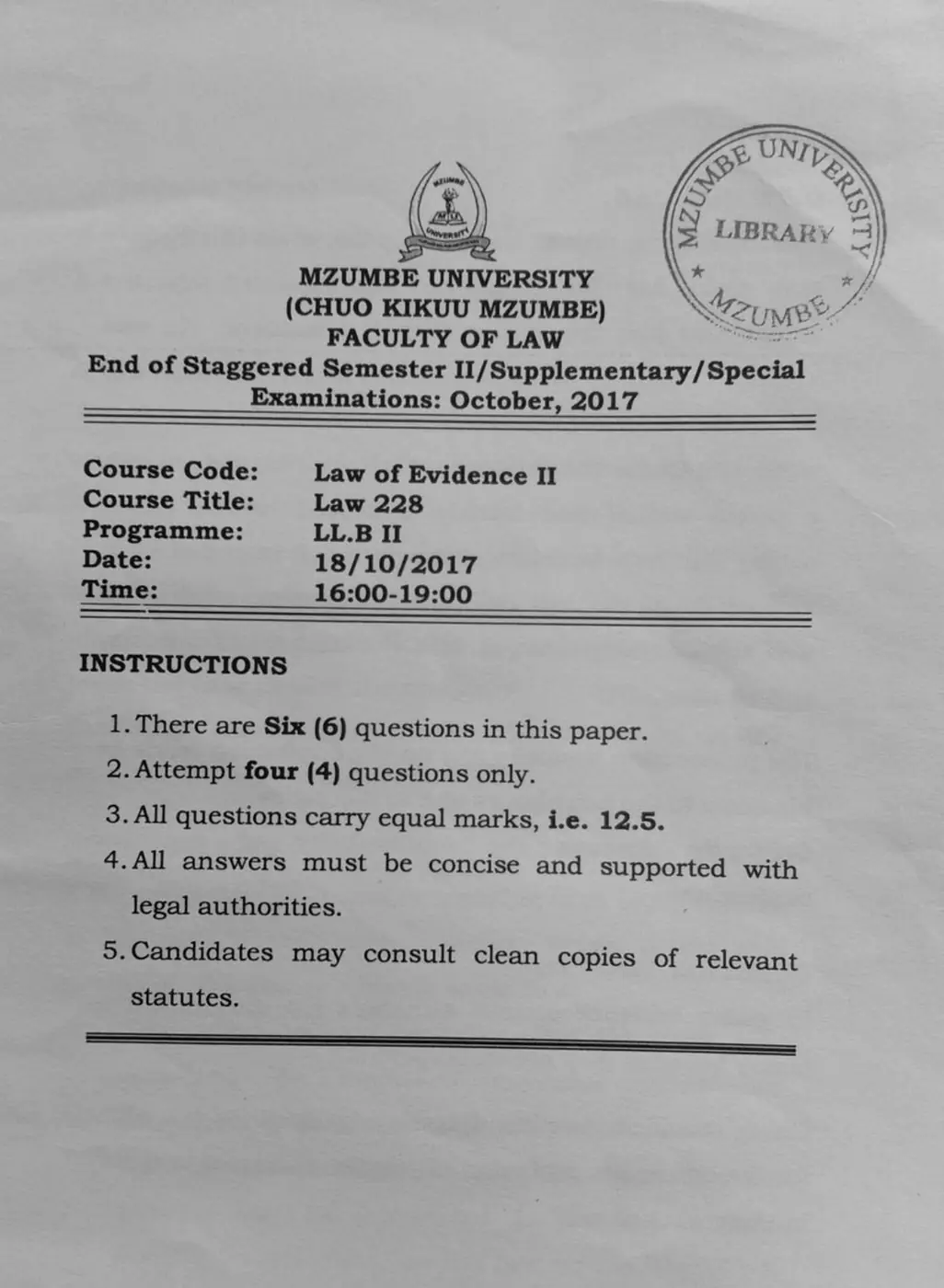
Six questions. Attempt any four. Each question carries 12.5 marks. Candidates may consult clean copies of relevant statutes.
 Full size
 Full size
Page 3 of 4
Create a free account to see the whole paper. It takes a minute.
Create a free accountAlready a member? Log in
Page 4 of 4
Create a free account to see the whole paper. It takes a minute.
Create a free accountAlready a member? Log inRead the questions as text
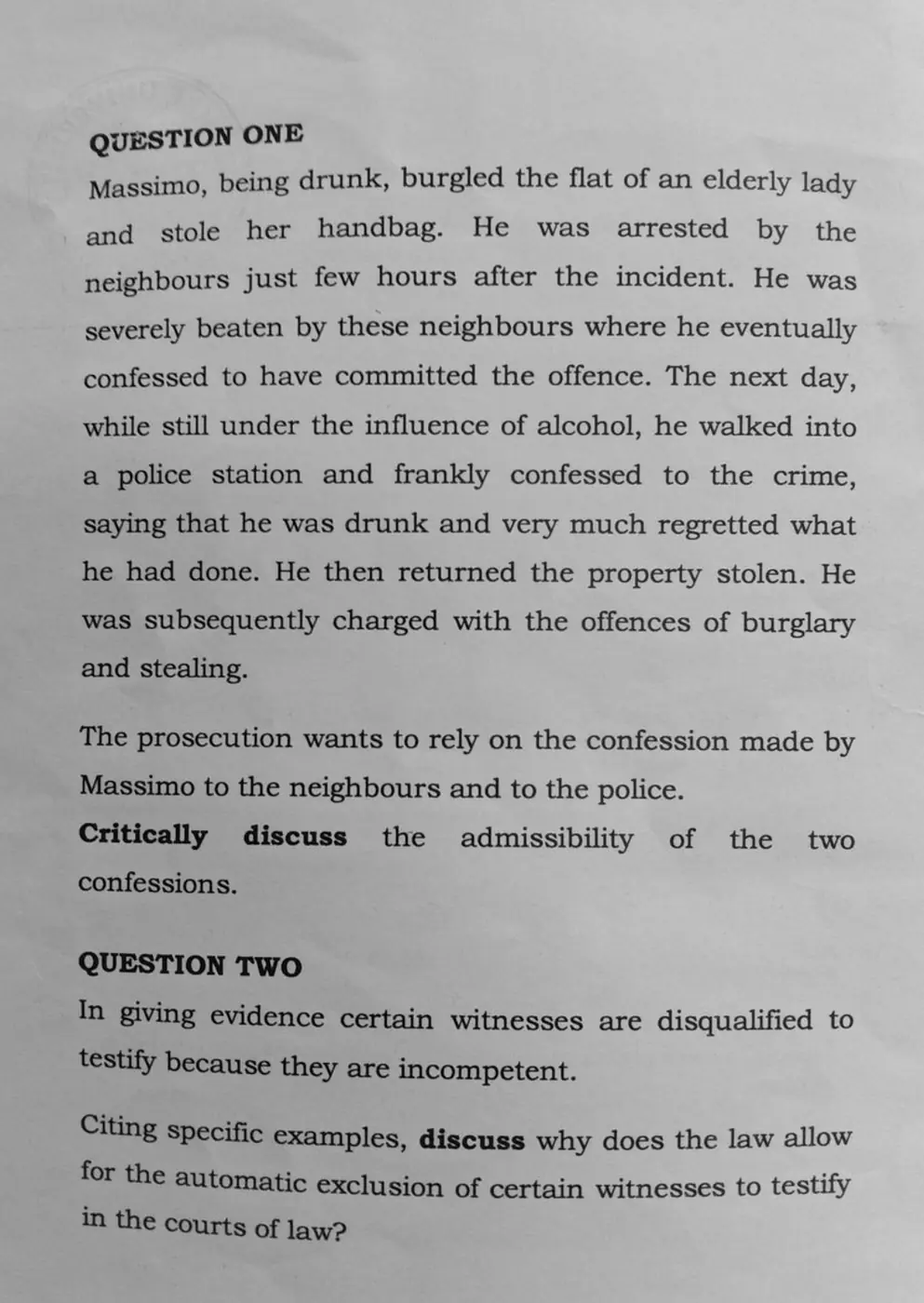
1. Massimo, being drunk, burgled the flat of an elderly lady and stole her handbag. He was arrested by the neighbours just few hours after the incident. He was severely beaten by these neighbours where he eventually confessed to have committed the offence. The next day, while still under the influence of alcohol, he walked into a police station and frankly confessed to the crime, saying that he was drunk and very much regretted what he had done. He then returned the property stolen. He was subsequently charged with the offences of burglary and stealing. The prosecution wants to rely on the confession made by Massimo to the neighbours and to the police. Critically discuss the admissibility of the two confessions.
2. In giving evidence certain witnesses are disqualified to testify because they are incompetent. Citing specific examples, discuss why does the law allow for the automatic exclusion of certain witnesses to testify in the courts of law?
3. Critically discuss how examination of witnesses is governed by the law in Tanzania?
4. The excerpt comes from a newspaper story about the criminal prosecution of the Fordi Motor Company for reckless homicide based upon their allegedly having sold cars with knowledge that their gas tanks were likely to explode if the car was struck in the rear. The prosecution plans to bring a mechanical engineer, as an expert, to prove the case against the company. Critically discuss the admissibility and weight of the evidence of an expert.
5. X sues a garage for damages resulting from faulty repairs to his car. In the correspondence, before action was instituted, the garage’s lawyer wrote to X: “We admit, without prejudice, that the work was done by an inefficient mechanic whom we subsequently dismissed and that that the work was possibly not faultless. However, we think that the contract can be interpreted to absolve us from liability. Nevertheless, we feel that we would prefer to settle the matter and hereby offer you again without prejudice, the sum of One Million Tanzanian Shillings in total settlement of your claim.” X rejects the offer and the matter proceeds to trial. At the trial, X tenders in evidence the letter written by the garage’s lawyer in order to prove the admission that the car was badly repaired. The opposing advocate objects on the ground that it was a ‘statement without prejudice’. Discuss the admissibility of the letter.
6. When is a fact said to be proved in criminal and civil cases?
Source: Mzumbe University examination paper, October 2017, shared for revision. Rights holders can ask for removal through our Contact page.
Part 2
Law of Evidence II Past Paper Answers: Model Answers to All 6 Questions
Question 1 is answered in full below, free. Tap any other question to see it and a preview of its answer.
Q1Question 1: Massimo's two confessions: to the neighbours and to the police
12.5 marks · problem Free answer
The question
Massimo, being drunk, burgled the flat of an elderly lady and stole her handbag. He was arrested by the neighbours just few hours after the incident. He was severely beaten by these neighbours where he eventually confessed to have committed the offence. The next day, while still under the influence of alcohol, he walked into a police station and frankly confessed to the crime, saying that he was drunk and very much regretted what he had done. He then returned the property stolen. He was subsequently charged with the offences of burglary and stealing. The prosecution wants to rely on the confession made by Massimo to the neighbours and to the police. Critically discuss the admissibility of the two confessions.
Model answer
The short answer
The confession to the neighbours is very likely inadmissible: it was extracted by a severe beating, which is the kind of threat or prejudice likely to produce a false admission (Evidence Act s.29). The confession to the police is more likely admissible: it was volunteered the next day, away from the neighbours, so the impression of the beating may be treated as removed (s.30). But because he was still drunk, the prosecution must prove it was voluntary and reliable (s.27), and it should have been recorded as the CPA requires. The return of the stolen handbag is strong independent evidence, and the court should look for such corroboration before relying on either confession.
Is each statement a confession?
Yes: each admits the offence in terms (s.3(1)(b)).
The confession to the neighbours
- A confession is rejected if the court finds it was induced by a threat, promise or inducement of a kind likely to produce a false admission of guilt (s.29).
- Massimo confessed while being severely beaten. Violence is the clearest example of an inducement likely to produce a false confession, whoever applies it. Even though the neighbours are private persons rather than police (s.27(3) speaks of persons in authority), s.29 and the general requirement of voluntariness apply.
- Mob violence also offends constitutional protection of dignity (art. 13(6)(d)–(e)). The court should exclude this confession.
The confession to the police
- Voluntariness: a confession made voluntarily to a police officer is admissible; the prosecution must prove voluntariness (s.27(1)–(2)). Massimo walked into the station on his own and spoke freely, expressing regret.
- Effect of the earlier beating: a confession made after the impression caused by an inducement has been fully removed is relevant (s.30). A day had passed and he was in a different setting, so the court may find the effect of the beating removed. The prosecution must show this.
- Intoxication: he was still under the influence of alcohol. Intoxication does not automatically exclude a confession, but the court must be satisfied he understood what he was saying and that the statement is reliable. If he was so drunk that the statement was not the product of a rational mind, it should be excluded or given little weight.
- Procedure: if police recorded it as a cautioned statement, they should have cautioned him and complied with CPA ss.50–58; non-compliance may lead to exclusion under CPA s.169.
The returned handbag
The return of the property is conduct that strongly corroborates the confession. Where a fact is discovered in consequence of information from a person in custody, the information relating distinctly to the discovery is relevant (s.31). Corroboration is important because the court should look for it before relying on a confession that is retracted or open to doubt (Tuwamoi v Uganda [1967] EA 84).
Conclusion
Exclude the neighbours’ confession; the police confession may be admitted if the prosecution proves it was voluntary and made while Massimo understood what he said, and it is corroborated by the return of the handbag.
What the examiner wants
Application of ss.27–31 to each confession, the effect of violence and intoxication, the burden on the prosecution, and corroboration.
Common mistakes
- Assuming confessions to private persons are always admissible.
- Ignoring s.30 on removal of the impression.
Q2Question 2: Why the law excludes incompetent witnesses
12.5 marks · essay Locked
The question
In giving evidence certain witnesses are disqualified to testify because they are incompetent. Citing specific examples, discuss why does the law allow for the automatic exclusion of certain witnesses to testify in the courts of law?
Model answer
Unlock the model answer to Question 2
Get all 5 locked answers on this paper for TSh 3,000. Pay once, keep them in Your Library for life.
Get the solved paper · TSh 3,000Or get every solved paper with Elite
Q3Question 3: How the law governs examination of witnesses
12.5 marks · essay Locked
The question
Critically discuss how examination of witnesses is governed by the law in Tanzania?
Model answer
Unlock the model answer to Question 3
Get all 5 locked answers on this paper for TSh 3,000. Pay once, keep them in Your Library for life.
Get the solved paper · TSh 3,000Or get every solved paper with Elite
Q4Question 4: Admissibility and weight of expert evidence
12.5 marks · essay Locked
The question
The excerpt comes from a newspaper story about the criminal prosecution of the Fordi Motor Company for reckless homicide based upon their allegedly having sold cars with knowledge that their gas tanks were likely to explode if the car was struck in the rear. The prosecution plans to bring a mechanical engineer, as an expert, to prove the case against the company. Critically discuss the admissibility and weight of the evidence of an expert.
Model answer
Unlock the model answer to Question 4
Get all 5 locked answers on this paper for TSh 3,000. Pay once, keep them in Your Library for life.
Get the solved paper · TSh 3,000Or get every solved paper with Elite
Q5Question 5: The garage's without prejudice letter
12.5 marks · problem Locked
The question
X sues a garage for damages resulting from faulty repairs to his car. In the correspondence, before action was instituted, the garage’s lawyer wrote to X: “We admit, without prejudice, that the work was done by an inefficient mechanic whom we subsequently dismissed and that that the work was possibly not faultless. However, we think that the contract can be interpreted to absolve us from liability. Nevertheless, we feel that we would prefer to settle the matter and hereby offer you again without prejudice, the sum of One Million Tanzanian Shillings in total settlement of your claim.” X rejects the offer and the matter proceeds to trial. At the trial, X tenders in evidence the letter written by the garage’s lawyer in order to prove the admission that the car was badly repaired. The opposing advocate objects on the ground that it was a ‘statement without prejudice’. Discuss the admissibility of the letter.
Model answer
Unlock the model answer to Question 5
Get all 5 locked answers on this paper for TSh 3,000. Pay once, keep them in Your Library for life.
Get the solved paper · TSh 3,000Or get every solved paper with Elite
Q6Question 6: When a fact is proved in criminal and civil cases
12.5 marks · essay Locked
The question
When is a fact said to be proved in criminal and civil cases?
Model answer
Unlock the model answer to Question 6
Get all 5 locked answers on this paper for TSh 3,000. Pay once, keep them in Your Library for life.
Get the solved paper · TSh 3,000Or get every solved paper with Elite
Get the Full Solved Paper
All 6 questions answered with the statutes and cases that apply, what the examiner wants and the mistakes to avoid. TSh 3,000, yours for life in Your Library.
Pata majibu yote ya mtihani huu kwa TSh 3,000 tu.




Statutes and Cases for This Law of Evidence II Past Paper
- Evidence Act, Cap. 6 R.E. 2002/2019s.3 (confession; when a fact is proved), s.25 (without prejudice), ss.27–31 (confessions; inducement; removal of impression; discovered facts), ss.47–48 (experts), s.127 (competency), s.130, ss.144–172 (examination of witnesses). R.E. 2023 renumbers some (e.g. s.127 is now s.135; experts s.52)
- Criminal Procedure Act, Cap. 20 R.E. 2002/2019ss.50–58 (recording statements), s.169 (exclusion)
- Penal Code, Cap. 16s.14 (intoxication)
- Tuwamoi v Uganda [1967] EA 84Retracted confessions
- Rush & Tompkins Ltd v Greater London Council [1989] AC 1280Without prejudice negotiations
- Woolmington v DPP [1935] AC 462Burden of proof
Mzumbe Law of Evidence II Past Paper: Common Questions
Is this the real Mzumbe Law of Evidence II exam paper?
Yes. These are scans of the Supplementary/Special Examination, October 2017 paper for LAW 228 Law of Evidence II at Mzumbe University, sat on 18 October 2017. Nothing has been retyped or changed.
How many questions do you answer in this Law of Evidence II paper?
Six questions. Attempt any four. Each question carries 12.5 marks. Candidates may consult clean copies of relevant statutes.
Are there answers to this past paper?
Yes. All 6 questions have full model answers written to Tanzanian law and reviewed by Isack Kimaro, LL.B, PDLP. The Question 1 answer is free; the full solved paper is TSh 3,000 (TSh 2,000 for Pro members) and is included in Elite.
How do I see every page of the paper?
The first pages are open to everyone. Create a free account to read the whole paper.