

In short
A law student CV should be one to two clear pages with your contact details, a short career objective, education in reverse order (with GPA if strong), legal experience such as internships, moot court and legal aid, skills, and referees. Tailor it to each firm, prove every claim with a concrete example, and proofread it carefully.
On this page 4 sections
Embarking on a career in law is a journey that requires not only academic prowess but also a compelling presentation of your skills and achievements.
As a law student in Tanzania, you’re on the cusp of entering a dynamic and challenging field where the first impression truly matters.
Your curriculum vitae (CV) is your passport to the legal world, and crafting it effectively can make the difference between landing your dream job and getting lost in the shuffle.
In this comprehensive guide, I’ll unlock the secrets to writing a standout CV tailored specifically for Tanzanian law students with little to no working experience.
From highlighting your academic achievements to showcasing relevant experiences, I’ll take you through the essential steps to ensure your CV is a powerful tool that opens doors to exciting career opportunities.
Are you ready?
Why do you need a CV as a law student?
Ever wondered why bother with a CV while you’re still in school? Well, here’s the deal.
If you wait until you’re done with college to make a CV, you’re basically tricking yourself.
Before I show you how to make a good one, let me explain why having a CV as a student is super important.
- Professional Development: A CV is a snapshot of your academic and professional achievements. It helps you track your progress, identify areas for improvement, and set goals for your legal career.
- Job Applications: When applying for internships, clerkships, or entry-level positions, employers typically request a CV. Your CV provides a comprehensive overview of your education, relevant coursework, skills, and any legal experience you may have, making it easier for employers to assess your qualifications.
- Networking: A well-crafted CV is a valuable tool for networking. Whether attending legal conferences, seminars, or networking events, having a CV on hand allows you to quickly share your background and interests with potential mentors, colleagues, or employers.
- Law Firms and Legal Organizations: Law firms and other legal organizations often require CVs as part of their application processes. Your CV allows these entities to evaluate your suitability for specific roles and assess your potential contribution to their teams.
- Demonstrating Skills and Achievements: Your CV is an opportunity to showcase not only your academic achievements but also any relevant skills, extracurricular activities, publications, or research projects. This can give potential employers a more holistic view of your capabilities.
- Professionalism: Maintaining an up-to-date and well-organized CV reflects your professionalism and attention to detail. It’s a document that evolves throughout your academic and professional journey, showcasing your commitment to your legal career.
The Anatomy of a Winning CV for a Law Student
A winning CV for a law student should effectively showcase your education, relevant skills, legal experience, and any additional qualities that make you a strong candidate.
As a law student, hatutarajii CV yako iwe na mambo meeeengii. Inatakiwa iwe na vitu vya msingi tu. CV haihitaji mbwembwe!
Here’s an outline with examples to help you create an impressive CV:
Hapa ntatumia mfano wa CV yangu ambayo niliiandaa kipindi nasoma Law School, CV hii ilinisaidia kupata internship ya kulipwa kwenye moja ya Law Firm bora Africa mwaka 2017.
Contact Information
Include your full name, phone number, email address, and postal and physical address.
for example;

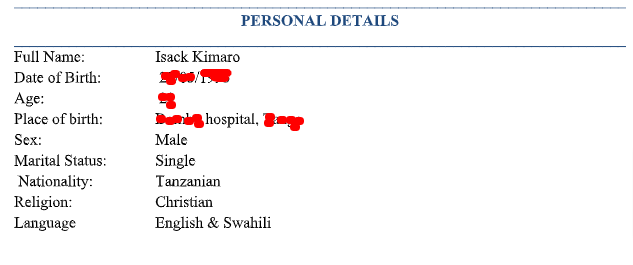
Personal details
Here you should include all relevant personal details like your age, place of birth, marital status, religion, nationality, etc.;
for example;
Profile/career objective
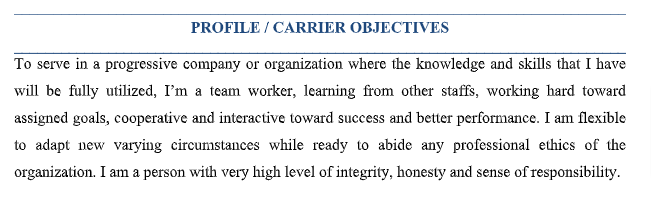
Here you should write a brief statement expressing your career goals and what you hope to achieve.
For example, the following was my career objective
Education
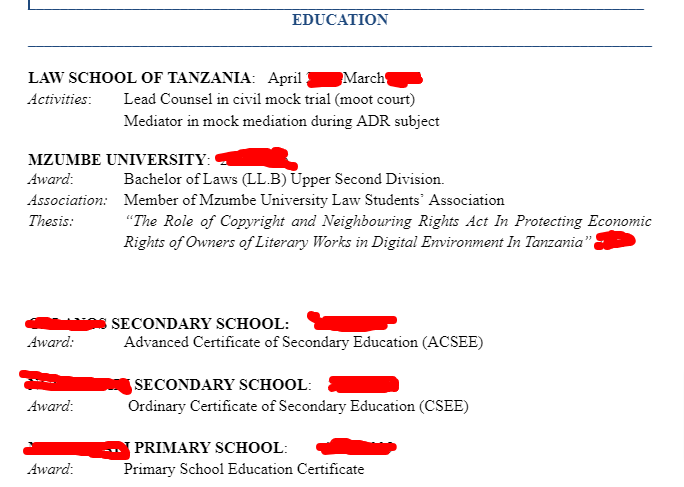
List your educational background in reverse chronological order.
Include the name of the School/institution, the start and the year of completion, and the award granted.
You may also include key milestones or activities that happened in your education journey for example if you have been a leader, participated in a certain key activity, etc. you may indicate that on your CV.
wakati nasoma Law school niliwahi kuwa a Lead Counsel in civil mock trial (moot court) angalia kwenye mfano hao chini, jinsi nilivyoiweka kwenye CV yangu.
for example,
Experience/Legal Skills
This might be the hardest part of your CV.
The problem is, when you hear about experience you think about big things that you have done.
Nop!
Even a little stuff that you have done relevant to your career can be a great working experience worthy to be included in your CV-legal internships, clerkships, relevant work experience, etc.
If you don’t have any experience at all (thing which I don’t agree) you can just highlight relevant legal skills, such as legal research, writing, case analysis, and any skill that you have acquired during your course.
Now the problem is not experience, the problem is how to present your experience effectively on your CV.
Well!
Here is how you can do it effectively
- Start with the position
- Include place
- Duration
These are the basic things to include when presenting your working experience.
But I have found them to be very boring!
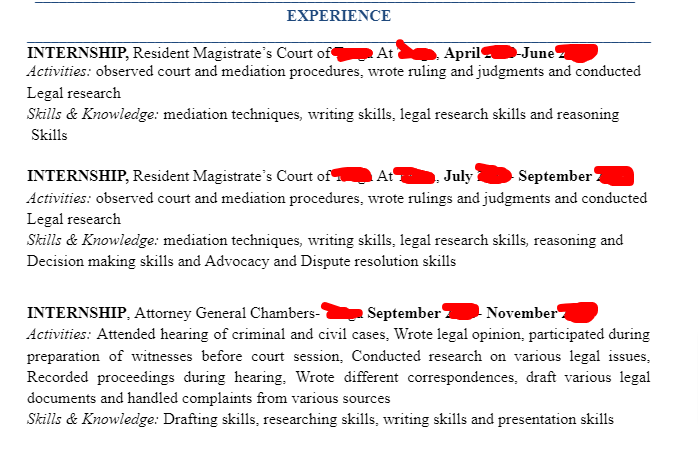
That’s why, in addition to them, I also add the things that I have done when I was working (primary duties) and the relevant skills that I have acquired along the way.
thus, to present your working experience effectively you must
- Start with the position
- Include place
- Duration
- Activities/Duties
- Skills acquired
kama bado hujaelewa, angalia mfano hapa chini
Here is how it actually looks like;
Areas of interest (optional)
This is an optional segment.
It should be added only if it adds value to your career goals.
for example, if you need to submit your CV for a legal internship at a law firm specializing in commercial law, then you might include all areas of commercial law subjects as your areas of interest.
Wakati naomba internship kwenye ile law firm niliyogusia, niliweka hii section ya Areas of interest . ilikuwa ni commercial law firm so nikaweka key ares ambazo walikuwa wanadeal nazo kama my areas of interests. Check mfano hapo chini;

Competence
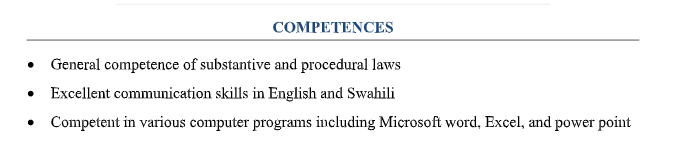
This is a section where you can highlight the things that you are competent to do.
for instance, the following is what I included as my competence in My CV for the internship application;
Referees
Make sure you have at least three referees in your CV.
It is not a must for your referee to be in the legal field.
He can be anyone who is ready to vouch for your skills and competence.
Provide their full name, occupation, address, and contact information.
Avoid relatives as your referee as they seem to be more biased when it comes to providing a comment or opinion concerning your career.
Declaration
Don’t forget to include the statement that you declare the details that you have provided in your CV are correct.
Be careful!
Once you have declared and provided false details, then you will be committing an offense of perjury.
Common mistakes to avoid in a CV as a law student
Writing a CV as a law student can be challenging, but avoiding common mistakes can significantly improve its effectiveness.
Here are some common mistakes to steer clear of:
- Overloading with irrelevant information: Avoid including every detail of your academic and professional history. Focus on relevant experiences, skills, and achievements that demonstrate your suitability for a specific role.
- Using a generic template: While templates can be convenient, avoid using generic CV templates. Tailor your CV to highlight your unique skills and experiences as a law student. (Hakikisha unakuwa bunifu kwenye kuandaa CV yako)
- Failing to proofread: Typos, grammatical errors, and formatting inconsistencies can detract from the professionalism of your CV. Always proofread your CV carefully or ask someone else to review it for you.
- Neglecting to customize for each application: Sending out the same CV for every job application can be a missed opportunity. Tailor your CV for each position by highlighting relevant skills and experiences that align with the job requirements. (Sio kila kitu CV io io, io itakuwa ni CV au cheti?)
- Including outdated or irrelevant information: Ensure that your CV is up-to-date and relevant to the specific role. Remove outdated details, age, marital status, phone number, etc.
- Omitting soft skills: While technical legal skills are essential, soft skills like communication, teamwork, and problem-solving are also highly valued in the legal profession. Make sure to highlight these skills on your CV.
- Exaggerating or lying: Integrity is crucial in the legal profession, so avoid exaggerating your experiences or skills on your CV. Be honest and transparent about your qualifications and accomplishments.(utakuta mtu kwenye CV yake ameandika ‘ability to multitask’ ukiambiwa umalttask utaweza? au umeandika tu)
- Neglecting to include extracurricular activities: Participation in moot court, mock trial, legal clinics, or student organizations can demonstrate your passion for the law and your commitment to your legal education. Don’t overlook these experiences on your CV.
Best practices for creating a polished and professional CV as a law student
Creating a polished and professional CV as a law student involves several best practices to effectively highlight your education, skills, and experiences.
Here are some key tips:
- Tailor Your CV for Each Application:
- Customize your CV for each job or internship application to emphasize the skills and experiences most relevant to the position.(hii ni muhimu sana)
- Use a Clean and Professional Format:
- Choose a clean and easy-to-read font (e.g., Arial, Times New Roman) with consistent formatting throughout the document. Avoid using excessive colors or fancy designs.
- Include a Clear and Concise Career Objective
- If you choose to include an objective, ensure it’s concise and tailored to the specific job or internship you’re applying for. Clearly state your career goals and what you bring to the table.
- Detail Legal Experience and Internships:
- Provide detailed descriptions of any legal internships, clerkships, or relevant work experience. Use action verbs and quantify your achievements where possible.
- Emphasize Extracurricular Activities and Leadership Roles:
- Highlight any law-related extracurricular activities, clubs, moot court participation, or leadership roles. These experiences demonstrate your commitment to the legal field and your ability to work in teams.
- Quantify Your Achievements:
- Wherever possible, quantify your accomplishments to provide context and demonstrate the impact of your work. For example, mention the number of cases researched or briefs drafted.
- Include Publications or Relevant Projects (If Applicable):
- If you’ve authored legal articles, papers, or publications, include them on your CV. Additionally, highlight any relevant research projects or presentations.
- Proofread for Errors and Consistency:
- Carefully proofread your CV for grammar, spelling, and formatting errors. Ensure consistency in font size, spacing, and alignment throughout the document.
- Keep It Concise and Relevant:
- Aim for a one-three-pages CV whenever possible. Focus on including only the most relevant information that showcases your qualifications and experiences related to the position.
- Include a Professional Email Address:
- Use a professional email address that includes your name rather than any nicknames or unrelated terms. (utakuta mtu anaitwa Fatuma Juma Msangi, bila aibu kwenye CV email yake ameweka [email protected], itakucost sana.)
- Provide accessible Contact Information:
- Include your phone number along with your email address. Ensure that your contact information is up-to-date and easily accessible.
- Use Action Verbs:
- Start each bullet point with a strong action verb to describe your responsibilities and achievements. This makes your CV more dynamic and engaging.
- Here are some examples of strong action verbs you can use to start each bullet point:
- Conducted:
- Conducted legal research on complex case law precedents.
- Conducted client interviews to gather relevant information for case preparation.
- Drafted:
- Drafted legal memoranda summarizing key case findings.
- Drafted applications and briefs for submission to the court.
- Analyzed:
- Analyzed statutes and regulations to assess their applicability to specific cases.
- Analyzed evidence and witness testimonies to prepare for trial strategy.
- Assisted:
- Assisted senior attorneys in preparing for hearings.
- Assisted in drafting settlement agreements and negotiating terms with opposing counsel.
- Presented:
- Presented legal arguments persuasively in moot court competitions.
- Presented research findings to colleagues and supervisors during case strategy meetings.
- Collaborated:
- Collaborated with a team of paralegals to gather evidence for discovery purposes.
- Collaborated with clients to gather necessary documentation for legal proceedings.
- Managed:
- Managed case files and documentation to ensure organization and accessibility.
- Managed scheduling and coordination of client meetings and court appearances.
- Negotiated:
- Negotiated favorable settlements on behalf of clients in civil litigation cases.
- Negotiated plea agreements with prosecutors in criminal defense cases.
- Prepared:
- Prepared trial exhibits and visual aids for courtroom presentations.
- Prepared comprehensive legal briefs outlining arguments and supporting case law.
- Reviewed:
- Reviewed contracts and agreements to identify potential risks and liabilities.
- Reviewed legal documents for accuracy and compliance with relevant laws and regulations.
- Advocated:
- Advocated for clients’ interests during negotiations and settlement discussions.
- Advocated for changes in legislation to address emerging legal issues.
- Resolved:
- Resolved legal disputes through alternative dispute resolution methods such as mediation.
- Resolved conflicts between parties through effective communication and negotiation skills.
- Conducted:
Using these strong action verbs will help your CV stand out and effectively demonstrate your contributions and accomplishments in various legal settings.
Key Takeaways
- Keep your CV to one or two pages.
- Lead with contact details and a two-line career objective.
- List education in reverse chronological order.
- Show legal experience: internships, moot court, legal aid, research.
- Use concrete achievements, not vague adjectives.
- Tailor the CV to each application and proofread it.
- Give referees who know your legal work and have agreed to be contacted.
Frequently Asked Questions
How long should a law student CV be?
One page is ideal for most students; two pages at most if you have substantial experience.
Should I include a photo on my CV?
It is not required. If you include one, use a professional passport-style photo.
Should I include my GPA on my CV?
Yes if it is strong, for example upper second class range (3.5 and above). Otherwise focus on skills and experience.
Should I include non-legal work experience?
Yes, briefly, especially if it shows responsibility, communication or teamwork.
How do I make my CV stand out?
Tailor it to the firm, show results with specific examples, and keep it clean and error-free.
Should I include volunteer or pro bono work?
Yes. Legal aid and community work show practical legal skills and commitment.


